

Small business owner meeting with a bank representative about SBA financing
SBA 7a Loan Guide for Small Business Owners

Content
Think of the SBA 7(a) program as a matchmaker between small businesses and traditional banks. Here's what most people get wrong right away: the Small Business Administration won't write you a check. Not even close.
What actually happens? Banks make the loans using their own money. The SBA just promises to cover a big chunk—anywhere from half to 85%—if everything goes sideways and you can't pay. That promise changes everything for banks that would otherwise show you the door.
This guarantee transforms the lending landscape. Picture this: you need $400,000 to buy commercial equipment, but you've only been in business three years. Most banks won't touch that deal without the SBA backing 75% of their exposure. Suddenly, that same bank offers you a 25-year term instead of the five years they'd demand on a conventional note.
The 7(a) program handles more volume than any other SBA product. We're talking billions in annual lending across every industry you can imagine—machine shops, medical practices, coffee roasters, software companies. The program's secret weapon is flexibility. Need working capital? Approved. Buying out your business partner? That works. Refinancing that awful merchant cash advance that's killing your cash flow? Often permitted.
Whether you're opening your first location or acquiring your third competitor, the 7(a) program adapts to real-world business needs in ways rigid conventional lending simply can't match.
How the SBA 7(a) Program Works
Getting funded through this program involves more choreography than you'd expect. The lender runs the show—not the SBA. You'll submit your application to a bank or credit union that's earned SBA approval credentials. They dig through your financials, credit history, and business plan using their normal standards plus the SBA's requirements.
Plan on two to three months start to finish. Sometimes experienced borrowers with straightforward deals close in six weeks. Complex situations—maybe you're buying a business with multiple properties and assuming seller debt—can push past 100 days.
Documentation requirements feel excessive until you remember the lender is betting hundreds of thousands on your business judgment. Three years of business returns (for existing companies), personal returns, profit and loss statements, balance sheets, tax transcripts, a solid business plan with realistic projections—gather all this before you start. Missing documents create the delays everyone complains about.
The lender packages everything and sends it to the SBA for guarantee approval. Once blessed, they fund the loan from their capital. You write monthly checks to the bank, never to the government.

Author: Olivia Stratfor;
Source: nayiyojna.com
Eligibility Requirements
Size matters first. The SBA sets employee and revenue caps that vary wildly by industry. Manufacturing allows up to 500 employees in most categories. Retail businesses get judged by annual receipts—often $8 million for grocery stores but $35 million for home improvement centers. Check the SBA's size standards table for your specific NAICS code before assuming you qualify.
Your business needs to operate for profit in the United States or territories. Nonprofits don't qualify. Passive investments don't qualify. You must demonstrate actual involvement in day-to-day operations.
Here's a tricky part: the "credit elsewhere" test. You don't need rejection letters from five banks, but you should be unable to secure reasonable financing without SBA help. A profitable business with thin collateral easily meets this test. The SBA wants to help businesses that need the boost, not subsidize borrowers who could get conventional terms.
Owner credit matters significantly. Everyone holding 20% or more gets scrutinized. Bankruptcies in the past three years create problems. Outstanding tax liens or judgments will derail your application. Delinquent student loans or child support? Same issue. The SBA also runs background checks—felony convictions related to dishonesty or breach of trust within the past seven years typically disqualify you.
Certain business types face automatic rejection: lenders, speculative developers, pyramid schemes, businesses earning more than a third of revenue from legal gambling, and religious organizations primarily engaged in teaching religious beliefs.
Loan Ceilings and How Much the SBA Actually Backs
The ceiling sits at $5 million across all your SBA loans combined—not per loan. If you already have a $2 million SBA loan on your manufacturing facility, you can only access $3 million more from the program.
The guarantee percentage shifts based on loan size. Borrow $150,000 or less, and the SBA covers 85% of losses if you default. Cross that threshold, and their guarantee drops to 75%.
This sliding scale influences lender behavior in unexpected ways. You'd think banks would love small loans with 85% guarantees, but many prefer larger deals. Why? The absolute dollar profit on a $50,000 loan doesn't justify the processing work, even with minimal risk. A $500,000 loan generates meaningful fee income even though the bank's unguaranteed portion reaches $125,000.
That guarantee doesn't eliminate lender skin in the game—exactly what the SBA intends. Banks still lose real money on defaults, ensuring they maintain proper underwriting discipline rather than rubber-stamping weak applications.
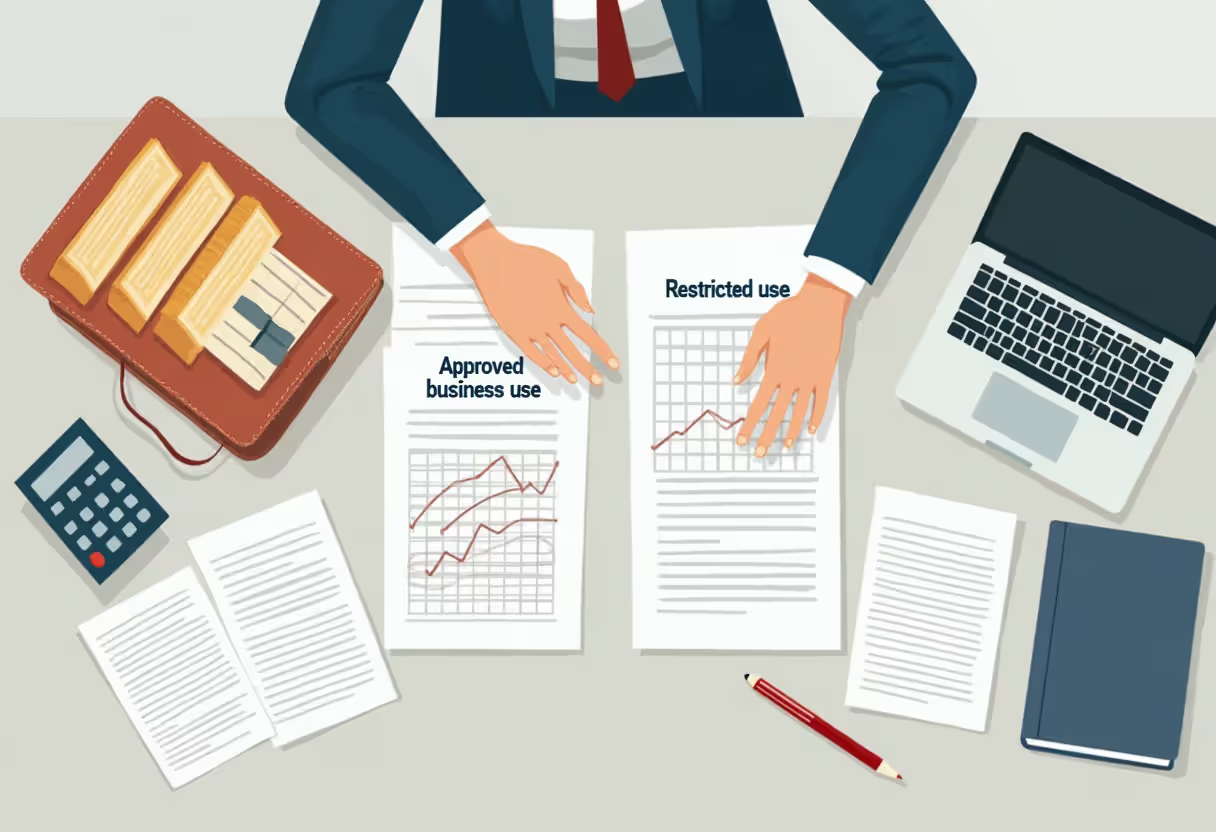
Allowed Uses of SBA 7(a) Funds
The versatility here separates 7(a) loans from nearly every other financing program. Working capital leads the pack—covering payroll gaps, buying inventory before the busy season, paying suppliers while waiting on receivables. Service businesses love using 7(a) funds for this purpose since they often lack hard assets that conventional lenders want to secure.
Equipment purchases of all types qualify. Restaurant owners buy ovens and refrigeration systems. Contractors finance excavators and trucks. Medical practices purchase diagnostic equipment. As long as the equipment serves a legitimate business purpose, you're good.
Real estate deals represent another huge category. Buying your facility instead of renting? The 7(a) program handles that. Purchasing land to build a new location? Covered. Major renovations to an existing building you own? Also permitted. One caveat: speculative real estate investing doesn't qualify. The property must serve your actual business operations.
Business acquisitions happen regularly through this program. You can finance the purchase price including tangible assets, goodwill, customer lists, patents, and other intangibles. The seller usually needs to retain at least 10% in the form of a standby note subordinated to the SBA loan, ensuring they have skin in the game regarding the business's success under new ownership.
Debt refinancing gets complicated fast. You can refinance existing business debt under specific circumstances—primarily when that debt carries punishing terms that threaten your viability. Think predatory merchant cash advances at 45% effective rates, or conventional notes with balloon payments you cannot possibly meet. Standard bank debt at market rates? The SBA won't let you refinance that just to shave a point off your interest rate.
What you absolutely cannot do: speculate in real estate, lend money to others, pay distributions to owners, reimburse yourself for past investments unless you've been working for below-market compensation, or pay delinquent payroll taxes. Mixing ineligible uses with eligible ones creates headaches—structure those as separate transactions.
Author: Olivia Stratfor;
Source: nayiyojna.com
SBA 7(a) Loan Terms Explained
Four main components determine what you'll actually pay: interest rates, how long you get to repay, fees tacked onto the loan, and what you pledge as security.
Interest Rates and How They're Set
The SBA establishes maximum spreads over Prime Rate that lenders cannot exceed. As of 2026, Prime hovers around 7.5%, though it moves with Federal Reserve policy. For loans maturing in under seven years, lenders can charge up to Prime plus 2.25% if you're borrowing $50,000 or more. Smaller loans allow spreads up to Prime plus 3.25%. Longer-term loans permit spreads reaching Prime plus 2.75%.
Translation? Current market rates typically land between 8% and 11% depending on your deal specifics. A strong borrower—750+ credit score, five years of profitable operations, substantial collateral—might secure Prime plus 2% on a real estate loan. A marginal borrower with challenged credit and minimal assets could face Prime plus 2.75%.
You'll choose between variable and fixed rates. Variable rates adjust quarterly as Prime moves, creating payment uncertainty but often starting lower. Fixed rates lock in your payment for the entire term, typically costing an extra quarter to half point upfront.
Shop around aggressively. The SBA sets maximums, not minimums. One lender might quote Prime plus 2.5% while another offers Prime plus 2% for the identical deal. Three quotes should be your minimum.
Repayment Terms by Use of Funds
Loan terms align with what you're financing. The SBA won't let you take 25 years to repay working capital—that makes no economic sense since inventory turns multiple times annually.
| What You're Financing | Longest Repayment Period |
| Working capital, inventory, accounts receivable | 10 years maximum |
| Machinery, equipment, furniture, vehicles | 10 years or equipment's useful life |
| Commercial real estate purchase or construction | Up to 25 years |
| Purchasing an existing business | 10 years standard |
| Debt refinancing | Depends on original purpose |
Longer terms slash monthly payments but multiply your total interest cost dramatically. Borrow $300,000 at 9% for 10 years and you'll pay roughly $3,800 monthly with total interest around $155,000. Stretch that same loan to 25 years and monthly payments drop to $2,520—but total interest explodes past $455,000.
Most lenders won't penalize prepayment on loans under three years old. Some impose declining penalties: maybe 5% if you pay off in year one, 3% in year two, 1% in year three. Always confirm this before signing. The ability to refinance or pay down principal early becomes valuable if rates drop or your business experiences unexpected growth.
Collateral follows a "pledge what you've got" philosophy. The SBA requires lenders to secure loans with available assets but won't kill an otherwise solid deal over collateral shortfalls. Loans under $25,000 don't require collateral under SBA rules, though individual banks often impose stricter policies.
Expect liens on business assets—equipment, inventory, receivables, real estate, intellectual property. Personal assets sometimes get dragged in, especially on larger loans or weaker business positions. That might include your house, investment accounts, or other valuables.
Personal guarantees are mandatory for anyone owning 20% or more of the company. This isn't optional. Your personal assets become fair game if the business defaults. Married borrowers in community property states should know that spousal assets face exposure even if your spouse doesn't sign the guarantee personally.

Author: Olivia Stratfor;
Source: nayiyojna.com
SBA 7(a) vs Other SBA Loan Programs
The SBA runs several programs targeting different needs. Understanding which fits your situation prevents wasting time on the wrong application.
The 504 program focuses exclusively on fixed assets—buildings and heavy equipment. Structure differs entirely from the 7(a). A typical 504 involves three funding sources: a conventional bank providing 50% of the project cost, a Certified Development Company (CDC) funding 40% through an SBA-guaranteed debenture, and you contributing the remaining 10% down payment.
That 504 structure shines for real estate-heavy projects. Rates on the CDC portion often beat 7(a) rates by a full point, and the 10% down payment requirement destroys conventional commercial real estate loans demanding 25% to 35%. But you can't touch 504 money for working capital, inventory, or most business acquisitions. The complexity also exceeds the 7(a)—more parties, more paperwork, longer timelines.
Microloans max out at $50,000 through nonprofit intermediary lenders focused on startups and underserved markets. Terms run six years maximum, and rates often exceed 7(a) levels—sometimes reaching 13%. Why bother? Approval criteria relax considerably. Entrepreneurs with thin credit files or those needing $15,000 for a food truck might find Microloan intermediaries far more accessible than navigating 7(a) requirements.
SBA Express offers speed—approvals sometimes in 36 hours for amounts up to $500,000. The trade-off? The SBA guarantee drops to just 50%, making lenders pickier and rates higher. Express works beautifully for established businesses with strong credit needing quick capital, but startups and marginal credits should look elsewhere.
| Program Type | Maximum You Can Borrow | Perfect For | How Long to Repay | Interest Rate You’ll See |
| 7(a) standard | $5,000,000 | General business needs, maximum flexibility | 25 years possible | 8% to 11% typically |
| 504 program | $5,500,000 | Real estate purchases, major equipment | 10 to 25 years | 6% to 9% range |
| Microloan | $50,000 | Startups, smaller needs, challenged credit | 6 years max | 9% to 13% common |
| Express | $500,000 | Speed priority, strong credit | 10 years max | 9% to 12% typical |
Match the program to your situation honestly. That restaurant buying its building should explore the 504's favorable real estate terms. A consulting firm needing working capital and computers belongs in the 7(a) program. A craft business requiring $25,000 for inventory might find Microloan intermediaries more welcoming than traditional SBA lenders.
Advantages and Disadvantages of SBA 7(a) Loans
The upside centers on access and terms that conventional lenders won't match. Down payments typically run 10% to 15% compared to 25% to 40% conventional lenders demand for business purposes. That difference preserves working capital when you need it most.
Repayment periods extend far beyond conventional loans. Banks might offer five or seven years on equipment financing; the SBA allows 10. Commercial real estate from conventional sources rarely exceeds 20 years; SBA deals reach 25. Those longer terms reduce monthly obligations substantially, protecting cash flow during expansion phases.
Interest rates usually beat conventional alternatives by one to three percentage points. On a $500,000 loan over 20 years, a two-point rate difference saves you nearly $140,000 in total interest. That's real money staying in your business.
Flexible use of proceeds represents the killer advantage. Most banks won't touch unsecured working capital loans for small businesses. The SBA guarantee makes this possible. Financing business acquisitions including intangible assets? Conventional lenders hate that deal. The 7(a) program handles it regularly.
We see clients initially hesitate over documentation requirements, but once they grasp they're accessing 25-year real estate financing at rates three points below conventional quotes, the paperwork becomes a minor inconvenience.The terms justify the effort for serious business owners
— Michael Torres
Now the downsides. Processing time kills time-sensitive opportunities. Conventional business loans might close in three weeks. SBA loans commonly require 75 to 90 days. Trying to buy a competitor before someone else grabs them? The 7(a) timeline probably doesn't work.
Documentation demands exceed conventional loans substantially. Personal financial statements, detailed business plans, multi-year projections, explanations of exactly how you'll deploy proceeds—expect your lender to request everything short of your high school transcripts. Disorganized borrowers sometimes abandon applications out of frustration.
Fees add thousands to your cost. The SBA charges guarantee fees from 0% on tiny loans to 3.75% on the guaranteed portion of large loans. Lenders pile on packaging fees, closing costs, appraisals, environmental reports, and other charges. On a $500,000 loan, total fees easily reach $20,000 to $30,000, usually rolled into the amount you're borrowing.
Personal guarantees create exposure beyond business assets. Your business fails, and lenders can pursue your home, brokerage accounts, even your spouse's assets in community property states. Borrowing $400,000 to expand a struggling operation puts your family's financial security directly at risk—consider that trade-off seriously.
Size standards and eligibility rules exclude some businesses entirely. Rapidly growing companies can exceed employee or revenue thresholds. Businesses in restricted industries—lending institutions, speculative real estate, passive investments—face automatic rejection regardless of financial strength.

Author: Olivia Stratfor;
Source: nayiyojna.com
Frequently Asked Questions About SBA 7(a) Loans
The SBA 7(a) program opens doors that conventional lending keeps locked for most small businesses. Government guarantees transform lender risk calculations, producing lower down payments, extended repayment terms, and competitive rates that preserve cash flow during critical growth phases.
Deciding whether this program fits requires honest self-assessment. Can you wait 75 days for funding? Do you have the financial records and documentation organized? Are you comfortable pledging personal assets to secure business debt? Answer yes to these questions and you're looking at financing terms that can legitimately transform your business trajectory.
Start by getting organized before approaching lenders. Assemble three years of financial statements, business and personal tax returns, and all supporting documents. Build realistic projections demonstrating debt service capacity while funding growth. Work with your accountant to present financials clearly and professionally—sloppy presentation kills deals that should succeed.
Compare at least three SBA-approved lenders. Rates, fees, and service quality vary enormously. Some lenders specialize in specific industries or loan types, offering expertise that accelerates the process. Others provide superior service but charge premium fees. The cheapest rate quote doesn't always represent your best deal if poor service creates frustrating delays or communication breakdowns.
Take the personal guarantee seriously. You're pledging everything you own to finance business growth. That creates risk extending far beyond the business itself. Understand worst-case scenarios clearly and develop contingency plans for business difficulties. Never borrow more than you could potentially repay from personal resources if necessary.
For businesses matching program requirements and willing to navigate the process properly, 7(a) loans deliver financing terms supporting sustainable growth, preserving precious working capital, and providing the runway needed to build enterprises that last.