
Student and parent reviewing college financing documents at a table
What Is a Private Student Loan and How Does It Work

Content
College costs keep climbing, and most families piece together funding from multiple sources—savings accounts, scholarship awards, federal aid packages, and sometimes loans from banks or other private companies. Understanding the difference between government-backed loans and those from private lenders can save you thousands of dollars and prevent financial headaches down the road.
Private Student Loan Meaning and Definition
Think of private student loans as educational financing that comes from banks, credit unions, or online lending companies instead of the U.S. Department of Education. You'll use these funds for school-related costs: tuition bills, campus fees, dorm rooms or apartment rent, textbooks, meal plans, and similar education expenses.
Here's what makes them "private": each lender sets its own rules. One bank might require a 700 credit score, while another accepts 650. Interest rates fluctuate based on your financial profile. Repayment terms differ significantly between companies. This contrasts sharply with federal Direct Loans, where Congress sets the rates and the Department of Education establishes uniform borrowing rules for everyone.
Both undergrads and graduate students can tap into private loans. Parents sometimes take them out too, though when a parent borrows, they're the one legally responsible for paying it back—not the student.
You'll typically consider private loans when you've already maxed out federal aid eligibility, when your school doesn't qualify for federal programs (some coding bootcamps or international universities fall into this category), or when you want to consolidate existing education debt at a lower rate.

Author: Matthew Redford;
Source: nayiyojna.com
How Private Student Loans Work
Getting a private student loan looks different from federal borrowing. You won't just fill out the FAFSA and wait for an aid package. Instead, you'll apply directly to each lender you're considering—think of it like shopping for a car loan or mortgage.
Most applications live online and take 20 minutes or so. You'll enter basic information: your name, school details, how much you want to borrow, your income (or your parents' if you don't work), and employment history. The lender pulls your credit report to assess risk and determine what rate they'll offer you.
Here's the catch—approval isn't guaranteed. Banks examine your credit history, how much debt you already carry compared to your income, and whether you can realistically afford payments. If approved, you'll receive a rate quote (sometimes a range if you haven't decided between fixed or variable). You can compare offers from different lenders before committing to anything.
Once you accept a loan, the money typically goes straight to your college's financial aid office. They'll apply it toward your outstanding tuition and fees, then cut you a check or direct deposit for any leftover amount to cover books, housing, or other expenses.
Repayment schedules vary wildly. Some lenders want you to start paying right away, even while you're in class. Others let you postpone payments until after graduation—though interest usually keeps piling up during school. You might have anywhere from five to 20 years to pay everything back, depending on your loan terms.
Credit Requirements and Cosigner Considerations
Banks care deeply about your credit score and payment track record. Most want to see FICO scores around 670 minimum for decent rates, though a handful will work with scores closer to 650. If you've got exceptional credit above 750, you'll qualify for those attractive rates you see advertised.
Here's the problem for most college students: you probably don't have much credit history yet. Maybe you've had a credit card for a year or two. You likely haven't held a full-time job long enough to impress a loan underwriter.
Enter the cosigner—usually a parent or relative with established credit. When someone cosigns, they're promising to repay your loan if you can't. The bank evaluates both of you and bases the interest rate on whoever looks stronger financially.
More than 90% of undergraduate private student loans involve a cosigner. That person takes on real liability here. Miss a payment, and both credit scores take a hit. Some lenders offer cosigner release after you've made two or three years of on-time payments and can prove you earn enough to handle the loan yourself, but qualifying for release can be surprisingly difficult.

Author: Matthew Redford;
Source: nayiyojna.com
Loan Amounts and Borrowing Limits
Unlike federal loans with their strict annual caps ($5,500 for most first-year dependent students, for example), private lenders generally let you borrow up to your school's total cost of attendance minus any other financial aid you're receiving.
Let's say your college determines the total cost for a year is $35,000. You've got a $10,000 scholarship and qualify for $5,500 in federal loans. That leaves a $19,500 gap—and a private lender might approve you for that full amount.
But here's the thing: approval amounts depend on your credit strength. Someone with marginal credit might only get approved for $10,000, while an applicant with stellar credit and substantial income could borrow the entire gap.
Career limits vary by lender and degree level. Undergrads often see cumulative maximums between $75,000 and $150,000. Grad students—especially those in medical or law school—might access $200,000 or more.
Just because you can borrow the maximum doesn't mean you should. Interest starts adding up immediately on most private loans, even while you're still in school. Borrow only what you actually need after exhausting cheaper options.
Private vs Federal Student Loans
Federal and private student loans both help pay for college, but they operate under completely different systems. Knowing these differences helps you avoid costly mistakes.
| Feature | Federal Loans | Private Loans |
| How rates get set | Congress decides rates each spring; everyone with the same loan type pays the same rate regardless of credit | Your credit profile determines your rate; rates vary between lenders and applicants |
| Credit checks | None for Direct Subsidized/Unsubsidized Loans; you can't use a cosigner even if you want to | Required for approval; most undergrads need a creditworthy cosigner |
| Payment plan options | Multiple income-based plans that cap payments at 10% of discretionary earnings | Standard fixed-payment schedules; few lenders offer alternative structures |
| Postponing payments | Automatic deferment while enrolled; forbearance available for financial hardship | Policies differ by lender; usually more limited options |
| Debt cancellation | Eligible for Public Service Loan Forgiveness and other federal programs | Forgiveness programs don't exist; you repay the full amount |
| Death/disability discharge | Automatically forgiven if borrower dies or becomes permanently disabled | Inconsistent policies; some lenders discharge debt, others pursue the estate |
| Maximum amounts | Caps of $5,500-$12,500 annually for undergrads depending on year and dependency status | Generally up to school's cost of attendance minus other aid received |
Federal programs offer protections that private loans typically don't match. Income-driven repayment can shrink your monthly bill to 10% of what you earn above basic living expenses. Work in government or nonprofit sectors for ten years while making payments, and you might qualify for loan forgiveness.
Private loans function more like a regular bank loan. You commit to a payment plan, and you're expected to stick with it regardless of job loss, salary cuts, or other financial setbacks. While some lenders have developed hardship programs, they're not standardized or guaranteed.
Watch out for interest capitalization—when unpaid interest gets added to your principal balance. Federal loans restrict when this can happen; private lenders write their own rules, potentially increasing what you owe significantly.
Private loans do have one occasional advantage: rates. Borrowers with excellent credit sometimes snag private loan rates below current federal pricing. For 2025-2026, federal undergraduate Direct Loans sit at 6.53%. Top-tier private applicants might find rates starting around 4.50% variable or 5.75% fixed.
What Affects Private Student Loan Interest Rates
Your interest rate determines what this loan actually costs you. Borrow $30,000 at 5% over ten years, and you'll pay roughly $31,800 total. That same loan at 9% costs about $45,600—$14,000 extra just for borrowing the same money.
Your credit score's impact: This matters more than anything else. Lenders view credit scores as financial report cards. Scores above 780 typically unlock the lowest advertised rates. Scores between 670 and 739 land in the middle range. Below 670, you're looking at higher rates or outright denial.
A 50-point difference in your credit score can shift your rate by a full percentage point or two. Over a decade, that translates to thousands in additional interest.
How long you'll take to repay: Shorter repayment periods come with lower rates but bigger monthly payments. A five-year loan might carry a rate 0.75% to 1.50% below a 15-year loan from the same company.
Here's the tradeoff: that $30,000 loan at 6% over five years means paying around $580 monthly. Stretch it to 15 years at 7%, and you'll pay approximately $270 per month—but you'll fork over roughly $18,600 more in total interest.
Fixed versus variable pricing: Fixed rates never change, so you know exactly what you'll pay each month for the entire loan. Variable rates fluctuate based on market benchmarks (usually SOFR—the Secured Overnight Financing Rate) plus the lender's margin.
Variable rates typically start 1% to 2% lower than fixed options from the same bank. Sounds great, right? But if SOFR climbs three percentage points during your repayment period (which has happened in past economic cycles), your bargain rate could end up costing more than if you'd chosen fixed.
Variable rates make sense if you plan to pay everything off within five years or refinance later. Fixed rates protect you from market swings—crucial if you'll need the full repayment term.
Adding a cosigner to your application: Including someone with strong credit can dramatically reduce your rate. A student with minimal credit history might receive a 10% rate quote alone but 6% with a parent cosigner who has excellent credit.
Essentially, the lender bases your rate on whoever looks better financially. This saves money but creates risk for your cosigner—their credit takes a hit if you miss payments.
Shopping around and loyalty perks: Many lenders knock 0.25% to 0.50% off your rate if you set up automatic payments or if you're already a customer. Credit union members sometimes get preferential rates unavailable to the general public.
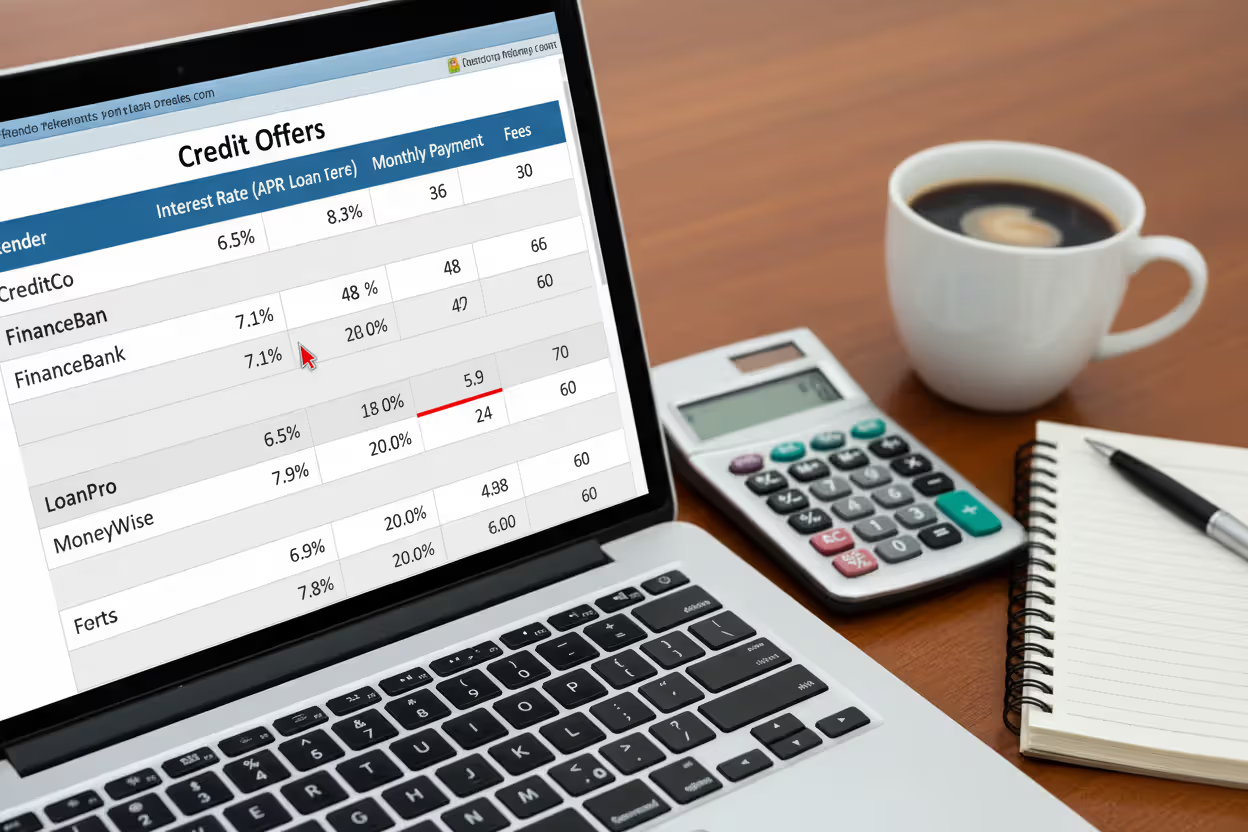
Rate differences of two to three percentage points between lenders aren't unusual for the same borrower. Comparison shopping isn't optional—it's essential.
Author: Matthew Redford;
Source: nayiyojna.com
When a Private Student Loan May Fit Your Situation
Private student loans aren't evil, and they're not a scam. They're tools that work well in specific situations but create problems in others.
You've hit federal borrowing limits: Dependent undergrads can only borrow $5,500 to $7,500 per year through federal Direct Loans. What if your remaining costs exceed that amount and your family can't cover the difference? You've got a funding gap. Independent students get higher federal limits ($9,500 to $12,500 annually), but an expensive school can still leave you short.
Private loans exist specifically to fill these gaps. Say your school costs $40,000 yearly, you receive $10,000 in scholarships and $7,500 in federal loans, but your family can only contribute $10,000. You need another $12,500 from somewhere—and that's where private loans enter the picture.
Graduate or professional programs: Some graduate programs run $30,000 to $80,000 per year. Federal Grad PLUS loans cover costs, but they charge 8.05% interest right now (2025-2026) plus a 4.228% origination fee upfront.
Graduate students with strong credit profiles sometimes find private loans offering lower effective rates, especially when you factor in those origination fees. A private loan at 6.50% with no origination fee costs less than Grad PLUS at 8.05% plus 4.228% deducted immediately.
Your school doesn't qualify for federal aid: Certain coding bootcamps, technical certification programs, and international universities don't participate in Title IV federal aid programs. Students attending these institutions can't access federal loans at all. Private loans become your only borrowing option besides personal loans or credit cards (both usually carry worse terms).
Refinancing existing education debt: If you're already juggling multiple student loans at high interest rates, private refinancing products let you consolidate everything and potentially cut your rate. Someone with $60,000 in loans averaging 7.5% might refinance down to 5.25%, saving thousands in interest.
The big tradeoff: converting federal loans to private means giving up federal protections forever. You lose income-driven repayment, deferment options during financial hardship, and any shot at loan forgiveness. This works for borrowers with stable, high incomes who won't need those safety nets, but it's risky for everyone else.
Strong credit and immediate repayment capacity: Borrowers who can start paying immediately (no deferment during school) and who have excellent credit sometimes beat federal rates with private loans. If you're financing a final semester, you've already landed a job, and you qualify for a 4.75% private rate versus the 6.53% federal rate, the private option saves money.
This scenario rarely applies to traditional undergrads fresh out of high school, but it happens more often with graduate students and working professionals going back for additional credentials.
Private student loans serve an important purpose when federal aid doesn't cover your full costs, but they should never be your first stop. Exhaust grants, scholarships, and federal loan eligibility before you even look at private options. When you do need private loans, get rate quotes from at least three different lenders—the rate differences can literally save you thousands of dollars over the life of the loan
— Jennifer Martinez
Common Mistakes to Avoid When Borrowing Private Student Loans
Ignoring federal loans entirely: Some students think private loans offer better deals or they just prefer working with a bank they already know. Wrong move. Federal programs provide superior protections and should always be your first choice for borrowing. Max out your subsidized and unsubsidized federal Direct Loan eligibility before you fill out a single private loan application.
Taking the first offer that comes along: Your school might have a "preferred lender" list, or maybe you bank with Wells Fargo and figure you'll just borrow there. Don't. Private student loan rates swing wildly between competitors. You need to shop around—get quotes from at least three to five different lenders. Most let you check rates through soft credit pulls that won't ding your credit score.
Not reading the terms carefully: Payment postponement policies, cosigner release requirements, and hardship programs differ dramatically between lenders. One company might release your cosigner after 24 months of on-time payments; another demands 36 months plus proof you earn three times the monthly payment amount.
Some lenders charge origination fees (usually 1% to 5% of what you borrow), while others don't charge upfront fees at all. A no-fee loan at 6.5% actually costs less than a loan at 6.0% with a 4% origination fee.
Choosing variable rates without grasping the risks: That attractive 4.25% variable rate looks amazing compared to a 6.0% fixed rate. But what happens if it climbs to 8% or 9% over ten years? Variable pricing works for borrowers planning aggressive repayment or refinancing within a few years. Need the full repayment term? Fixed rates provide essential predictability.
Borrowing for expenses unrelated to education: Private student loans legally should fund qualified educational expenses, though enforcement varies. Some students borrow extra to fund spring break trips or buy a car. This creates debt that doesn't boost your earning potential—a recipe for financial regret.
Not applying for scholarships because it seems like too much work: Here's the truth—spending an hour on scholarship applications can yield better returns than hours of loan comparison shopping. Win a $1,000 scholarship, and you've just saved yourself $1,000 plus years of compounding interest. Students frequently borrow first and think about scholarships later, when the order should be reversed.

Author: Matthew Redford;
Source: nayiyojna.com
Frequently Asked Questions About Private Student Loans
Private student loans bridge the gap when federal aid and personal resources don't cover educational costs. They're not automatically good or bad—their value depends entirely on your situation, how much you need to borrow, and the terms you can negotiate.
Successful borrowers follow a clear strategy: chase scholarships and grants aggressively, accept all eligible federal student aid, minimize costs through smart school choices and disciplined spending, and only then look at private loans for whatever gap remains. They compare multiple lenders, understand the difference between fixed and variable rates, and borrow exclusively what they actually need.
Borrowers who struggle often skip these steps. They choose private financing without exploring federal options, grab the first offer without comparing, or borrow their maximum approved amount without questioning whether they truly need that much.
How you handle private student loan decisions will impact your finances for years, maybe decades. A $40,000 private loan at 7% takes ten years to repay at $464 monthly—that's $55,680 total. The same loan at 5% costs $424 monthly and $50,880 total, saving nearly $5,000. Multiply these differences across all your college borrowing, and the impact of smart choices becomes crystal clear.
Before you sign any private loan documents, confirm you've completed the FAFSA, accepted all federal aid offers, and compared pricing from at least three lenders. Understand exactly what you're agreeing to: the rate type, repayment timeline, monthly payment amount, total interest cost, and any fees. Know your lender's policies on payment postponement, financial hardship help, and cosigner release.
Private student loans make higher education accessible when used thoughtfully. They create financial burdens when borrowed carelessly. The difference comes down to the choices you make before signing on the dotted line.