

Bakery owner standing near commercial ovens with business financing documents
Business Term Loan Guide for Small Business Owners

Content
When Sarah needed $120,000 to buy ovens for her bakery expansion, she didn't want a credit card or a line of credit that tempted her to keep borrowing. She wanted one chunk of money, a clear payoff date, and payments she could predict six months ahead. That's exactly what business term loans deliver—and why they've remained popular for decades despite flashier alternatives.
Here's what separates term loans from other financing: you get everything upfront, you know exactly when you'll be debt-free, and your payment doesn't change based on how much you use. Compare that to a line of credit (borrow, repay, borrow again) or merchant cash advances (payments drain a percentage of daily sales). Both have their place, but neither gives you the certainty that term loans provide.
What Is a Business Term Loan?
Think of a business term loan as the commercial equivalent of your car loan or mortgage. The lender wires you a specific dollar amount. You pay it back over an agreed timeframe—could be six months, could be ten years—with interest added on top.
The business term loan meaning boils down to three pieces: how much you're borrowing (principal), how long you have to pay it back (the term itself), and what the money costs you (interest rate). Your lender calculates a payment amount that covers both principal reduction and interest charges. You make that same payment—usually monthly, sometimes weekly or biweekly—until the balance hits zero.
Here's what makes this different from a business line of credit: once you've paid down $30,000 of your $100,000 term loan, you can't just borrow that $30,000 again tomorrow. The money flows one direction. If you need more capital later, you're filling out a new application.
Banks have offered these loans for generations. Credit unions jumped in. Now online lenders and fintech platforms compete aggressively in this space. A community bank might spend two months reviewing your $400,000 request and offer you 6.5% if you qualify. An online lender could say yes to $75,000 in 48 hours but charge you 18%. Neither is "better"—it depends whether you value time or cost more, and whether you can meet traditional underwriting standards.

Author: Hannah Kingsley;
Source: nayiyojna.com
How Business Term Loans Work
Understanding how term loans for business work means following the money from application to final payment. Lenders are fundamentally asking one question: "Will this business generate enough cash to pay us back on schedule, and what can we claim if it doesn't?"
You'll submit financial documents that prove your business makes money consistently. Most lenders want two years of business tax returns, personal returns from anyone who owns 20% or more, recent bank statements (three to six months' worth), and profit-and-loss statements. They're looking for patterns: Do deposits match what your tax returns claim? Are you overdrafting constantly? Do you have seasonal swings that might make payments difficult in slow months?
Startups without two years of history face tougher scrutiny. Expect requests for personal guarantees (you're personally on the hook if the business folds) and collateral (assets the lender can seize and sell if you stop paying). Established businesses with clean financials might get unsecured approval, especially for smaller amounts.
Once approved, money typically arrives within a week via wire transfer or ACH. Your first payment usually comes due 30 days later, though some agreements start immediately. Unlike specialty loans with interest-only periods, term loans typically require you to pay both principal and interest from payment one.
Eligibility Requirements
Your credit score matters, but it's not everything. I've seen businesses with 660 scores get approved over businesses with 740 scores because the lower-score business had three years of steady $500K revenue while the higher-score business launched eight months ago and couldn't prove consistent income.
Revenue requirements vary wildly. Traditional banks often want $250,000+ in annual sales as a minimum threshold. Online lenders might work with you at $75,000 annually. Time in business counts too—banks prefer companies that have survived at least two years, proving the business model works through different seasons and economic conditions.
Lenders calculate your debt-service coverage ratio, abbreviated DSCR. Take your annual operating income and divide it by your annual debt payments (including the new loan you're applying for). If you generate $125,000 in operating income and owe $100,000 annually in debt service, your DSCR is 1.25. Banks want 1.25 or higher, meaning you're generating $125 for every $100 in debt obligations. Fall below 1.0 and you're underwater—spending more on debt than you're bringing in.
Whether you'll need collateral depends on the amount you're borrowing and who's lending it. Secured loans—backed by equipment, property, inventory, or receivables—typically cost less because the lender's risk drops. They can recoup losses by selling your assets if you default. Most loans above $150,000 require some form of collateral. Personal guarantees are nearly universal for small business loans, putting your personal assets (house, savings, investments) at risk if the business can't pay.

Author: Hannah Kingsley;
Source: nayiyojna.com
Interest Rates and Fees
Business term loan rates in 2026 span from roughly 6% to 40% APR depending on your qualifications and who's lending. Banks and credit unions cluster at the lower end. Online and alternative lenders charge more—sometimes significantly more—but approve faster and accept riskier borrowers.
Fixed rates never change during your loan term. Your payment in month one equals your payment in month 60. Budget once and you're done. Variable rates move with economic benchmarks like the prime rate or SOFR. When the Federal Reserve adjusts rates, your rate adjusts too, pulling your payment up or down. Fixed rates eliminate surprises but might cost more if rates drop later. Variable rates might save money in falling-rate environments but can devastate your budget if rates climb.
Origination fees run anywhere from 1% to 6% of your loan amount, covering the lender's underwriting and administrative costs. Borrow $100,000 with a 3% origination fee and you'll receive $97,000 (or $100,000 with the fee rolled into what you owe). Either way, you're paying $3,000 for the privilege of accessing the loan. Some lenders advertise "no fee" loans but bake those costs into higher interest rates instead.
Prepayment penalties punish you for paying off the loan ahead of schedule. Why? Because lenders expect to collect interest over the full term—that's their profit. Pay everything off in year two of a seven-year loan and they've lost five years of interest income. Penalties might equal a set number of months' interest or use a sliding scale where the penalty decreases over time. Not every loan includes prepayment penalties, so ask explicitly before signing anything.
Short Term vs Long Term Business Loans
The difference between short term vs long term business loans goes way beyond duration. These two categories serve fundamentally different purposes and carry distinct financial implications.
Short-term business loans typically run three to 18 months. They're built for immediate, temporary needs. Maybe you're a landscaping company buying equipment and inventory before your busy season. Maybe you're a retailer stocking up for Black Friday. Maybe you landed a huge contract but need cash to buy materials before your client pays. Because you're repaying everything quickly, monthly payments run high—but your total interest paid stays relatively low.
Long-term business loans stretch from two years to 25 years, with most falling in the five-to-ten-year range. These finance major investments: buying your building instead of leasing it, acquiring a competitor, replacing your entire delivery fleet, or installing manufacturing equipment. Spreading payments over many years makes each monthly installment manageable from your operating cash flow. The downside? You'll pay substantially more interest over time.
The key to choosing correctly: match the loan term to the asset's useful life. Financing a $50,000 commercial HVAC system over seven years makes perfect sense because that system will serve your business for a decade or more. Financing $50,000 in seasonal inventory over seven years would be financial insanity—you'll sell that inventory within weeks or months, not years.
| Feature | Short-Term Loan | Long-Term Loan |
| How Long You're Paying | 3 to 18 months | 2 to 25 years (typically 5-10) |
| Dollar Amounts Available | $5,000 to $250,000 | $25,000 to $5 million or more |
| What Interest Costs | 10% to 40% APR | 6% to 20% APR |
| Speed to Funding | 1 to 5 business days | 2 to 8 weeks |
| Best Used For | Inventory purchases, covering temporary gaps, quick opportunities | Real estate, major machinery, expansion projects, acquisitions |
Watch out for factor rates on short-term loans from alternative lenders. Instead of APR, they'll quote something like a 1.3 factor rate. That means borrowing $50,000 requires you to repay $65,000 total. Sounds like 30% interest, right? Wrong. If you're repaying over six months, the effective APR approaches 60% because you're paying that "30%" over half a year, not a full year. Always demand APR calculations so you can compare apples to apples across different lenders and products.
Understanding Your Business Term Loan Repayment Schedule
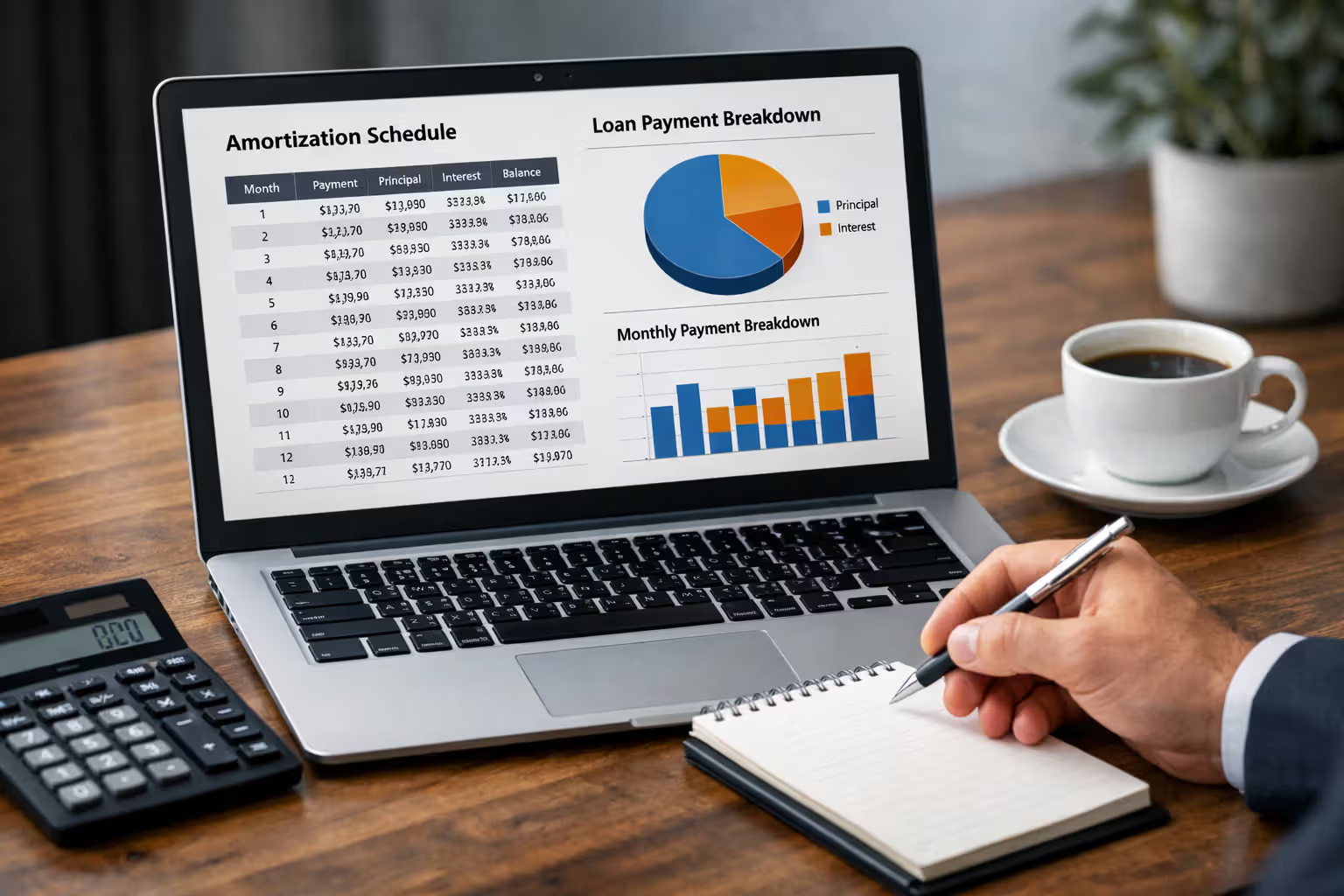
Your business term loan repayment schedule breaks down every single payment you'll make from start to finish, showing exactly how much chips away at what you borrowed versus what you're paying in interest costs.
Most term loans use amortization. Here's how it works: Your payment stays the same every month, but early payments are interest-heavy while later payments demolish more principal. Take a $100,000 loan at 8% over five years. You'll pay approximately $2,028 monthly. Month one splits roughly $667 to interest and $1,361 to principal. Fast-forward to month 60, and the split flips dramatically—maybe $13 to interest, $2,015 to principal. Same payment amount, completely different allocation.
Payment frequency affects both your cash flow and your total interest costs. Monthly payments are standard across the industry. Some lenders offer biweekly or weekly schedules instead. Paying more frequently shrinks your principal balance faster, which reduces the interest you'll pay over time. There's also a mathematical quirk: biweekly payments mean 26 half-payments per year, which equals 13 full monthly payments instead of 12. That extra payment each year can shave months or even years off your payoff date.
Fixed-rate loans lock your interest rate the day you sign. Variable-rate loans tie your rate to a benchmark plus a margin. Sign a variable-rate loan at "prime plus 3%" when prime sits at 7.5%, and you're paying 10.5%. If prime climbs to 8.5% next year, your rate becomes 11.5%, pushing your monthly payment higher. Variable rates made sense when rates were dropping. In 2026, with economic uncertainty and rate volatility, most business owners sleep better with fixed-rate predictability.
Paying off your loan early can save thousands in interest—but check your agreement first. If you're facing a prepayment penalty, calculate whether your interest savings exceed the penalty cost. No penalty? Then extra payments whenever cash allows will accelerate your debt freedom and strengthen your balance sheet. That said, consider opportunity cost: if you could invest that extra cash back into your business and generate returns exceeding your loan rate, early payoff might not be your smartest move.
Author: Hannah Kingsley;
Source: nayiyojna.com
Common Uses for Business Term Loans
Common uses for a business term loan cover nearly everything a growing business might need, though some applications make more financial sense than others.
Equipment purchases top the list of smart term loan uses. Manufacturing machinery, restaurant equipment, medical devices, construction equipment, delivery trucks—these assets often cost more than your available cash reserves. Financing them over their useful lifespan aligns your payment obligations with the revenue they help generate. A $175,000 CNC machine that'll serve your shop for 12 years? Finance it over seven years and let the increased production capacity cover the payments.
Business expansion—opening a second location, renovating your existing space, entering new markets—requires substantial upfront capital. Term loans deliver the lump sum you need for construction, leasehold improvements, or initial inventory without diluting your ownership stake by bringing in investors. The critical factor: the expansion must generate enough additional revenue to cover the debt service comfortably.
Inventory purchases make sense for seasonal businesses or those capitalizing on bulk discounts. A toy retailer might borrow $80,000 in September to stock shelves before the holiday rush, then repay the loan from November-December sales. Works great if your profit margin on that inventory comfortably exceeds your interest costs. Falls apart if you misjudge demand and get stuck with unsold product.
Real estate acquisition—buying your business location rather than renting—builds equity while stabilizing your occupancy costs. Commercial real estate loans (a term loan subset) typically demand 20% to 30% down payments and run 10 to 25 years. Your monthly payment might exceed your current rent initially, but you're building a sellable asset and eliminating the risk of lease non-renewal or sudden rent spikes.
Debt consolidation can simplify your financial life and cut costs—if done intelligently. Combining multiple high-interest debts into one term loan at a lower rate reduces both monthly obligations and total interest paid. But this strategy only works if you've addressed whatever spending patterns created the debt originally. Consolidating $90,000 in credit card debt at 24% into a term loan at 12% saves you serious money—unless you immediately run those cards back up to their limits.
Working capital loans—borrowing to cover day-to-day operations—often represent a misuse of term financing. Working capital needs tend to be cyclical and unpredictable, making a revolving credit line more appropriate. Saddle yourself with fixed term loan payments for working capital and you're stuck making those payments even during slow months, creating cash flow crunches that can spiral into bigger problems.
Advantages and Drawbacks of Term Loans
Author: Hannah Kingsley;
Source: nayiyojna.com
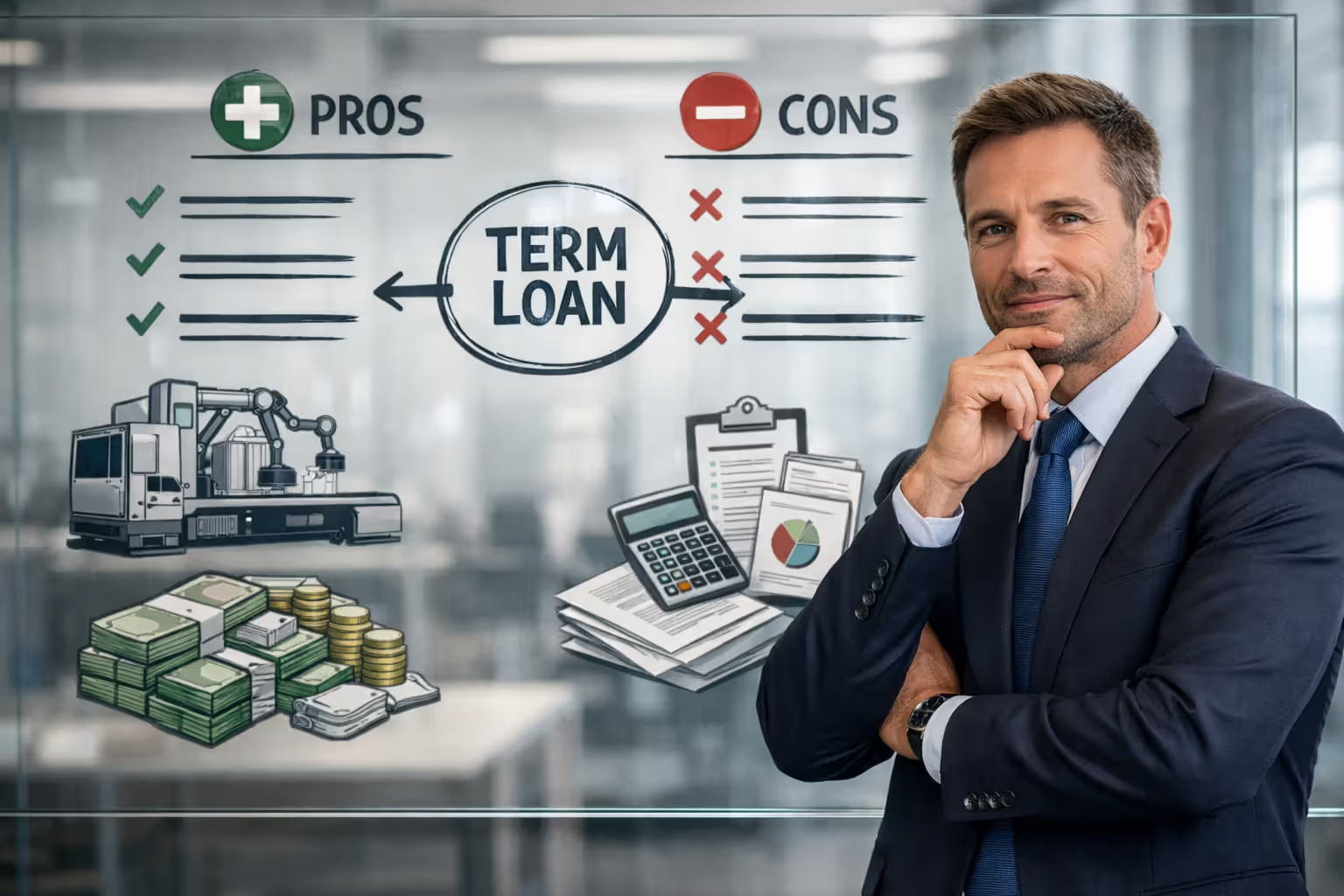
Business term loans deliver clear advantages that make them the right choice for specific situations. Your payments never change, which makes budgeting straightforward. You're not guessing what you'll owe next month or next quarter—you know the exact dollar amount, making cash flow forecasting actually possible.
Getting all the money at once lets you act immediately on opportunities or needs. No waiting for credit line draws or milestone-based disbursements. For time-sensitive purchases—equipment that's discounted this month only, a competitor willing to sell now—immediate access to capital matters.
Every on-time payment you make reports to business credit bureaus, gradually strengthening your credit profile. A solid payment history on a term loan improves your terms on future financing. Better rates, larger approvals, more attractive offers—all because you've proven you pay debts as promised.
You're not selling ownership stakes in your company. Debt financing preserves your 100% control. Equity financing means permanent partners who own a piece of your profits and expect a say in your decisions. Take a term loan, repay it, and nobody owns a slice of your business except you.
Interest payments are generally tax-deductible as business expenses, reducing your effective borrowing cost. Borrow at 10% but land in a 25% tax bracket, and your after-tax cost drops closer to 7.5%. (Obviously, consult your accountant for specifics based on your situation.)
But drawbacks deserve equal attention. Qualification requirements can be steep, especially with traditional lenders. Startups, businesses with weak credit, or companies in high-risk industries might not qualify at all—or face rates so high the loan becomes unaffordable.
Putting up collateral or signing personal guarantees puts your assets on the line. Default on a secured loan and the lender seizes and sells whatever you pledged—equipment, property, inventory. Personal guarantees expose your home, retirement accounts, and personal savings if your business can't meet its obligations.
Your payment obligation doesn't flex with revenue fluctuations. Sales drop 30% because a major client left? Your loan payment stays exactly the same. This inflexibility strains cash flow during downturns, forcing impossible choices about which bills to pay and which to delay.
Long loan terms mean massive total interest costs. Borrow $200,000 at 9% over ten years and you'll pay roughly $104,000 in interest alone. Your monthly payments might be manageable, but your total repayment exceeds $304,000. Shorter terms slash total interest but jack up monthly payments—pick your poison.
Prepayment penalties can trap you in the loan even when you want out. Experience rapid growth and want to eliminate debt? Penalties can cost thousands or tens of thousands, erasing much of the benefit from early payoff.
Business term loans work best when the thing you're financing will generate returns exceeding your borrowing costs. Too many business owners borrow simply because credit's available, without calculating whether the investment will produce enough additional profit to justify the monthly payments. The businesses that succeed with term loans treat borrowed money as seriously as investor capital—because functionally, that's exactly what it represents
— Michael Torres
Frequently Asked Questions
Selecting the right business term loan requires matching the financing structure to your specific need, timeline, and financial capacity. A loan that works perfectly for one business might strangle another's cash flow, even if both companies show similar revenue.
Start by calculating precisely how much you need and what you'll use it for. Borrow more than necessary and you're paying interest on money you didn't need. Borrow too little and you're scrambling for additional financing mid-project, often at worse terms because you're desperate. Build a detailed budget accounting for your primary expense plus a 10-15% contingency buffer.
Model different repayment scenarios before committing to anything. Use online loan calculators to see how different terms, rates, and amounts affect your monthly payment obligations. Stress-test your cash flow by asking uncomfortable questions: "Can we make these payments if revenue drops 25%? What if our second-largest customer leaves? What if we lose a key employee and have to hire two people to replace them?" If the answer to any of these scenarios is no, you're overleveraged.
Compare at least three to five lenders across different categories—a traditional bank, a credit union, two online lenders, and perhaps an SBA-approved lender. Request quotes with identical terms (same amount, same duration) so you're making true apples-to-apples comparisons. Look past the interest rate to the total cost of borrowing, including origination fees, prepayment penalties, annual fees, or any ongoing charges.
Read the entire loan agreement before signing anything. Pay close attention to default provisions (what triggers a default beyond simply missing payments), cross-default clauses (where defaulting on other debts automatically triggers this loan's default), and any covenants restricting your business activities. Some agreements require maintaining minimum cash balances, prohibit taking on additional debt, or restrict owner distributions—requirements that might conflict with your business plans or make future flexibility impossible.
Business term loans are tools, not solutions. The loan itself won't fix operational inefficiencies, create demand for your products, or compensate for poor management decisions. Used strategically to acquire revenue-generating assets, capture time-sensitive growth opportunities, or consolidate expensive debt, they accelerate business progress. Used carelessly to patch chronic cash flow problems or fund expenses that should come from operations, they accelerate failure instead. Choose wisely, borrow deliberately, and ensure every dollar of debt works harder than the interest it costs you.