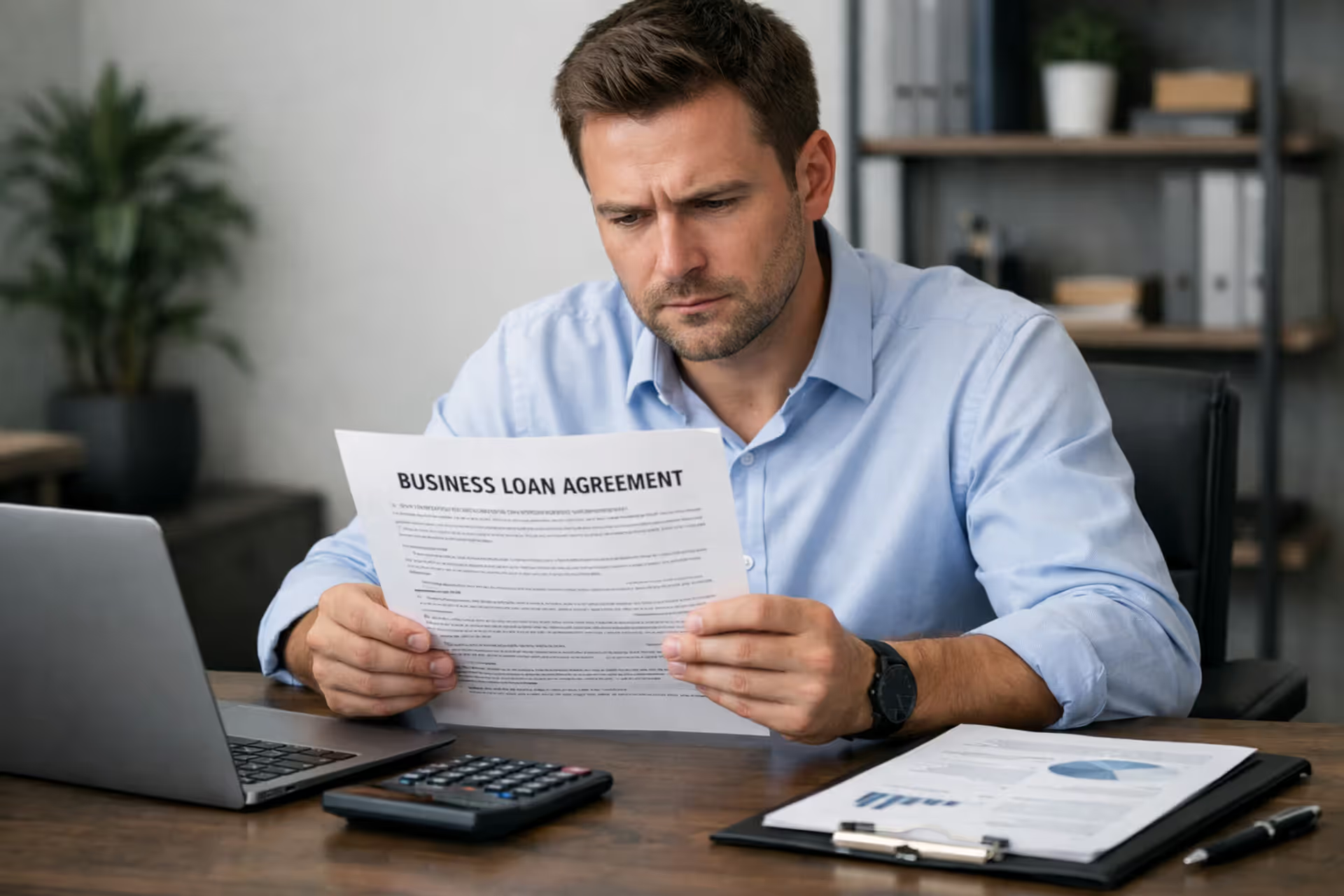

Small business owner comparing installment loan and revolving credit options at a desk
Is a Small Business Loan Installment or Revolving

Content
You're looking at financing options for your business, and suddenly you're drowning in credit terminology. Here's what you actually need to know: most traditional small business loans work as installment credit—you get one lump sum deposited into your account and pay it back through scheduled monthly payments until it's gone. A business line of credit? That's revolving credit, which works more like a credit card where you can borrow, repay, and borrow again without reapplying.
Why does this matter to your bottom line? Because the structure you choose determines how much you'll pay each month, what happens when you need more money later, and whether your payment obligations will match your actual revenue cycle.
Pick the wrong structure and you might end up making $3,000 monthly payments during your slowest quarter, or paying triple the interest you needed to because you financed a one-time equipment purchase with high-cost revolving credit.
Let's break down exactly how each structure works and when each one makes sense for your situation.
What Installment and Revolving Credit Mean for Business Borrowing
I see business owners get this backwards constantly.They'll grab whatever gets approved fastest without considering whether the payment structure actually fits how money moves through their business. A landscape company with zero winter income shouldn't be locked into the same rigid payment schedule as a dentist with fully-booked appointments year-round
— Jennifer Hartman
Installment business loan explained: Think of this as the traditional way to borrow money. Your lender approves you for—let's say—$75,000. That full amount hits your bank account, usually within a few business days. Starting next month, you'll make the same payment every month (maybe $1,650) for the next five years until you've paid back every dollar plus interest. Once that final payment clears? The loan closes. Need another $75,000 in two years? You're filling out a whole new application.
Revolving business credit explained: This works completely differently. Instead of getting all the money upfront, your lender approves you for a maximum amount—say $50,000. You might pull out $12,000 in March to cover payroll during a slow stretch. Pay back $5,000 in April, and now you've got $43,000 available ($50,000 limit minus the $7,000 you still owe). The account stays open indefinitely as long as you're paying your bills and staying within the limit.
Here's how the classification changes your actual borrowing experience:
Repayment predictability: Installment financing means you'll know your exact payment on day one—it's not changing whether you have your best month ever or your worst. With revolving credit, your minimum payment shifts based on what you currently owe. Borrowed nothing this month? You might pay zero (except maybe a small maintenance fee).
Access to additional capital: Run an installment loan down to its last $5,000 owed and need another $30,000? You're starting the whole application process from scratch—new credit checks, updated financials, approval timeline. Revolving credit? If you've got available room under your limit, just transfer the money to your checking account. Done.
Interest calculation methods: Most installment products calculate interest using amortization tables that front-load interest charges into your early payments. A revolving line calculates interest based on your daily or monthly average balance—borrow $8,000 for three weeks and pay it back, you're only charged for those three weeks.
How Installment Business Loans Work
Let's walk through a real-world installment loan from application to final payment.
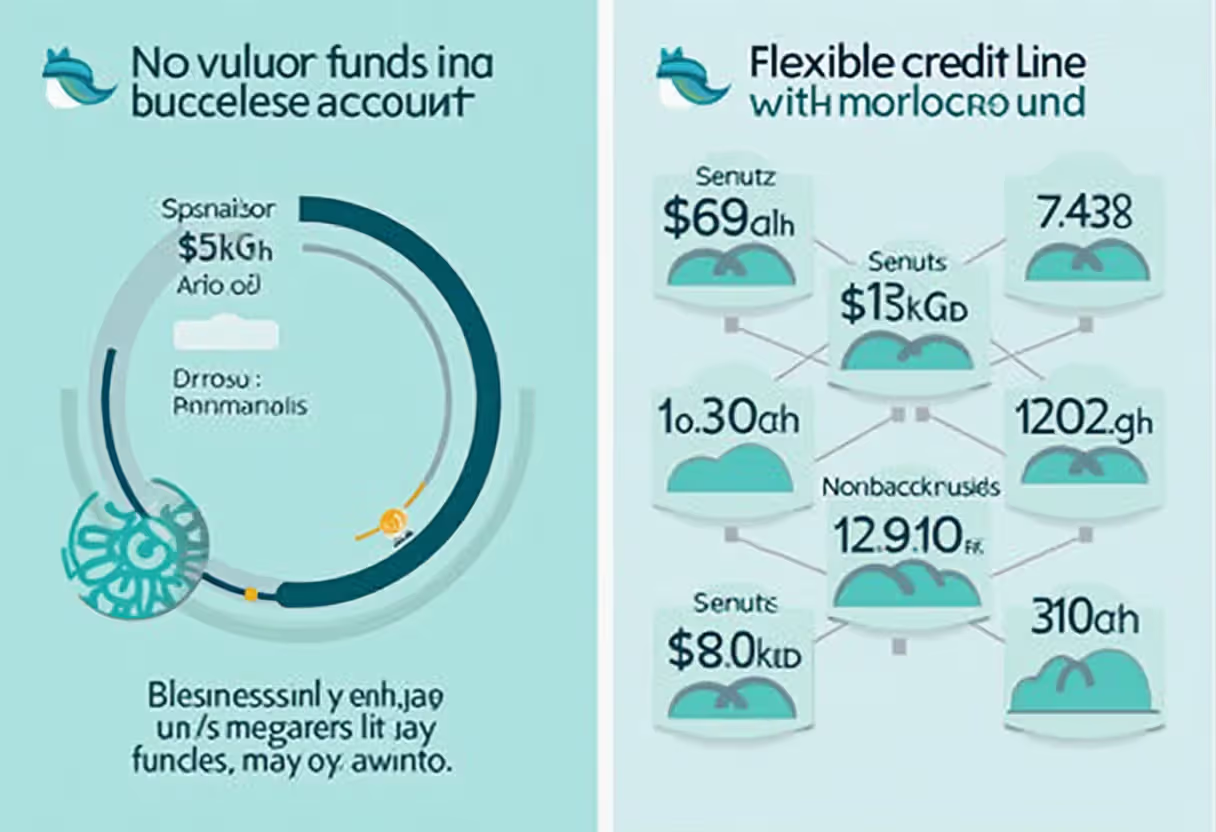
Structure and repayment schedule: Your lender deposits the approved amount—the entire sum—into your business account in one transaction. Most lenders then expect monthly payments that combine both principal (the actual money you borrowed) and interest (what they're charging you to borrow it). You'll receive an amortization schedule—basically a spreadsheet showing exactly where every dollar of every payment goes.
Here's an actual example: Borrow $100,000 at 8% annual interest, repaid over five years. Your monthly payment comes to $2,028. But here's the catch—that first payment breaks down to roughly $667 in interest and only $1,361 actually reducing what you owe. Fast forward to payment #55 out of 60, and you're paying $13 in interest with $2,015 knocking down the principal. Same $2,028 payment, completely different allocation.
Author: Hannah Kingsley;
Source: nayiyojna.com
Fixed terms and typical use cases: You'll find terms anywhere from twelve months to 25 years, though most small business financing falls between three and ten years. A three-year loan means swallowing significantly higher monthly payments—maybe $3,100 instead of $2,028 in our example above—but you'll pay maybe $11,600 total interest instead of $21,700. Stretch that same loan to ten years and your monthly payment drops to around $1,213, which feels great until you realize you've paid $45,500 in interest.
Real businesses use installment loans for purchases where they know exactly what they're buying:
- A food truck costing $85,000 that'll start generating revenue within weeks
- Commercial real estate where the mortgage payment stays below the rental income
- A major kitchen remodel for a restaurant expanding from 50 to 90 seats
- Consolidating $120,000 in scattered debts into one $2,800 monthly payment
- Bulk inventory purchases when you're a toy store preparing for the holiday rush with predictable sales data
Principal and interest payment timing: Most lenders want that first payment within 30 to 90 days after funding. Some offer grace periods where you're only paying interest for maybe the first three or six months—sounds nice, but you're just adding to your total interest bill since the principal isn't shrinking. The vast majority of small business installment loans start chipping away at both principal and interest immediately.
That predictability becomes your planning advantage. You can budget for the next 60 months knowing exactly what's going out the door every single month, which makes financial forecasting actually possible instead of guesswork.
How Revolving Business Credit Works
A business credit line functions less like a traditional loan and more like having a reserve tank you can tap whenever needed.
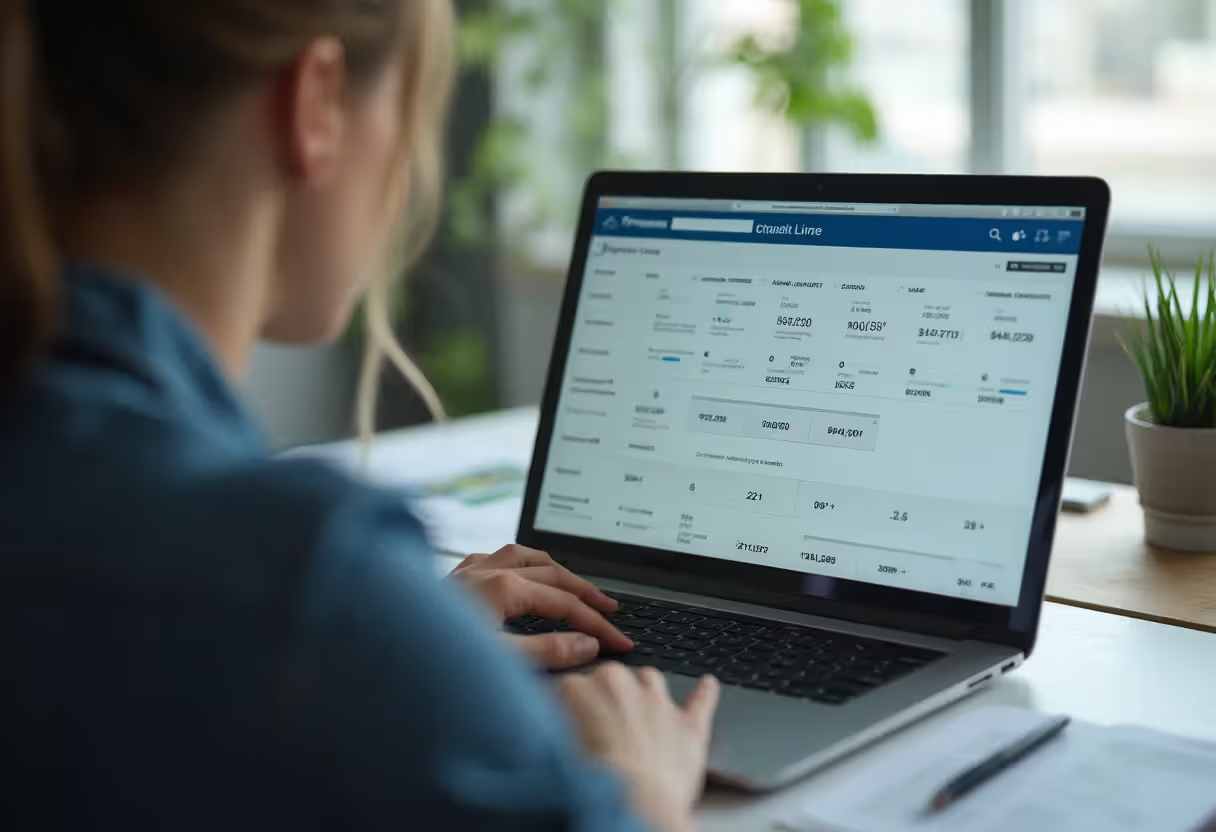
Structure and draw period: Once you're approved for—let's use $75,000 as an example—you enter what's called a draw period. This typically runs 12 to 60 months where you can access funds up to your limit whenever you want. You might pull $15,000 in January for a marketing campaign, repay $8,000 in February when clients pay invoices, then grab another $12,000 in March for unexpected equipment repairs. Your available credit constantly adjusts.

Author: Hannah Kingsley;
Source: nayiyojna.com
Most modern lenders let you access funds through online transfers (often arriving same-day or next-day), checks written against the credit line, or even a linked debit card. When your HVAC system dies on a Friday afternoon, you're not waiting for a loan committee to meet on Tuesday.
Credit limit resets and ongoing access: This is where revolving credit gets its name. Say you've got that $75,000 limit and you've drawn $40,000. Your available credit sits at $35,000. Pay back $20,000 next month? Now you've got $55,000 available. The credit you repay immediately becomes accessible again without any paperwork, applications, or approval processes.
Most lines require minimum monthly payments—sometimes just the interest you've accumulated, sometimes interest plus maybe 1-2% of the outstanding principal. A few require you to pay the balance to zero occasionally and stay there for maybe 30 days before drawing again, but these "clean-up" requirements have become less common as of 2026.
Typical use cases: Revolving credit shines in situations where your needs fluctuate:
- Covering payroll when your biggest client is 60 days late paying a $45,000 invoice
- Stocking up on seasonal inventory three months before your busy season hits
- Jumping on supplier deals that require payment within 48 hours
- Bridging the gap between materials costs and client payments for contractors
- Managing emergency repairs that can't wait for traditional loan approval
Author: Hannah Kingsley;
Source: nayiyojna.com
Flexibility considerations: The primary advantage is financial agility—you're never paying interest on money sitting unused in your account, and you can access additional funds the moment you need them. The flip side? Less predictability in your monthly obligations, and it takes serious discipline to avoid carrying a permanent balance that slowly drains your profits through accumulated interest charges.
Term Loan vs Business Line of Credit Comparison
| Feature | Term Loan | Line of Credit |
| Repayment structure | Same payment amount each month combining principal and interest until loan is paid off | Flexible payments based on what you currently owe; often just interest minimum |
| Interest calculation | Applied to the original borrowed amount; front-loaded into early payments through amortization | Applied only to your current outstanding balance; calculated daily or monthly |
| Access to funds | Receive entire approved amount in one deposit; accessing more requires new loan application | Draw any amount up to your limit whenever needed; repaid amounts immediately available again |
| Typical terms | One to 25 years (most common: three to ten years) | Six months to five years for draw period; often renewable at expiration |
| Best for | Specific large purchases, real estate, equipment, defined expansion projects | Cash flow management, seasonal working capital, emergency funds, opportunity purchases |
| Average rates (2026) | 6.5% to 13% APR based on credit strength and what's securing the loan | 10% to 25% APR; often includes draw fees (1-3%) or yearly maintenance charges |
| Collateral requirements | Usually required above $50,000; typically the purchased asset, real estate, or blanket lien | May approve unsecured to $100,000; higher limits need collateral backing |
Payment structure for business borrowing creates fundamentally different obligations depending on which product you choose. That term loan requires the same $2,000 payment whether you had a $50,000 sales month or a $5,000 sales month. Miss it during a rough quarter and you're in default. A credit line? If you haven't borrowed anything, you're paying maybe nothing or just a $25 monthly fee. Use $15,000, and you might owe just $150 in interest that month.
But here's the math that trips people up: revolving credit costs significantly more per dollar you actually borrow. That term loan at 8% for five years might cost you $10,600 total interest on $50,000. Keep that same $50,000 balance sitting on a 12% line of credit for five years? You're paying roughly $30,000 in interest—almost triple. You're paying for the flexibility whether you're using it or not.
Cost comparison scenario: A real business example helps clarify this. You need $50,000 to upgrade your production equipment. Finance it through a five-year term loan at 8%, and your total interest bill comes to about $10,600. Your monthly payment is $1,014, and in 60 months you're done.
Take that same $50,000 from a line of credit at 12% and just make minimum payments that barely touch the principal? Five years later you've paid roughly $30,000 in interest charges and you might still owe $35,000 on the original amount. The flexibility to potentially pay it off faster is worth something, but only if you actually do it.
Author: Hannah Kingsley;
Source: nayiyojna.com
Which Business Borrowing Type Fits Your Cash Flow
Your revenue pattern should drive this decision more than any other factor.
Cash flow patterns: If your business brings in roughly the same amount every month—think subscription software company, medical practice with insurance contracts, or property management with long-term leases—you can budget for fixed installment payments without much stress. When you know you're collecting between $45,000 and $52,000 monthly, committing to a $2,500 loan payment isn't risky.
Running a business with unpredictable or seasonal revenue? Revolving credit saves you from disaster. Ski resorts making 70% of their annual revenue between December and March can't handle rigid payment obligations during the summer months. Same goes for pool installation companies, seasonal landscapers, or retailers where Q4 makes or breaks the year. You need borrowing that matches your revenue reality.
Predictability of expenses: Buying one specific thing—a $95,000 piece of manufacturing equipment, a delivery truck for $48,000, renovating your retail space for $125,000—matches perfectly with installment financing. You know the exact cost, you borrow that precise amount, and you pay it back systematically. The asset you're buying might even generate the revenue to make the payments (that delivery truck enables you to take on new contracts, for instance).
When your needs vary month to month, revolving credit makes more sense. Marketing agencies covering production costs before clients pay, restaurants buying inventory at varying amounts based on seasonal menus, or consultants covering travel expenses before reimbursement all benefit from the ability to borrow different amounts as needs change.
Growth stage considerations: Brand-new businesses often struggle to qualify for large installment loans since they lack the revenue history lenders want to see. A $25,000 to $50,000 line of credit might be more accessible with just your personal credit score and six months of bank statements. Use it well, build some business credit history, and you can qualify for bigger term loans 18 months later when you're ready for major expansion.
Established businesses with solid financials should probably maintain both: term loans for big capital purchases where you want the lowest possible interest rate, and a line of credit sitting there for working capital emergencies and opportunities. You're not using the line much (hopefully), but it's there when you need it.
Decision framework:
Go with an installment loan when: - You're financing something specific with a known price tag - Your monthly revenue is consistent enough to handle the same payment every month - The purchase will either generate revenue or cut costs enough to justify the payment - Getting the absolute lowest interest rate and total cost matters most - You actually prefer having a forced repayment schedule to keep you disciplined
Choose revolving credit when: - Your borrowing needs change significantly month to month - You've got gaps between when you pay expenses and when customers pay you - Quick access to funds without reapplying is worth paying more in interest - You're confident you can pay down balances relatively fast - You'd rather pay interest only on exactly what you use when you use it
Plenty of successful businesses run both simultaneously: a $150,000 term loan financing new equipment, plus a $75,000 line of credit they tap occasionally for working capital crunches. This combination delivers cost-efficient financing for big purchases while maintaining flexible access for everything else.
Common Payment Structure Mistakes Business Owners Make
Mismatching loan type to need: Taking out a five-year, $40,000 term loan just to bridge a temporary three-month cash flow gap locks you into 60 monthly payments for a problem that only lasted one quarter. You'll spend years paying interest on money you only needed briefly. The flip side? Using a 16% line of credit to finance a $80,000 equipment purchase means paying premium rates for years on a long-term asset when an 8% term loan would've been way cheaper.
Ignoring draw fees and maintenance charges: Many business lines charge you 1% to 3% every time you actually move money from the line to your checking account—so accessing $10,000 might cost you an instant $100 to $300 fee. Add in annual maintenance fees of $150 to $500, and suddenly that advertised 12% APR is really costing you closer to 15% when you factor in all the extras. Calculate the true all-in cost, not just the number they advertise.
Underestimating revolving credit costs: Business owners see "minimum payment $200" and think that's fine, missing that they're carrying $35,000 at 18% APR. That's $525 monthly in interest charges alone. Pay just the minimum and you're barely making a dent in the principal—you could be paying that $200 for years and still owe $30,000. Revolving credit only makes financial sense if you're paying it down aggressively when cash flow allows.
Failing to read prepayment terms: Some lenders charge you 2% to 5% of whatever you still owe if you dare to pay off your term loan early. Owe $60,000 and want to pay it off? That's potentially a $3,000 penalty just for being responsible. Other lenders use archaic interest calculation methods that front-load all the interest charges, meaning paying off early barely saves you anything. Always confirm you can prepay without penalties before signing anything.
Refinancing at the wrong time: If you're in month 8 of a 60-month term loan, you've mostly been paying interest so far—the principal has barely budged. Refinancing now means restarting that whole front-loaded interest schedule all over again. Similarly, consolidating revolving debt into a term loan eliminates your financial flexibility—if you suddenly need access to credit again next quarter, you'll be reapplying from scratch.
Not maintaining an emergency cushion: Committing to the absolute maximum installment loan payment you can theoretically afford, with zero backup credit available, leaves you completely exposed when revenue inevitably dips. A smarter approach keeps some borrowing capacity available—maybe a smaller term loan payment plus an unused line of credit—so you've got options when the unexpected happens.
Frequently Asked Questions About Business Loan Types
Here's the bottom line: a small business loan is installment credit, while a business line of credit is revolving credit. But that distinction isn't just vocabulary—it shapes your monthly cash obligations, your total interest costs, and your financial flexibility for the entire life of the debt.
Installment loans deliver cost-effective financing when you're making substantial purchases and can commit to identical monthly payments. Revolving credit provides adaptability for handling irregular cash flow and unexpected needs, though you'll pay significantly more per dollar borrowed.
Your revenue patterns should drive the decision more than anything else. Does money flow into your business consistently every month, or does it come in waves? Are you financing something specific with a known price tag, or do your capital needs shift month by month?
Many thriving businesses use both strategically: term loans for major capital investments that generate returns over time, and lines of credit for short-term working capital crunches.
Before signing anything, calculate the true all-in cost including every fee buried in the agreement, confirm whether you can repay early without penalties, and honestly assess whether the payment structure matches your actual cash flow—not your optimistic projections. The cheapest available financing that you can't reliably afford to repay will cost you way more than a slightly higher-rate product that actually fits how money moves through your business.