
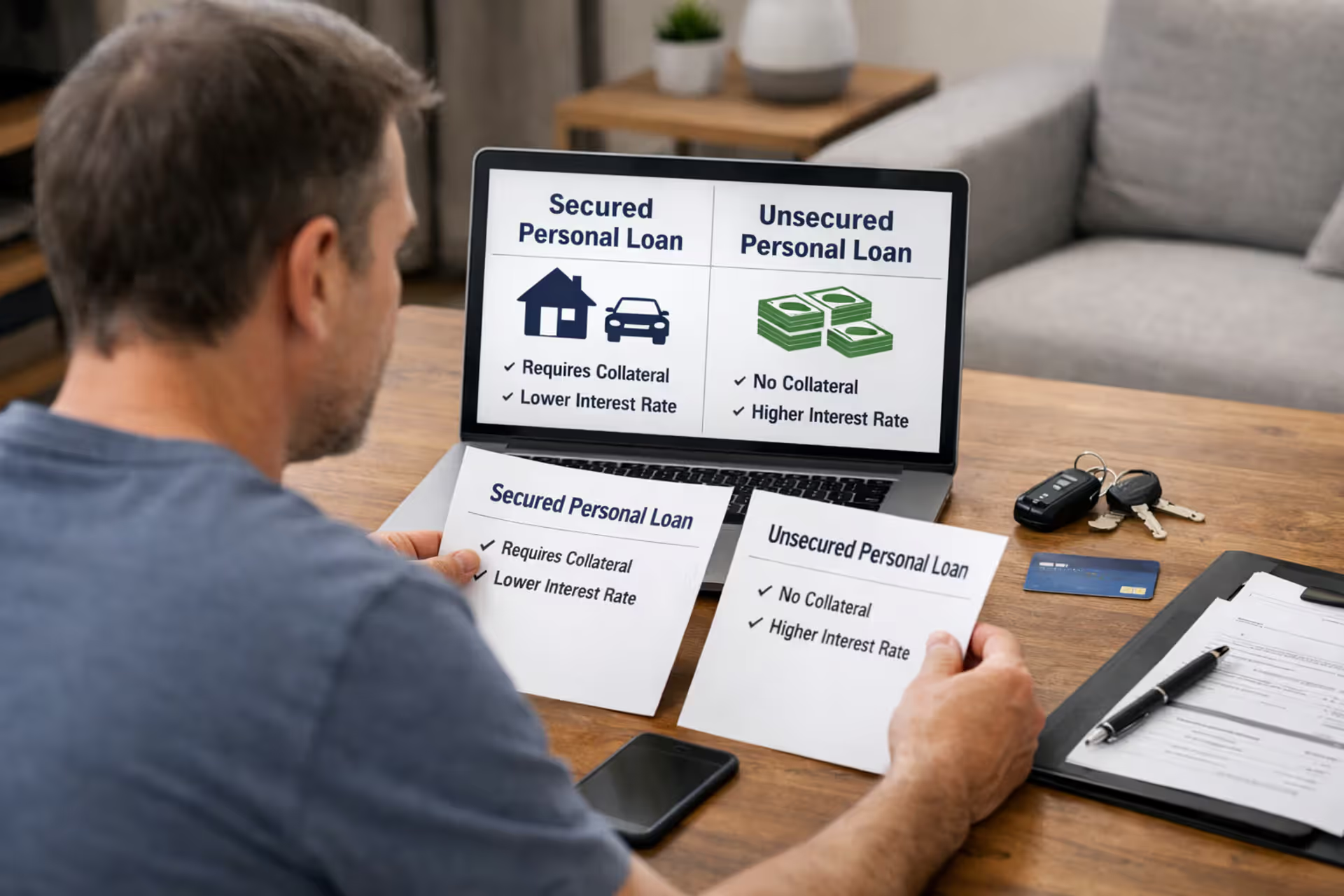
Person comparing secured and unsecured personal loan options at home
Is a Personal Loan Secured or Unsecured

Content
You're shopping for a personal loan, and suddenly you're drowning in terminology. Secured this, unsecured that—what does it actually mean for your wallet?
Here's what matters: some personal loans demand you hand over something valuable (your car title, your savings account) as a safety guarantee. Others? The lender just trusts you'll pay them back based on your financial track record. These two approaches create completely different borrowing experiences.
Let's break down exactly how these loans work and which one fits your situation.
What Makes a Personal Loan Secured or Unsecured
Everything hinges on one concept: collateral.

Author: Brandon Ellery;
Source: nayiyojna.com
When you secure a loan, you're essentially telling the lender, "Here's my car title" or "Here's access to my savings account—if I stop paying, you can take it." That physical asset becomes the lender's backup plan. You're still on the hook to make payments, but now there's something tangible they can grab if things go south.
Collateral for personal loans dramatically changes the lender's risk calculation. They're not just hoping you'll pay; they're holding onto something valuable. Can't make your payments? They'll sell your asset and recoup their losses. This safety cushion usually means they'll charge you less interest.
Contrast that with unsecured borrowing. No car titles change hands. No savings accounts get frozen. You sign papers promising to repay, backed by your signature and credit history—that's it.
The lender has to trust that your credit score, your job, and your track record paint an accurate picture of someone who pays their bills. If you default, they can't just swing by and tow your car. They'll have to sue you, chase you through collections, and hope to eventually recover something. That uncertainty? They charge you extra for it.
Here's something most people don't realize: roughly 85% of personal loans in the US are unsecured. Walk into most banks or check online lenders—their default offering is almost always unsecured. Secured personal loans exist, absolutely, but they're more niche. You'll find them at credit unions or specific lenders targeting borrowers with credit problems.
Too many people with 750 credit scores get talked into putting up collateral they don't need to. On the flip side, I've seen borrowers with 620 scores pay 24% interest when a car-secured loan would've given them 9%. Know what you qualify for before you sign anything
— Jennifer Martinez
How Secured Personal Loans Work
Let's get concrete about what "secured" actually means in practice.
You walk into a credit union needing $15,000. They look at your 630 credit score and say, "We can work with this, but we need collateral." You agree to pledge your 2019 Honda Civic as security. They file paperwork with your state's DMV establishing a lien—basically a legal claim that says, "This bank has an interest in this vehicle until the loan is paid."
What can you actually use as collateral? The most common options:
Cash or near-cash assets: Your own savings account at the same bank, a CD you've been holding, even a money market account. These are lender favorites because there's zero ambiguity about value. You have $10,000 in savings? They'll typically loan you $8,000-$9,000 against it.
Vehicles of all types: Cars, trucks, motorcycles, even RVs or boats. The lender orders a value assessment (often using Kelley Blue Book or NADA guides), then offers 60-80% of that value as your maximum loan amount.
Property: Home equity is huge here—though most people call these "home equity loans" rather than secured personal loans, they're technically the same structure. Some lenders also accept vacant land or investment properties.
Investment portfolios: Got a brokerage account with $50,000 in stocks? Some banks will loan against that. They're pickier here because stock values fluctuate, so expect conservative loan-to-value ratios.
Specialty items: Rare, but some lenders work with jewelry, collectibles, or business equipment if you can document value.
Here's the approval dance: First, you fill out an application identifying what you want to pledge. The lender investigates—they'll verify you actually own it, check for existing liens (another loan against the same asset), and determine current market value.
For a car, they might use automated valuation tools. For real estate, they'll order an actual appraisal that costs you $300-$500. Once they know what it's worth, they calculate how much they'll lend. Expect something like 70% of value for most assets.
Then comes the legal stuff. They file paperwork creating their security interest—that lien I mentioned earlier. You still own the asset and can use it (drive your car, keep your savings accessible for emergencies if structured right), but you can't sell it or fully control it without their permission until the loan is paid off.

Author: Brandon Ellery;
Source: nayiyojna.com
The terrifying part? Default on payments—typically 60-90 days past due triggers this—and they start seizure proceedings.
Fall behind on a vehicle-secured loan? A repo company shows up at 3 AM and tows your car away. You wake up, your ride's gone, and you still owe money if the auction doesn't cover your balance.
Secured by savings? They drain the account immediately. No court, no warning beyond what's in your loan agreement.
Real estate? Foreclosure proceedings start, though these take months and you'll get multiple notices.
One silver lining: these loans offer a legitimate path to rebuild damaged credit. Lenders approve them for lower scores precisely because the collateral protects them. Make 12-18 months of on-time payments, and watch your credit score climb.
How Unsecured Personal Loans Work
No collateral means the lender's entire decision rests on a single question: Will this person actually pay us back?
They're essentially betting on your character and financial situation. To make that bet, they dig into multiple factors:
Your credit score is the gatekeeper. Below 600? Most traditional lenders won't even consider you for unsecured credit—too risky. In the 600-660 range, you'll find approvals but the interest rates sting. Hit 680-700, and suddenly you're in "acceptable risk" territory with reasonable rates. Above 750? You're shopping among the lender's best available terms.
They verify every dollar you claim to earn. Lenders want recent pay stubs if you're employed (usually the last 30 days), or tax returns if you're self-employed (typically two years' worth). Bank statements showing regular deposits help too. They're trying to confirm you have reliable income, not a one-time windfall.
Then they calculate your debt-to-income ratio—it sounds complicated but it's just math. Add up all your monthly debt obligations (mortgage, car payment, minimum credit card payments, student loans, any other loans). Divide that by your gross monthly income.
If you earn $6,000 monthly and pay $2,100 toward debts, that's a 35% DTI. Most lenders want you below 40%, some will stretch to 45-50% if other factors look great.
Job stability matters more than you'd think. Been at the same employer for three years? Perfect. Changed jobs five times in two years? Red flag. They're worried you might lose income unpredictably.
Other debts paint a broader picture. Already juggling three personal loans and maxed-out credit cards? Even strong income won't save you—lenders worry you're overextended.
When you can't pay an unsecured loan, the lender can't just grab your stuff. They start with late fees and angry letters. After 30 days past due, they report the delinquency to credit bureaus—your score plummets. At 90-120 days, many lenders charge off the debt (write it off as a loss) and sell it to a collection agency for pennies on the dollar.
That collection agency then hounds you with calls and letters. They might sue you in civil court. Win a judgment, and they can garnish your wages (up to 25% in many states) or levy your bank account. But none of this happens quickly—it takes months, you'll get multiple warnings, and they have to follow legal processes.
Interest rates span a massive range. In 2026's lending environment, someone with an 800 credit score might snag a personal loan at 6.5%. Someone at 650? Try 17%. At 620, you're looking at 22-25% if you can get approved at all. That's why credit score is so critical—it literally determines if borrowing even makes financial sense.
Speed is a genuine advantage here. Without appraisals or title work, many online lenders approve and fund unsecured loans within 24-48 hours. Some even do same-day funding if you apply early and have direct deposit set up. Need money for an emergency? Unsecured loans win on timeline.

Author: Brandon Ellery;
Source: nayiyojna.com
Comparing Secured vs Unsecured Personal Loans
Let's lay out the real differences in a way that actually helps you decide.
| What You're Comparing | Secured Personal Loan | Unsecured Personal Loan |
| Do You Pledge an Asset? | Yes—you put up your car, savings, property, or other valuables | No—your signature and credit history are sufficient |
| What Interest Rate Should You Expect? | Usually 3%-12%, heavily influenced by your collateral type and credit standing | Anywhere from 6%-36%, driven almost entirely by your credit score |
| Minimum Credit Score for Approval | Many lenders work with scores as low as 580-600 | Typically need at least 620; rates below 10% usually require 720+ |
| How Long Until You Get the Money? | Generally 1-2 weeks because of asset verification and documentation | Often 1-3 business days, sometimes same-day with online lenders |
| How Much Can You Borrow? | Higher limits possible—based on how much your collateral is worth | Most lenders cap between $1,000-$50,000, constrained by your income and credit |
| What Happens to Your Property If You Can't Pay? | Extremely high risk—lender seizes whatever you pledged | No immediate asset loss, though legal action and wage garnishment remain possible |
| Who Benefits Most? | People with valuable assets but lower credit scores, or those needing larger amounts | People with solid credit who want quick access to cash without risking property |
The interest rate gap deserves emphasis because it's where you actually see dollar-for-dollar impact.
Imagine you have a 650 credit score and need $15,000 for five years. An unsecured lender quotes you 18% APR. That's a monthly payment of roughly $381, with total interest of about $7,860 over the life of the loan.
Same scenario, but you secure the loan with your car. The lender offers 9% APR. Your monthly payment drops to $311, and total interest falls to around $3,660. You've just saved $4,200 by pledging collateral.

Author: Brandon Ellery;
Source: nayiyojna.com
Now flip it. You have a 740 credit score. Unsecured rate: 7.5%. Secured rate: 5.5%. On that same $15,000 over five years, the unsecured loan costs you about $2,850 in interest versus $2,150 secured—a difference of $700. Still savings, but is it worth the risk of losing your car over $700? That's debatable.
Approval probability shifts dramatically based on loan structure. Someone with a 590 credit score applying for a $12,000 unsecured loan will likely face rejection after rejection from mainstream lenders. Maybe a predatory lender offers 32% APR—financially toxic.
That same person with a paid-off car worth $15,000? A secured loan suddenly becomes very feasible, possibly at 11-12%.
Maximum loan amounts differ too. Unsecured lenders rarely go above $50,000 even for borrowers with excellent credit and high income. Many cap at $35,000.
But secure a loan with real estate, and suddenly $75,000 or $100,000 becomes available. The collateral value expands what lenders are willing to risk.
Repayment terms? These are actually pretty similar whether secured or unsecured—usually anywhere from two to seven years, occasionally up to 10 years for larger secured amounts. This isn't where you'll see major differences.
Risk is where everything diverges. With unsecured debt, you face credit damage, collection calls, potential lawsuits, maybe wage garnishment. Terrible outcomes, yes, but you're not homeless and carless tomorrow.
With secured debt, consequences arrive faster and more tangibly. They take your vehicle and you lose your ability to get to work. They seize your savings and your emergency fund vanishes. They foreclose on property and you're displaced. The severity is undeniable.
How Lenders Determine Whether Your Loan Needs Collateral
Ever wonder why one lender demands collateral while another doesn't? It comes down to institutional risk tolerance, underwriting policies, and what you're actually asking for.
Credit scores create invisible dividing lines that lenders rarely advertise. Here's the rough landscape as of 2026:
- Above 720: You're golden for unsecured loans. Lenders compete for your business. Nobody's asking for collateral unless you want it for rate advantages.
- 660-720: Unsecured loans remain available, but you'll pay moderate interest rates (maybe 10-15%). Secured options might save you 3-5 percentage points.
- 600-660: Unsecured becomes expensive or hard to find. Secured loans often provide your best—or only—affordable path.
- Below 600: Unsecured lending is mostly off the table with traditional lenders. Secured loans are often your sole realistic option beyond predatory high-cost lenders.
These aren't universal cutoffs. Some credit unions work with 580 scores on unsecured loans for existing members. Some online lenders won't touch anyone below 640. But these ranges reflect common thresholds.
Income stability carries different weight depending on loan type. Two applicants, both earning $70,000 annually. One works a salaried position at a Fortune 500 company—three years tenure, W-2 income, highly predictable. The other freelances with variable monthly income—some months $8,000, some $3,000, all 1099 income.
For unsecured loans, the salaried employee is far more attractive. The freelancer might face rejection or needs to show substantial cash reserves. But if the freelancer offers collateral, suddenly the income variability matters less—the lender has a safety net.
Loan amount triggers different policies. Request $5,000 with a 680 credit score? Almost any lender will offer unsecured terms. Request $45,000 with the same credit score? Many lenders will want collateral even though your credit is decent. Larger amounts mean larger losses if you default, so lenders get conservative.
Each lender's business model shapes what they offer. Credit unions love secured loans because they can offer members low rates—a 5% secured loan is affordable for the member and safe for the credit union. It fits their mission. They'll frequently offer share-secured loans (backed by your savings) even when you don't technically need them.
Online fintech lenders mostly skip secured loans entirely. Their entire infrastructure is built around speed: automated underwriting, instant decisions, rapid funding. Managing collateral—getting titles, filing liens, arranging appraisals—slows everything down and requires staff they don't have. They'd rather just decline risky borrowers than deal with collateral logistics.
Traditional banks often do both but may steer you based on profitability. They might approve you unsecured at 14% or secured at 8%, presenting both options. Or they'll deny you unsecured but approve you secured, essentially saying "we'll lend to you, but only with protection."
Existing banking relationships influence decisions. Been banking somewhere for 10 years with multiple accounts and no overdrafts? That history builds goodwill—they might extend unsecured credit more freely. Brand new customer walking in off the street? They're more cautious, might require collateral even for moderate amounts.
A critical mistake: assuming the first lender's requirements apply everywhere. Get told you need collateral? Shop around before you accept that. If three lenders all want collateral, okay, that's probably your reality. But one lender requiring it doesn't mean they all will—underwriting standards vary wildly.

Author: Brandon Ellery;
Source: nayiyojna.com
Which Type of Personal Loan Is Right for You
This isn't a theoretical question—it's about matching loan structure to your actual financial reality and goals.
Secured loans make sense when:
- Your credit score sits below 650 and unsecured options are either unavailable or carrying interest rates above 20%
- You own valuable assets outright (or nearly paid off) and you're absolutely confident in your repayment ability
- You're requesting amounts beyond what unsecured lenders offer—$40,000+, for instance
- The interest rate difference between secured and unsecured exceeds 5 percentage points, representing thousands in savings
- You're specifically trying to rebuild credit and need an approval-friendly product
Real example: Maria has a 615 credit score after a medical bankruptcy three years ago. She needs $18,000 to consolidate high-interest debt. Unsecured lenders either reject her or quote 26-28% APR—barely better than her current credit cards. Her credit union offers a secured loan at 9.5% using her 2020 Toyota Camry (paid off, worth $22,000) as collateral. She has stable nursing income and her budget comfortably handles the payment. The secured loan saves her roughly $6,800 in interest over five years. Makes sense.
Unsecured loans make sense when:
- Your credit score exceeds 680 and you qualify for competitive rates (under 12%)
- You can't stomach risking specific property—you need that car, can't afford to lose those savings
- You need money immediately and can't wait for collateral paperwork
- You're borrowing modest amounts—$15,000 or less—where rate differences are less dramatic
- You simply don't own assets valuable enough to pledge
Real example: James has a 730 credit score and needs $10,000 to replace his HVAC system before summer. He qualifies for an unsecured loan at 8.9% through an online lender, funded within 48 hours. He could potentially secure it with his savings account for maybe 6.5%, saving roughly $250 in interest over three years. But he wants that savings liquid for emergencies, and $250 isn't worth tying up $12,000 in assets. Unsecured makes sense.
Key factors in your decision:
How crucial is the asset you'd pledge? There's a universe of difference between securing a loan with a second car that sits in your garage versus your daily commute vehicle. Lose the daily driver and you might lose your job—which makes repaying any loan impossible. Don't pledge essential assets.
How solid is your income situation? If you're already stretched thin each month or facing potential layoffs, don't risk secured debt. A month or two of missed income could spiral into repossession. Unsecured debt gives you more flexibility to negotiate, settle, or work out payment plans when things go wrong.
What are the actual dollar savings? Run the numbers. Use online calculators to compute total interest paid over the full term for both loan types.
A 4% rate difference on an $8,000 three-year loan saves you roughly $350. Is $350 worth pledging your car? Probably not.
That same 4% difference on a $35,000 seven-year loan saves approximately $5,600. Now we're talking real money—possibly worth the collateral risk if the asset isn't essential.
What's your urgency? Emergency car repair needed this week? Unsecured funding speed might trump everything else. Planned home renovation starting in three weeks? You have time for secured loan paperwork if the rates justify it.
A rough guideline: if the secured rate is less than half the unsecured rate, and you're using non-essential collateral, the numbers probably favor secured. If rates are within 2-3 percentage points of each other, unsecured's simplicity and peace of mind likely wins unless you're borrowing massive amounts.
Frequently Asked Questions About Personal Loan Security
Whether your personal loan requires collateral fundamentally reshapes your borrowing experience—affecting your interest costs, approval odds, and what's at stake if repayment becomes difficult.
Unsecured loans deliver convenience and keep your assets safe, but demand stronger credit and typically extract higher interest payments. Secured loans unlock better rates and approval paths for challenged credit, but they put your property directly in the crosshairs if you can't pay.
Your credit standing, the amount you're borrowing, what you can afford to risk, and the actual numbers—total interest paid, not just the rate—should guide your choice.
Don't assume one type is automatically superior. A secured loan saving you $4,000 in interest might absolutely justify the collateral risk if you're confident about repayment and using a non-essential asset. Conversely, paying an extra $800 over the loan term for unsecured borrowing might be money well spent for the peace of mind that comes with not risking your car.
Get quotes for both types if you're eligible for each. Compare the total cost across the full loan term—not just monthly payments or advertised rates. Consider what default would actually mean in each scenario. Would you lose something irreplaceable?
The 2026 lending market offers more choices than ever—traditional banks, credit unions with member benefits, online platforms with instant decisions. Each operates with different risk appetites and product offerings.
Shop around. Understand exactly what you're agreeing to. Choose the loan structure that aligns with both your financial reality and how much risk you can genuinely handle.