

Person reviewing loan documents at a desk with calculator and laptop
Loan Definition and How Loans Work

Americans sign their names to loan paperwork every single day—car notes, student debt, mortgages—but here's something strange: most people couldn't explain what they actually agreed to if you asked them a week later. At its core, borrowing money means someone gives you cash now, and you promise to pay it back later, usually with extra money on top (that's the interest part). Sounds simple, right? But the difference between understanding how this process actually works and just hoping for the best can easily cost you $10,000, $50,000, or more over your lifetime.
What Is a Loan in Banking?
When you walk into a bank or fill out an application online, you're asking to borrow a specific chunk of money. The bank hands over that full amount—let's say $15,000—and you sign documents promising to send regular payments until you've paid back everything, plus the lender's fee for letting you use their money.
Here's what makes this different from swiping a credit card: you get all the cash in one shot, not a revolving balance you can tap whenever. After your last payment clears, that's it—the account closes. Want another $5,000 next year? You'll start the whole application dance from scratch.
Credit cards work the opposite way. They give you a spending limit, you can use it and pay it down over and over, month after month, without asking permission each time. Same goes for home equity lines of credit. Traditional loans? One-and-done funding.
Banks make their profit by charging you interest—basically rent for using their money. Your interest rate depends on how risky you look on paper. Stellar credit score and a steady paycheck? You might snag 6%. Shaky payment history and you're freelancing without consistent income? Could be 18% or higher. They'll also look at whether you're putting up collateral (more on that in a minute) and what you plan to do with the money.
Here's what people forget: signing loan documents isn't just a gentleman's agreement. You've entered a binding legal contract. Mess it up, and the consequences follow you—credit report damage, getting turned down for future borrowing, even losing your house or car depending on the loan type.

Author: Hannah Kingsley;
Source: nayiyojna.com
How Do Loans Work?
The journey from "I need money" to "loan paid off" follows several predictable stages, though timing varies wildly based on what you're borrowing for.
You start by filling out an application. That means handing over personal details, work information, income proof, and stating how much you want. Lenders dig into your credit score, examine how much debt you already carry compared to your income, and review whether you pay bills on time. A mortgage application? Expect appraisals, mountains of paperwork, and potentially six weeks of waiting. Personal loan through an online lender? You might have approval before lunch.
Get approved, and you'll receive a contract spelling out every single condition. This isn't bedtime reading, but you'd better treat it that way—this document controls your financial life until you make that final payment. Sign on the dotted line, and money flows either into your account or directly to whoever you're paying (the car dealership, the university, the contractor).
Now comes repayment. Most agreements demand monthly payments, though some let you pay every two weeks or on other schedules. Each payment chips away at what you owe until you hit zero. At that point, you're free, and if you pledged collateral, the lender releases their claim to it.
Skip a payment, and you'll face late fees immediately—plus your credit score takes a hit. Keep missing payments, and things escalate fast: collection calls, potential lawsuits, or if you pledged property, they'll take it. Some borrowers assume they can just walk away when money gets tight. You can't. The debt doesn't vanish; it multiplies into bigger problems.
The Role of Interest and Principal
Open your loan statement and you'll see two numbers: principal and interest. Principal means the actual amount you borrowed. Interest is what the lender charges for giving you that money in the first place.
Here's the part that surprises people: early on, most of your payment goes straight to interest, barely touching the principal. A $20,000 car loan at 6% over five years? Your payment runs about $387 monthly. That first payment might split $100 to interest and only $287 to principal. Flash forward to payment number 50, and now you're sending $190 to principal with just $97 going to interest. This shifting ratio—called amortization—explains why paying extra early saves you so much money. You're cutting off all those future interest-heavy payments.
Over five years on that car loan, you'll hand over roughly $3,200 in pure interest. That's $3,200 that doesn't reduce what you owe—it's just the price of borrowing.
Secured vs. Unsecured Loans
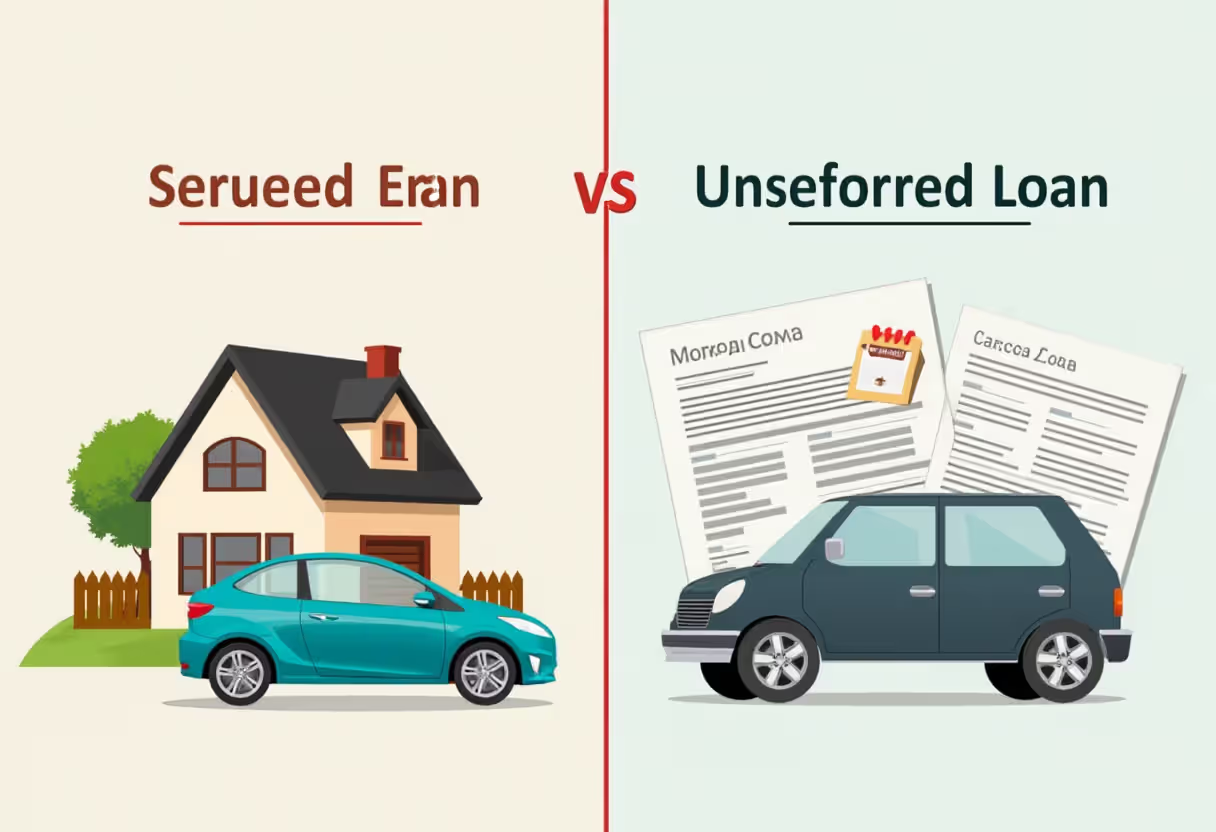
Lenders split loans into two camps based on one question: what can we take if you stop paying?
Secured borrowing means you've promised them a specific asset—your house, your car, money in a savings account—that they can grab if you default. Since they're protected beyond just suing you, they'll offer better interest rates and let you borrow more. Mortgages and auto loans almost always work this way. The property you're buying is what secures the loan.
Unsecured borrowing has nothing backing it up except your word and your credit history. Personal loans, most student loans, and credit cards fit here. Without property to claim, lenders jack up interest rates to cover their increased risk. If you default, they have to drag you to court, get a judgment, then chase wage garnishments or bank account levies—way messier than just repossessing a vehicle.
Check out the contrast:
| Loan Type | Collateral Required | Interest Rate Range | Risk to Borrower | Common Examples |
| Secured | Yes—house, vehicle, deposit account | 3%–10% | You lose whatever you pledged | Home loans, car financing, home equity products |
| Unsecured | Nothing | 6%–36% | Ruined credit, potential wage garnishment, lawsuits | Personal loans, student debt, credit cards |
Notice the trade-off: secured loans give you cheaper rates but your stuff's on the line. Unsecured loans keep your property safe but cost significantly more, and they can still wreck your finances through legal action.
Author: Hannah Kingsley;
Source: nayiyojna.com
Key Parts of a Loan Agreement
Loan contracts run long and dense, but certain elements show up in virtually every agreement. Knowing these helps you compare competing offers and catch bad terms before signing.
Loan amount (principal): The total you're borrowing. Seems obvious, but watch out—some lenders roll origination fees into this number, so you're paying interest on money that never actually reached you.
Term: How many months or years you have to pay everything back. Stretch to 30 years instead of 15 on a mortgage, and your monthly bill drops, but you'll pay staggering amounts of extra interest. A 30-year mortgage easily costs double what a 15-year mortgage does in total interest, even when the monthly payment feels more comfortable.
Interest rate: The yearly percentage charged on your remaining balance. Fixed rates stay locked in for the entire term. Variable rates bounce around with market conditions—they often start attractively low, then suddenly spike, transforming an affordable loan into a budget nightmare.
Payment schedule: When payments hit and how much you owe each time. Monthly is standard, but some lenders offer biweekly payments. Sounds like a small detail, but biweekly payments sneak in an extra payment each year, shortening your term and saving interest.
Collateral requirements: For secured loans, the contract specifies exactly what property backs your promise and when the lender can seize it. Read carefully—some agreements have cross-collateralization clauses letting them claim multiple assets if you default on one loan.
Fees: Origination charges, application costs, late payment penalties, early payoff penalties—they all boost your real cost. A loan advertising 5% interest but loaded with fees might actually cost more than a 5.5% loan with minimal fees. Run the full numbers, not just the rate they advertise.
Default clauses: These paragraphs define what counts as default (usually one or more missed payments) and what the lender can do about it. Some include acceleration clauses that make your entire remaining balance due immediately if you miss a single payment, not just the amount you're behind.
Grace periods: The breathing room some loans give you. Federal student loans typically pause payments for six months after graduation. Some credit cards won't charge interest on purchases if you pay your full statement balance monthly. Mortgages might give you 15 days past your due date before late fees kick in.
Common Loan Terms You Should Know
Financial vocabulary shouldn't be a secret language. Here are the terms you'll see repeatedly:
APR (Annual Percentage Rate): What borrowing actually costs you per year when you include both interest and fees. A lender might advertise 5% interest, but tack on a big origination fee, and suddenly the APR is 5.5%. Federal rules require APR disclosure, so compare this number across lenders, not just the basic interest rate.
Amortization: How loans get paid down through scheduled payments covering both principal and interest. An amortization schedule breaks down every single payment, showing you exactly how much goes where throughout your loan's life.
Origination fee: What lenders charge upfront to process your application, typically one to five percent of your loan amount. Some subtract this from your loan money—you applied for $10,000, they keep $500 as their fee, you receive $9,500, but you owe $10,000 plus interest. Sneaky.
Prepayment penalty: A charge for paying off your loan ahead of schedule. Lenders include these because early payoff kills their expected interest profits. Not every loan has them—ask directly before you sign anything.
Cosigner: Someone who agrees to take over your payments if you can't. Cosigners help people with weak credit qualify or get better rates, but they're accepting serious risk. You miss payments? Their credit gets destroyed too, and lenders can chase them for every penny you owe.
Default: Breaking your loan agreement, usually by skipping payments. Default triggers late charges, credit damage, and potentially lawsuits or property seizure. Each loan defines this differently—some call it default after one missed payment, others after 90 days of silence.
Grace period: Breathing room where you don't owe payments yet, or where late fees don't apply immediately. Student loans often give you six months post-graduation. Mortgages might give you two weeks past your due date before penalties start.
Forbearance and deferment: Temporary payment pauses during financial hardship. Forbearance typically lets you stop paying for a set period, but interest keeps piling up. Deferment might pause both payments and interest accumulation, depending on your loan type. Federal student loans offer both options; most others only do forbearance.
Debt-to-income ratio (DTI): What percentage of your monthly gross income goes toward debt payments. Lenders use this to judge whether you can handle another loan. The magic number most prefer? Below 43%, though it varies. Earning $5,000 monthly with $2,000 in debt payments gives you a 40% DTI.

Author: Hannah Kingsley;
Source: nayiyojna.com
Types of Loans Available to Borrowers
Loans come in various flavors, each built for different purposes and borrower situations.
Personal loans: Unsecured borrowing for whatever you need—consolidating credit cards, fixing your roof, covering medical bills. Amounts range from $1,000 to $50,000, with two-to-seven-year terms being typical. Rates swing wildly: maybe 6% if your credit's pristine, potentially 36% or higher if it's rough.
Mortgages: Secured loans for buying or refinancing property, usually stretching across 15 or 30 years. These represent the largest debt most Americans will ever carry—frequently $200,000, $400,000, or more. As of 2026, rates typically land somewhere between 5% and 8%, depending on your credit quality, down payment size, and current market conditions.
Auto loans: Secured financing for vehicles, generally running three to seven years. The car itself serves as collateral, making repossession straightforward if you stop paying. Dealers often advertise promotional rates, but these usually require top-tier credit and may come with strings attached.
Student loans: Money for education expenses, available through federal programs and private lenders. Federal loans offer fixed rates, income-based repayment plans, and potential forgiveness programs. Private student loans behave more like regular personal loans—rates depend on your credit, and you get fewer flexible repayment choices.
Business loans: Financing for launching or growing a business. These span tiny microloans under $50,000 to massive commercial real estate loans in the millions. Business loan applications often demand detailed financial projections, complete business plans, and sometimes personal guarantees where you're on the hook if the business fails.
Each type brings unique qualification hurdles, rate structures, and repayment rules. Getting a mortgage might take 45 days with extensive documentation requirements, while an online personal loan could get approved and funded within 24 hours with barely any paperwork.
Most borrowers fixate exclusively on whether the monthly payment fits their budget and completely ignore total interest paid across the loan's lifetime.This narrow focus costs tens of thousands of dollars. Understanding amortization mechanics and the real impact of interest rates protects borrowers from agreements that seem affordable month-to-month but drain wealth over years
— Jennifer Martinez
Frequently Asked Questions About Loans
Getting loan fundamentals right empowers smarter borrowing decisions. Before signing anything, calculate total cost including all interest and fees, confirm you can handle monthly payments even if your income dips slightly, and read every clause to spot unfavorable terms like prepayment penalties or harsh default provisions.
Shopping around remains one of your most powerful money-saving strategies. Interest rates and fees vary dramatically between lenders—even a half-percentage-point difference creates substantial savings on large loans or long terms. Gather quotes from at least three lenders, and negotiate aggressively. Many lenders will match or beat competitors' offers when you show them documentation.
Finally, borrow only what you actually need. The temptation to take the maximum approved amount runs strong, especially when lenders pre-approve you for impressive sums, but every borrowed dollar must be repaid with interest on top. Smaller borrowing means lower monthly obligations, less interest paid overall, faster payoff, and more financial flexibility when unexpected expenses pop up. Loans are powerful financial tools when used strategically, but they demand careful consideration and complete understanding of the obligations you're accepting.