

Person reviewing student loan documents at home
What Happens to Student Loan Debt When You Die

Content
Here's something most borrowers never discuss with their families: what actually happens to those student loans after you're gone. The answer isn't simple—it splits right down the middle depending on whether you borrowed from the federal government or a private lender.
Your loan type determines everything. Federal borrowers? Their families walk away clean. Private loan holders? Well, that's where things get complicated, especially if someone cosigned those loans. And here's the kicker: thousands of people refinanced their federal loans into private ones without realizing they just traded iron-clad protections for policies that vary wildly between lenders.
The rules changed dramatically over the past decade. Before 2018, even discharged federal loans could trigger massive tax bills. Private lenders used to chase grieving families for repayment. Today's landscape looks completely different, but outdated advice still circulates online, leaving families confused when they need clarity most.
Federal Student Loan Death Discharge
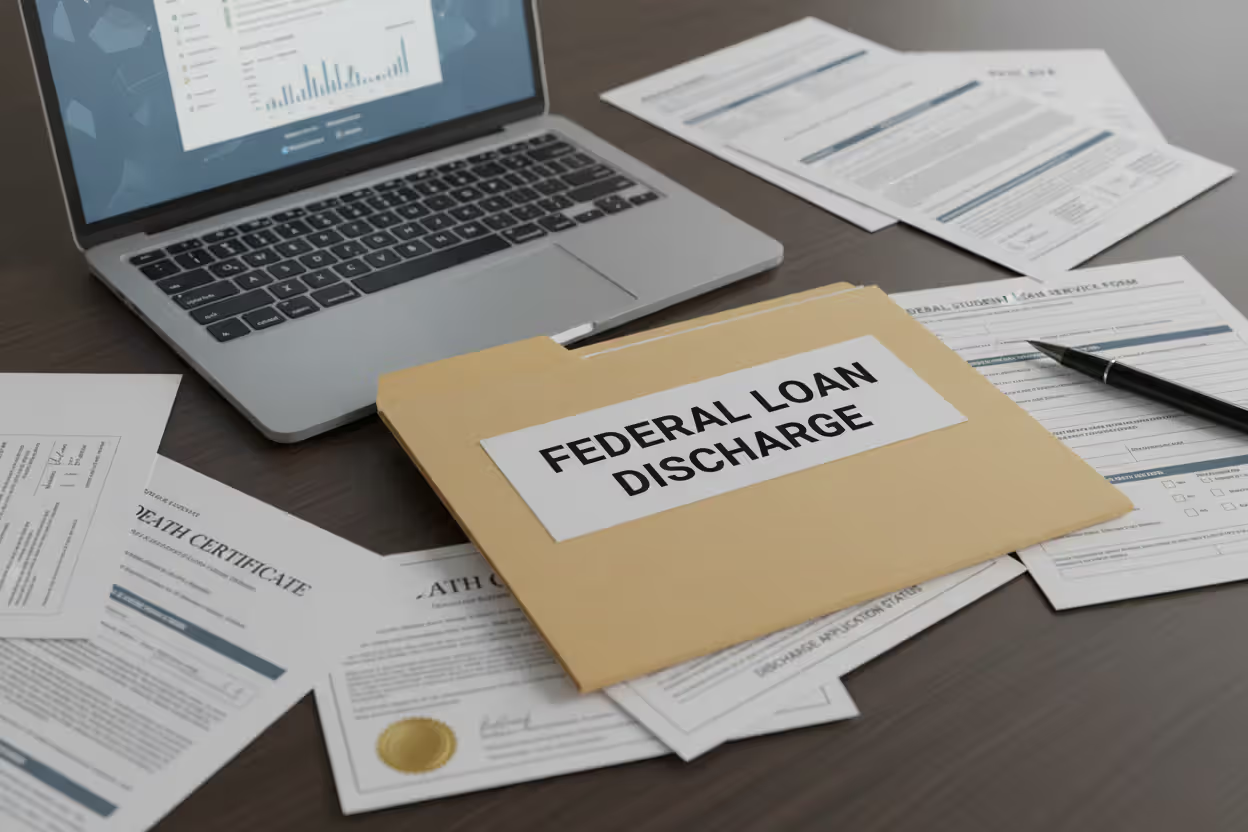
When you die with federal student loans, those debts die with you. Period. Your family won't owe a dime. Your estate won't take a hit. The government writes off the entire balance—whether it's $10,000 or $200,000.
This protection covers three main federal loan types: Direct Loans (the current program), the older FFEL program loans, and Perkins Loans that some schools still service. Borrowed $50,000 for your bachelor's degree and $80,000 for graduate school? All of it disappears once the Department of Education confirms your death.
Here's where it gets better: since Congress passed the Tax Cuts and Jobs Act in 2018, forgiven federal student debt doesn't count as taxable income anymore. Before that change, imagine this nightmare scenario—your parents just lost you, and then the IRS sends a bill treating your $100,000 in forgiven loans as "income" to your estate. That disaster no longer happens.
What about cosigners? They're off the hook completely. Parent PLUS Loans are the main federal loans with cosigner provisions, and when the borrower dies, parents receive full discharge. No exceptions, no fine print, no "gotcha" clauses. The federal government releases everyone simultaneously.
The discharge kicks in once your loan servicer learns about your death. Sometimes this happens automatically—servicers run periodic checks against Social Security Administration death records, usually catching deaths within 60 to 90 days. But families shouldn't wait. Calling the servicer directly and submitting a death certificate speeds everything up dramatically.
Author: Matthew Redford;
Source: nayiyojna.com
Private Student Loan Death Policies
Private student loans operate in a completely different universe. There's no federal law requiring private lenders to forgive anything when borrowers die. Each company makes its own rules, creating a confusing patchwork of policies that vary from generous to potentially devastating.
The good news? Most major lenders now forgive loans after death. Sallie Mae does it. So does Discover. College Ave, CommonBond, Earnest, SoFi—they've all implemented death discharge policies over the past decade. If you borrowed from one of these big players, your family probably won't face collection efforts.
But "probably" isn't "definitely." Smaller regional lenders and credit unions remain wild cards. Some discharge debt voluntarily. Others evaluate each situation individually. A few still reserve the right to pursue full repayment from estates or cosigners. The only way to know? Read your actual loan agreement or call and ask directly.
Here's the trap that catches people: refinancing federal loans converts them into private debt. Let's say you graduated with $120,000 in federal loans at 6.8% interest. You refinanced with a private lender at 4.2%, saving hundreds monthly. Smart move financially—until you consider what you traded. That guaranteed federal discharge? Gone. Your protection now depends entirely on whatever that private lender decides to offer.
Refinancing grew massively popular between 2015 and 2020 when interest rates dropped. High-earning professionals with six-figure student debt refinanced aggressively. Many never realized they'd surrendered federal protections that could matter more than the interest savings if something goes wrong.
Credit unions pose another challenge. Unlike banks with standardized policies across all branches, credit unions serve specific communities with varying rules. Your local credit union might forgive student loans out of goodwill, or their board might decide estate assets should cover the debt. You can't assume anything.

Author: Matthew Redford;
Source: nayiyojna.com
What Cosigners Need to Know After Borrower Death
Cosigning a student loan creates dramatically different outcomes depending on loan type. Federal loan cosigners (mostly parents with Parent PLUS Loans) receive automatic protection. Private loan cosigners? Their experience ranges from complete relief to financial disaster.
When federal loan borrowers die, cosigners immediately stop owing anything. The Department of Education doesn't transfer debt, doesn't expect continued payments, doesn't leave any liability hanging. If you cosigned your daughter's federal loans and she passes away, you're done. The balance disappears.
Private loans work differently—way differently. If the lender offers death discharge, cosigners should get released, but "should" is doing heavy lifting in that sentence. Some lenders make cosigners submit separate discharge applications even after the primary borrower's death has been verified and documented. The lender knows the borrower died, processed that claim, but still requires cosigners to separately prove the same death and request their own release. It's bureaucratic, frustrating, and delays relief during an awful time.
Worse scenarios exist. Private loans without death discharge policies leave cosigners holding the entire bag. The loan doesn't disappear—it becomes the cosigner's responsibility completely. All $75,000 of it, plus the interest that keeps accumulating. For parents who thought they were helping their kids access education, this can be financially devastating.
Older private loans contained something even nastier: auto-default clauses. These provisions allowed lenders to demand immediate full repayment the moment a borrower died, even when cosigners had been paying on time for years. Picture this: your son dies tragically, and within weeks, the lender demands $60,000 immediately. Not over the remaining loan term—right now, in full. Consumer advocacy groups fought these clauses aggressively, and most major lenders eliminated them by 2018. But loans originated before then might still contain this language buried in the contract.
How do you know if you're actually released? Don't trust assumptions. Call the servicer and demand written confirmation that you're no longer liable. Then monitor your credit reports for six months minimum. Discharged loans should vanish from your credit file. If they're still appearing three months after discharge confirmation, file disputes directly with Equifax, Experian, and TransUnion. Lingering student loan entries can tank your credit score and complicate everything from mortgages to car loans.
Refinancing creates a special nightmare for cosigners. Imagine parents cosigned their daughter's original federal loans. Later, she refinanced those federal loans into a private loan—and needed her parents to cosign again. Those parents just went from zero liability (federal loans discharge automatically) to potential full liability (depending on the new private lender's policies). Many parents in this situation had no idea they were taking on new risk.

Author: Matthew Redford;
Source: nayiyojna.com
How to Apply for Student Loan Death Discharge
Getting loans discharged after a death requires submitting paperwork and following up to make sure it actually happens. The process varies—federal loans offer straightforward procedures, while private lenders each maintain their own systems.
Federal loan discharge starts with contacting your loan servicer—that's the company sending monthly bills, not the Department of Education itself. Companies like MOHELA, Aidvantage, Nelnet, and EdFinancial service federal loans. Each maintains departments specifically handling death discharges. They've processed thousands of these claims and can walk you through their exact requirements. The Federal Student Aid website also posts downloadable forms and detailed instructions.
Private loan discharge means calling each lender individually. Got loans from three different companies? That's three separate phone calls, three different sets of forms, three different procedures to follow. Some lenders accept email submissions with scanned documents. Others require physical mail with original certificates. A few use online portals. There's no universal system.
Documents Required for Death Discharge
Every discharge application needs one critical document: an official death certificate issued by your state's vital records office. Not a photocopy. Not the memorial card from the funeral home. An original or certified copy with a raised seal.
Federal servicers keep it simple—death certificate only. That certificate needs to show the borrower's complete legal name exactly matching loan records, date of death, and the official state registrar's signature or seal. Name mismatches cause headaches. If someone legally changed their name after taking out loans—through marriage, for example—you might need to submit the marriage certificate too.
Private lenders often want additional proof. Some require documentation showing your relationship to the deceased borrower, especially when someone outside the immediate family handles estate matters. Executors should include their letters testamentary or estate administration papers. It sounds excessive when you're already submitting a death certificate, but lenders create their own rules.
Social Security numbers complicate things when they don't match exactly. Old loans sometimes contain data entry errors—someone transposed two digits back in 2009, and now the loan file shows the wrong SSN. When the death certificate SSN doesn't match the loan file SSN, servicers flag the claim for additional review. You might need to submit the deceased's birth certificate, Social Security card, or government ID to prove identity.
Timeline and Processing
Federal death discharge typically takes 60 to 90 days after the servicer receives complete documentation. The Department of Education reviews your claim, verifies the death certificate's authenticity, and approves the discharge. Servicers mail written confirmation to the address on file and notify any cosigners separately.
Stop making payments once you submit a discharge application. Don't continue paying while they process the claim. Here's something frustrating though: servicers might keep sending automated billing notices during those 60 to 90 days because their billing systems don't automatically pause when discharge claims are pending. Ignore those notices. Any payments made after the date of death typically get refunded, but why create extra hassle?
Private loan discharge timelines range from 30 days to 120-plus days. Large national lenders with dedicated discharge departments? Usually 30 to 60 days. Smaller regional banks and credit unions? Often 90 to 120 days or longer. Their smaller staff means fewer people handling these specialized claims.
Credit reporting updates lag behind the actual discharge. Expect a 60 to 90 day delay before discharged loans correctly appear on credit reports. When they do update, they should show "paid in full" or "discharged due to death"—not "charged off" or "defaulted." Those negative classifications trash credit scores unnecessarily. Cosigners should verify discharged loans vanished from their credit reports within 90 days of discharge approval. If they're still there, file disputes with all three credit bureaus directly.
Does Student Loan Debt Affect Your Estate
Discharged student loans—federal loans and private loans with discharge policies—create zero claims against the borrower's estate. The debt gets completely canceled. It doesn't reduce what heirs inherit. Executors can wrap up estates without setting aside money for student loans that no longer exist.
But private student loans without discharge policies become legitimate estate claims that must be addressed during probate. The lender files a creditor claim against the estate, and the executor has to pay it from estate assets before distributing anything to beneficiaries. That $45,000 student loan balance effectively reduces the estate's value by $45,000 plus whatever interest accumulated.
State law determines how estate liability works and which creditors get paid first. Student loan debt ranks as unsecured debt in most states—meaning it gets paid after secured debts like mortgages and car loans, but it stands in line equally with credit cards and medical bills. If the estate doesn't have enough assets to cover everything, unsecured creditors might receive partial payment or nothing at all.
Community property states create a special complication. Nine states follow community property rules: Arizona, California, Idaho, Louisiana, Nevada, New Mexico, Texas, Washington, and Wisconsin. In these states, debts incurred during marriage become community obligations—even when only one spouse signed the loan. Surviving spouses might face claims against community property for student debt they never cosigned. However, death discharge policies typically prevent these claims from materializing in the first place.
Life insurance proceeds offer crucial protection. Beneficiaries receive life insurance payouts outside the probate estate, which shields that money from creditor claims, including student loans. If you're concerned about leaving debt behind, a modest life insurance policy ensures your family has resources that creditors can't touch.
Student loan debt cannot force sales of inherited property when proper discharge occurs. Federal discharge and private lender discharge prevent any claims against inherited homes, cars, or other assets. Families keep what they inherit without facing pressure to liquidate property to pay discharged student debt.
Parent PLUS Loans and Death Scenarios
Most families never discuss student loan death discharge until they're facing a tragedy. Understanding these policies beforehand—and making absolutely certain cosigners know their potential exposure—prevents financial disasters during emotionally devastating times. I know it's an uncomfortable conversation. Have it anyway. Your family will thank you
— Michael Rodriguez
Parent PLUS Loans get discharged in two situations: when the parent borrower dies, or when the student dies. This dual protection acknowledges that Parent PLUS Loans serve educational purposes that become meaningless when either party passes.
Parent borrower dies? The loan disappears completely. No obligation transfers to the student (even though the student benefited from the education). No obligation transfers to other family members. Surviving spouses don't inherit Parent PLUS Loans their deceased spouse borrowed alone, even in community property states. The student's own personal federal loans remain that student's responsibility, but the Parent PLUS Loan taken by the deceased parent gets canceled.
Student dies? Parent PLUS Loans taken for that specific student's education get discharged even though the parent borrower is alive and well. This prevents the heartbreaking scenario of parents continuing to pay for education their deceased child never got to use. Parents with multiple children might have other Parent PLUS Loans that remain in repayment, but loans tied to the deceased student are wiped out.
Multiple Parent PLUS Loans for different children are evaluated individually. Say you borrowed Parent PLUS Loans for three kids—$30,000 for Sarah, $40,000 for Michael, and $25,000 for Emma. If Michael tragically dies, only his $40,000 gets discharged. You continue repaying the loans for Sarah and Emma. The Department of Education tracks which loans funded which child's education.
What about married parents who both borrowed separately? If both parents took out their own Parent PLUS Loans for the same child, both loans get discharged if that child dies. But if one parent dies, only that parent's loan disappears. The surviving parent keeps paying their own Parent PLUS Loan. This distinction matters when parents strategically split borrowing to maximize tax deductions or manage their individual debt-to-income ratios.
Consolidating Parent PLUS Loans doesn't eliminate discharge protection. Consolidated Parent PLUS Direct Consolidation Loans maintain the same discharge triggers—parent death or student death. Consolidation just combines multiple loans into one payment; it doesn't change the fundamental discharge rights.
Comparison: Federal vs. Private Student Loan Death Discharge Policies
| Loan Type | Automatic Discharge | Cosigner Released | Documentation Required | Tax Implications | Processing Time |
| Federal Direct Loans | Yes, guaranteed by law | Yes, complete release | Death certificate (original or certified) | None—eliminated in 2018 | 60-90 days typically |
| Federal FFEL/Perkins | Yes, guaranteed by law | Yes, complete release | Death certificate (original or certified) | None—eliminated in 2018 | 60-90 days typically |
| Parent PLUS Loans | Yes, for either parent or student death | Yes, complete release | Death certificate (original or certified) | None—eliminated in 2018 | 60-90 days typically |
| Private Loans (major lenders) | Depends on specific lender policy | Usually yes, if discharge policy exists | Death certificate, possibly relationship proof | Generally none | 30-120 days depending on lender |
| Private Loans (small lenders/credit unions) | No guarantee—case by case | No guarantee—case by case | Varies widely by institution | Potentially taxable—consult tax advisor | 60-120+ days often |
| Refinanced Federal Loans | Only if new lender voluntarily offers it | Only if new lender voluntarily offers it | Varies by new lender | Generally none | 30-120 days depending on lender |
Frequently Asked Questions
Student loan debt after death creates completely different outcomes depending on whether you borrowed from the federal government or private lenders. Federal loans offer guaranteed discharge with straightforward procedures that protect families automatically. Private loans require careful investigation of individual lender policies—assumptions can be expensive and painful.
The single most important action for borrowers and cosigners: verify death discharge policies for every private loan in writing. Don't accept verbal assurances. Call servicers, ask direct questions, and request written confirmation via email or letter. Document everything. For borrowers carrying substantial private loan balances without clear discharge policies, term life insurance provides a financial safety net that protects cosigners from catastrophic liability.
Families dealing with a borrower's recent death should move quickly on discharge applications. Order multiple certified death certificates immediately—various institutions require originals, and delays in getting additional copies slow everything down. Contact all loan servicers the same week. Don't wait, don't assume automatic processing, and definitely stop making payments once you've submitted discharge documentation.
Private lender death discharge policies represent real progress in consumer protection compared to a decade ago. But gaps still exist. Borrowers with older private loans (originated before 2015) or loans from smaller regional institutions face the most uncertainty. Review your loan terms now, not after something terrible happens. Contact lenders proactively to understand their current policies—even if those policies weren't in place when you originally borrowed, many lenders apply current discharge policies retroactively to older loans.
One final critical point: refinancing federal loans means trading guaranteed protections for variable private lender policies. That interest rate reduction might save you $5,000 over ten years, but it could cost your cosigners $75,000 if something happens to you. Calculate that trade-off seriously before refinancing, especially if someone cosigned your loans or you work in a high-risk profession.