

Person reviewing loan options at kitchen table with bills and laptop
What Is a Consumer Loan and How Does It Work

Content
Picture this: Your car dies on Monday, your water heater floods the basement on Wednesday, and your kid needs braces by Friday. Most Americans don't have $10,000 sitting around for emergencies like these. That's where consumer loans enter the picture—financial lifelines that help regular people handle everything from crisis repairs to planned purchases.
Here's what catches most borrowers off guard: they'll sign loan paperwork, make payments for years, yet never quite grasp what they agreed to. The fine print matters. The interest calculations matter. Understanding the difference between loan types could mean paying $5,000 less for the same borrowed amount.
Consumer loans fund personal needs—anything from wedding rings to hospital bills—rather than business ventures or investment properties. Whether you'll pay a fair price or get trapped in an expensive borrowing cycle depends entirely on knowing how these financial products actually operate before you sign anything.
Consumer Loan Meaning and Basic Definition
Think of consumer loan meaning this way: it's cash you borrow for yourself or your household, not your company or rental properties. Remodeling your kitchen? That's consumer borrowing. Buying equipment for your landscaping business? That falls under commercial lending instead.
The basic setup works like this: someone (a bank, credit union, or online platform) hands you money. You promise to pay it back with extra (called interest) following a schedule you both agree on. The contract spells out the borrowed amount, what you'll pay in interest, when payments happen, and the consequences if you stop paying.
Why does the consumer versus commercial distinction matter? Consumer lending comes with specific legal protections. The Truth in Lending Act requires lenders to disclose costs clearly. The Fair Credit Reporting Act governs how they use your credit information. Business loans operate under different rules with fewer borrower protections. Tax treatment differs too—mortgage interest on your home might reduce your tax bill, while interest on your personal car loan won't.
Nearly everyone borrows for personal reasons at some point. Twenty-somethings finance their first cars. Parents take education loans for college-bound kids. Couples get mortgages for starter homes. Even wealthy individuals sometimes borrow strategically instead of draining investment accounts that earn more than the loan costs.
How Consumer Lending Works
You spot a need, then start hunting for money to cover it. Maybe your bank comes first, or perhaps you search "personal loans" online and find dozens of lenders you've never heard of. Online platforms have grabbed massive market share since 2020 by approving applications in minutes instead of days.
Here's what happens after you click "submit." Lenders immediately pull your credit file from Experian, TransUnion, or Equifax (sometimes all three). That report shows every credit card, loan, and payment you've made for years. Late payments from 2019? They'll see it. That medical collection you forgot about? It's right there.
Your credit score—that number between 300 and 850—tells lenders whether you typically pay bills on time. Score above 740? You'll get their best offers. Below 670? Expect higher interest rates or flat rejection. The difference between 720 and 640 might mean 8% versus 18% on a personal loan, costing you thousands extra.
Then comes income verification. Lenders want proof you earn enough to afford another monthly bill. W-2 employees usually just need recent paystubs. Self-employed folks face tougher scrutiny—expect to hand over two years of tax returns, bank statements, and maybe a letter from your accountant. That freelance writer making $75,000 annually needs way more documentation than a nurse earning the same amount.
Your debt-to-income ratio determines how much more you can borrow. Add up everything you already pay monthly (other loans, credit cards, child support). Divide that by your gross monthly income. If you bring home $6,000 monthly and already pay $2,000 toward debts, that's 33%. Most lenders cap personal loans around 40-43%, though mortgage companies sometimes stretch to 50% if your credit shines.

Author: Hannah Kingsley;
Source: nayiyojna.com
Where you borrow matters as much as how much. Traditional banks offer relationship perks—my credit union knocked 0.5% off my auto loan because I've banked there for a decade. But they'll also reject you faster if your credit has blemishes. Online lenders approve riskier borrowers but might charge 25% when a bank would offer 10% to someone with better credit. Peer-to-peer platforms like Prosper connect individual investors to borrowers, sometimes creating middle-ground rates that beat both banks and online lenders.
Speed varies wildly. SoFi funded my friend's loan eighteen hours after she applied. Her local bank took eleven days for the same amount. Car dealerships often approve financing while you're still test-driving. Mortgages crawl along for 30-45 days while appraisers inspect the property and title companies verify ownership history.
Main Types of Consumer Loans
Secured vs. Unsecured Consumer Loans
Here's the fundamental split: does the lender get to take your stuff if you stop paying?
Secured lending means you pledge something valuable as backup. Your vehicle guarantees your auto loan. The house itself backs your mortgage. Miss enough payments, and they'll repossess the car or foreclose on the home. Sounds scary, but this collateral arrangement lowers lender risk, which translates directly into lower interest rates for you.
Unsecured options don't attach to physical property. Most personal loans, credit cards, and federal student loans work this way. Default on these, and lenders can't automatically grab your car or house. They'll sue you instead, potentially garnishing paychecks or freezing bank accounts after winning a court judgment. Higher lender risk means you'll pay 5-10 percentage points more in interest compared to secured alternatives.
The tradeoff extends beyond rates. Secured products often let you borrow larger sums over longer periods. My neighbor got $60,000 for seven years on a home equity loan (secured by his house). His bank capped unsecured personal loans at $35,000 for five years maximum. Lower monthly payments, but your home's on the line if life goes sideways.
Installment Loans
Installment lending gives you everything upfront, then you chip away at it through identical monthly payments until it's gone. Auto financing, mortgages, personal loans, and student debt typically follow this pattern.
That predictability helps budgeters sleep at night. Borrow $15,000 at 7% for four years? You'll pay $359.37 monthly, and that never changes. You'll know your exact payoff date before making the first payment. The downside? Zero flexibility. Can't reduce payments during a tight month without triggering late fees and credit damage.
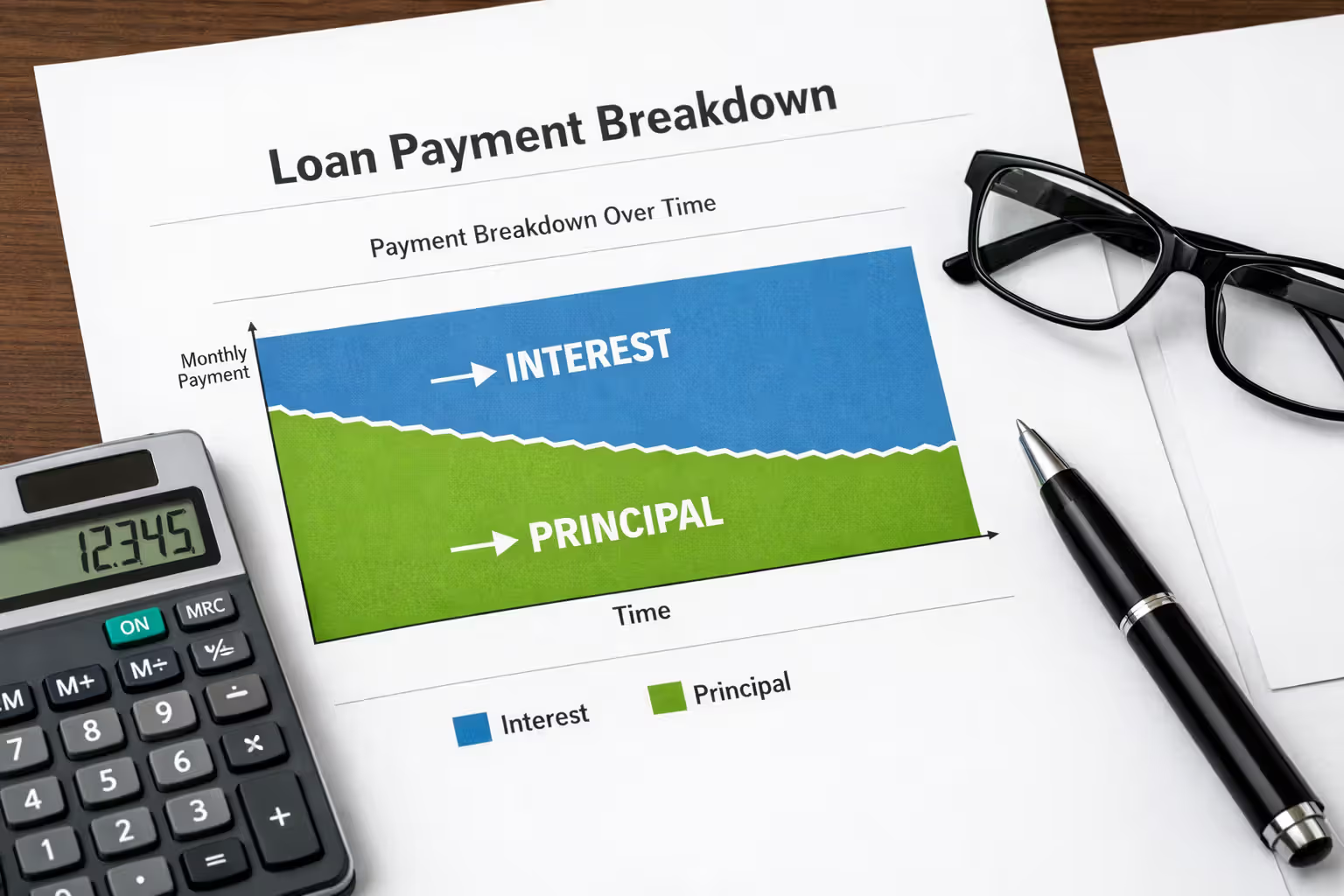
Check out how amortization works—it's sneaky. Early payments go mostly toward interest, with just a sliver reducing your actual debt. Later payments flip that ratio. On a $200,000 mortgage at 6.5%, your first payment might include $1,083 in interest but only $250 toward principal. Payment 300 reverses to maybe $400 interest and $900 principal. This structure explains why paying extra during year one saves way more than extra payments in year twenty.
Author: Hannah Kingsley;
Source: nayiyojna.com
Revolving Credit
Revolving products work completely differently. Instead of one lump sum, you get a spending limit you can use repeatedly. Credit cards are the obvious example. Home equity lines of credit (HELOCs) work similarly.
Charge $2,000, pay it back, and that $2,000 becomes available again without filling out new applications. Your minimum payment fluctuates based on the balance—usually 2-3% of whatever you owe. This flexibility becomes dangerous fast. Paying minimums only on a $8,000 credit card balance at 21% APR takes 23 years and costs over $12,000 in interest charges.
The reborrowing feature creates a psychological trap. You might tap your HELOC for $6,000 to replace the roof, then $4,000 for a vacation, then $3,000 for dental work. Suddenly you're $13,000 deep without making a single large purchase decision that felt significant.

Author: Hannah Kingsley;
Source: nayiyojna.com
Common Consumer Loan Examples
Real-world consumer loan examples make these categories clearer:
Auto loans turn monthly payments into transportation. Most run $10,000 to $60,000 depending on whether you're financing a used Civic or a new F-150. Terms stretch three to seven years. Since the vehicle serves as collateral, rates hover between 5% and 13% based on your credit and the vehicle's age. Here's an insider tip: dealers mark up rates 1-2 percentage points above what lenders actually approved, pocketing the difference. Get pre-approved through your credit union before shopping—that $25,000 loan at 6% instead of 8% saves you $1,600 over five years.
Personal loans offer the most flexibility—consolidate credit cards, remodel bathrooms, pay medical bills, or fund almost anything else. Borrow anywhere from $1,000 to $100,000 (though most lenders cap around $50,000). Repayment spans two to seven years. These unsecured products charge 6% to 36% depending almost entirely on creditworthiness. Someone with a 790 FICO might qualify at 6.5%, while a 620 score faces 27% from the same lender.
Student loans cover tuition, textbooks, housing, and related education costs. Federal loans offer fixed rates Congress sets annually (currently 5.5% to 8.05% for loans disbursed in 2024-2025 depending on undergraduate versus graduate status). Private student loans from banks fill gaps federal programs don't cover, but they'll check credit and typically demand cosigners for 18-year-olds with no credit history. Rates span 4% to 15% depending on credit profiles.
Mortgages make homeownership possible for families who can't drop $350,000 cash on a house. The property itself guarantees repayment. Conventional mortgages want 5-20% down and offer 15- or 30-year repayment. FHA loans accept just 3.5% down if your credit scores 580 or higher, though you'll pay mortgage insurance premiums. Rates currently run 6.5-7.5% for qualified borrowers, though they bounced between 3% and 8% over the past five years depending on Federal Reserve policies.
Credit cards represent America's most popular revolving credit—over 180 million people carry at least one. They offer convenience, fraud protection, and rewards points. But average interest rates hit 20-25%, making them expensive for carrying balances month-to-month. Watch out for promotional 0% periods that suddenly jump to 24.99% after twelve months.
| Loan Type | Typical Use | Secured/Unsecured | Average Term | Typical Interest Rate Range |
| Personal loan | Consolidating high-interest debt, home repairs, major purchases | Unsecured | 2–7 years | 6%–36% |
| Auto loan | Purchasing vehicles | Secured by the vehicle | 3–7 years | 5%–13% |
| Mortgage | Buying residential property | Secured by the home | 15–30 years | 6.5%–7.5% |
| Student loan | Education-related expenses | Federal: unsecured; Private: often needs cosigner | 10–25 years | 4%–15% |
| Credit card | Day-to-day purchases, short-term financing | Unsecured | Revolving | 20%–25% |
How Consumer Loans Are Repaid
Most installment loans work on monthly schedules, with payments due the same calendar date you received funding. Get your loan on March 15th? Expect payments every 15th afterward. Even one day late triggers $25-50 fees and potentially dings your credit report.
Loan terms range from several months to three decades. Short-term personal loans might demand full repayment within 12-36 months, creating hefty monthly bills but minimal total interest. Mortgages stretch across 15-30 years, shrinking monthly obligations while maximizing lifetime interest costs. Compare a $250,000 mortgage at 7%: the 30-year version costs $1,663 monthly with $348,772 in total interest paid. Choose 15 years instead, and you'll pay $2,247 monthly but only $154,393 in interest—a $194,379 difference for the same borrowed amount.
Interest comes as fixed or variable. Fixed rates stay put for the entire loan—your 8% stays 8% whether the economy booms or tanks. Variable rates fluctuate with market indexes like the prime rate. That HELOC at prime plus 1.5% costs you 10% when prime hits 8.5%, but drops to 6.5% when prime falls to 5%. Budgeting gets trickier, but initial rates often start lower than fixed alternatives.
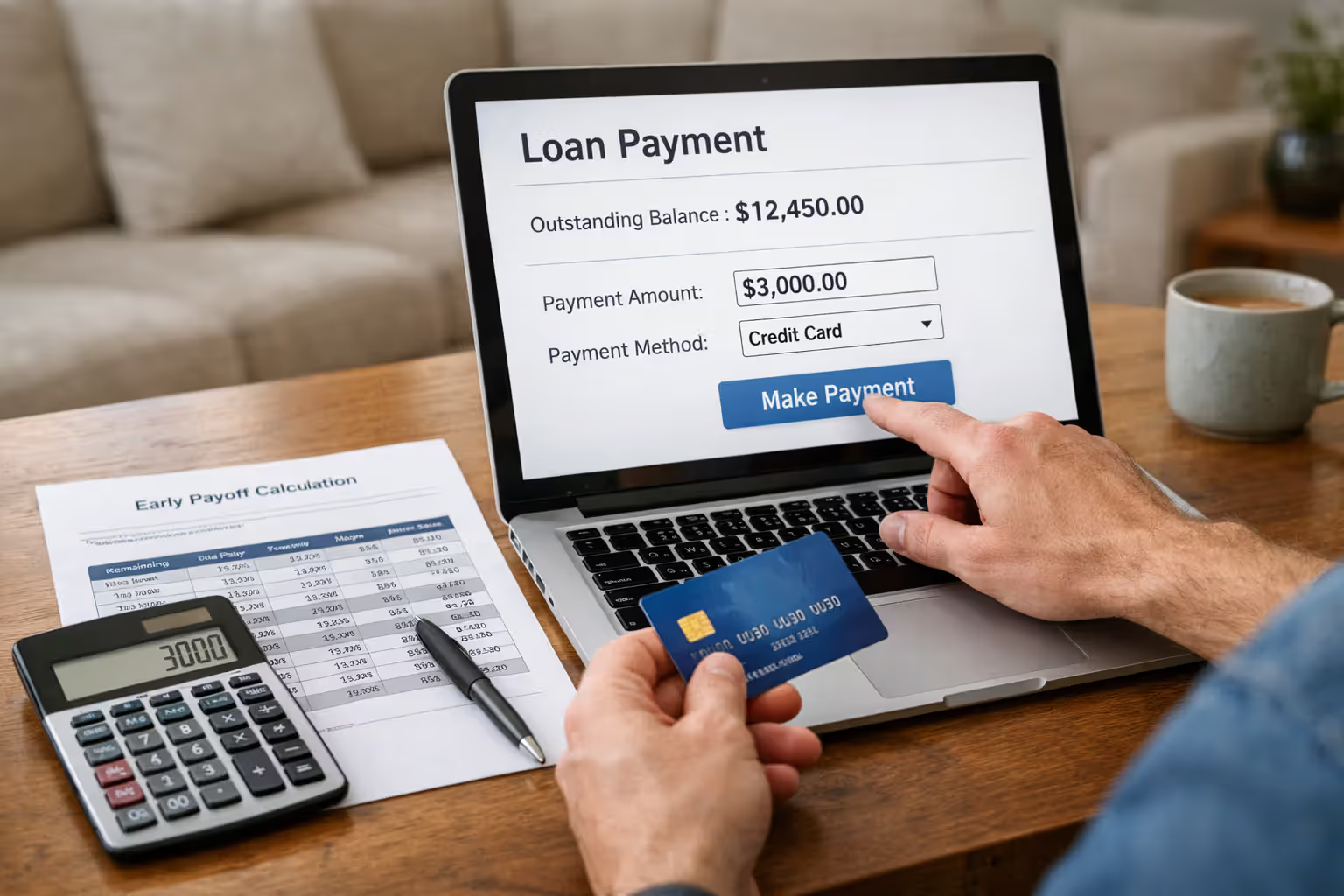
Early payoff deserves careful attention. Some lenders charge prepayment penalties—fees for eliminating the loan before its scheduled end. These penalties protect expected interest income. A mortgage with a 2% prepayment penalty on a $300,000 balance costs an extra $6,000 if you pay it off early to refinance or sell. Always check for these clauses before signing. Most personal loans skip prepayment penalties these days, but some auto loans and mortgages still include them.
Extra payments dramatically reduce total costs. Add $100 monthly to a $25,000 auto loan at 6.5% over five years, and you'll finish nine months early while saving $890 in interest. Bigger loans see bigger impacts. The trick is confirming extra money goes toward principal, not just prepaying next month's interest—some lenders require you to specify this in their payment system or via written instruction.
Author: Hannah Kingsley;
Source: nayiyojna.com
Missing payments creates escalating problems fast. The first missed payment brings a late fee and a friendly reminder call. Hit 30 days overdue, and most lenders report it to all three credit bureaus—expect your score to plummet 60-110 points instantly. Reach 60 days late, and collection calls intensify. At 90 days delinquent, many lenders charge off the debt entirely, devastating your credit for seven years and often selling the debt to aggressive collection agencies. Secured loans start repossession (autos) or foreclosure (homes) procedures around 90-120 days of non-payment, though state laws create variation.
When to Consider a Consumer Loan
Smart borrowing finances things that genuinely improve your situation: reliable transportation for commuting to work, education that boosts earning potential, consolidating $15,000 in credit card debt at 22% into a personal loan at 9%, or buying a home that builds equity while you live there.
Questionable borrowing funds stuff that loses value or doesn't move you forward financially: loans for vacations, weddings, luxury items you couldn't otherwise afford, or covering routine living expenses your income should handle. I watched my cousin take a $12,000 personal loan for a destination wedding in Cancun. Beautiful weekend, but he's still making $285 monthly payments four years later for a party nobody remembers clearly.
Try the "sleep test" before borrowing: if worrying about the payments will keep you awake at night, you're borrowing too much. Also ask yourself whether you can clearly explain how this loan improves your financial life. Vague answers suggest you don't actually need it.
Consider alternatives first. Emergency funds prevent crisis borrowing—stash $50 weekly for two years and you'll have $5,200 cash instead of a $5,200 loan costing $800 in interest. Saving up front eliminates interest entirely. Setting aside $400 monthly for 30 months gives you $12,000 cash versus borrowing $12,000 and paying $2,100 in interest over the same timeline. Medical providers, contractors, and service companies often offer payment plans directly, avoiding formal lending.
Watch for predatory lending red flags. Lenders who skip credit checks entirely, guarantee approval regardless of history, or pressure immediate decisions usually charge abusive rates or hide horrible terms. Payday lenders and title loan companies often operate this way, with effective annual rates exceeding 300%. Legitimate lenders clearly explain terms, give you time to review contracts, and follow state and federal regulations.
Here's what I tell clients: the smartest loan is one you avoid by saving first. But when borrowing makes financial sense—like financing a reliable car for work—focus on total cost, not just monthly payments. That's what separates people who use debt as a tool from those who become trapped by it for years
— Jennifer Martinez
Avoid any lender demanding upfront fees before releasing funds. Legitimate lenders deduct their fees from what they give you, or add fees to your loan balance—they never require payment before funding. Also run from balloon payment structures (tiny monthly payments followed by a massive final lump sum) unless you have a concrete plan for that ending payment.
Frequently Asked Questions About Consumer Loans
Consumer loans function as tools enabling major purchases most people couldn't afford through savings alone. The line between helpful financial leverage and destructive debt comes down to understanding what you're agreeing to before putting your signature on anything.
Smart borrowing starts with honest evaluation of genuine need versus simple want. It continues through comparing at least three different lenders. It concludes with a repayment plan fitting comfortably in your budget with room for emergencies. Monthly payments matter, sure, but total lifetime cost determines whether you're getting reasonable value or throwing away thousands on unnecessary interest.
Before applying anywhere, calculate total repayment including all interest and fees. Compare that figure to what you're financing. A $30,000 vehicle costing $37,500 after six years of payments might justify itself for reliable transportation to work. That same loan structure for a vacation or wardrobe refresh rarely makes financial sense.
Credit scores, income stability, and existing debt levels dictate what rates you'll qualify for and how much you can responsibly borrow. Improving these factors before applying—even just a few focused months—can save thousands in interest while expanding your options significantly.
Consumer lending boils down to this: borrow intentionally for things improving your life or financial position. Understand exactly what you'll pay in total. Commit to the repayment schedule before signing. Loans used wisely build credit, enable important purchases, and support financial goals. Loans used carelessly trap borrowers in years of payments for things they barely remember buying, damaging credit and limiting future opportunities.
Borrowing power is a privilege requiring responsibility. Armed with knowledge about how consumer loans operate, what types exist, and how repayment functions, you can make informed decisions supporting your financial wellbeing rather than undermining it.