

Driver behind the wheel in city traffic
Insurance Liability Coverage Guide

Content
When you're behind the wheel, one mistake can lead to thousands—or even millions—of dollars in damages. Insurance liability coverage exists to protect your financial future when you're legally responsible for injuring someone or damaging their property. Yet many drivers carry barely enough to meet state minimums, not realizing they're one serious accident away from personal bankruptcy.
This guide breaks down exactly what liability coverage protects, how it responds when you cause an accident, and why the limits you choose today could determine your financial security for decades.
What Liability Coverage Means in Auto Insurance
Liability coverage is the portion of your auto insurance policy that pays for injuries and property damage you cause to others when you're at fault in an accident. It's a promise from your insurer to cover your legal responsibility—up to your policy limits—when your driving harms someone else.
Unlike collision coverage, which repairs your own vehicle, or comprehensive coverage, which handles non-accident damage like theft or hail, liability coverage only pays for harm you inflict on others. If you rear-end another car at a stoplight, your liability coverage pays for the other driver's medical bills and vehicle repairs. Your own injuries and car damage would fall under your collision and medical payments coverage, if you carry them.
Every state except New Hampshire requires drivers to carry minimum liability coverage amounts. These mandates exist because society has decided that operating a vehicle creates risk, and drivers must demonstrate financial ability to compensate victims. Without liability insurance, an at-fault driver with limited assets might leave injured parties with unpaid medical bills and no recourse.
The coverage operates on a third-party basis. You're the first party, your insurer is the second party, and the people you injure or whose property you damage are third parties. Your liability policy creates a legal obligation for your insurer to defend you against covered claims and pay settlements or judgments up to your policy limits.

Author: Brandon Ellery;
Source: nayiyojna.com
How Liability Coverage Works When You Cause an Accident
When you cause an accident, your liability coverage activates through a specific claims process. The injured party or property owner files a claim either directly with your insurance company (a third-party claim) or through their own insurer, which then seeks reimbursement from yours (subrogation).
Your insurance company investigates the accident to determine fault and assess damages. They review police reports, interview witnesses, examine vehicle damage, and evaluate medical records. If they accept liability on your behalf, they'll negotiate with the claimant or their attorney to reach a settlement.
Here's a concrete scenario: You're driving through an intersection when you misjudge the timing and strike a sedan crossing on a green light. The other driver suffers a broken collarbone and concussion. Their passenger has whiplash. Both vehicles sustain significant damage.
Within days, your insurer assigns a claims adjuster who contacts you for your statement. The adjuster determines you violated the right-of-way, making you liable. Over the following weeks, the injured parties submit medical bills, and repair shops estimate vehicle damage. Your insurer evaluates these expenses and the potential for future medical costs and lost wages.

Author: Brandon Ellery;
Source: nayiyojna.com
If the total damages amount to $85,000 and you carry $100,000 in bodily injury liability per accident, your insurer handles the entire claim. They pay the medical providers, compensate for lost wages, cover pain and suffering within reasonable limits, and repair or replace the damaged vehicle. You pay nothing out of pocket except your deductible—which doesn't apply to liability coverage.
Your insurer also provides legal defense if the injured parties sue you. This defense coverage is separate from your policy limits and can be worth tens of thousands in attorney fees alone. If the case goes to trial and a jury awards damages within your policy limits, your insurer pays the judgment.
Bodily Injury Liability Explained
Bodily injury liability covers the physical harm you cause to other people in an accident where you're at fault. This includes drivers, passengers, pedestrians, and cyclists—anyone who suffers physical injury due to your negligent driving.
The coverage pays for several categories of expenses. Medical bills form the most straightforward category: emergency room treatment, hospital stays, surgery, prescription medications, physical therapy, and follow-up appointments. If the injured person requires ongoing care, such as multiple surgeries or long-term rehabilitation, bodily injury liability continues paying these expenses up to your policy limits.
Lost wages represent another major component. When injuries prevent someone from working, your liability coverage compensates them for income they would have earned during recovery. For a construction worker who misses three months of work after you cause an accident that breaks their leg, your coverage would reimburse their typical earnings during that period.
Pain and suffering damages account for the non-economic harm caused by injuries. These compensate victims for physical pain, emotional distress, loss of enjoyment of life, and permanent disfigurement or disability. A young professional who develops chronic back pain and can no longer play recreational sports might receive pain and suffering compensation beyond their direct medical costs.
In severe cases involving permanent disability or death, bodily injury liability can pay hundreds of thousands or millions of dollars. A 35-year-old accountant paralyzed in an accident you cause might face lifetime care costs exceeding $2 million. If your bodily injury limit is only $50,000, you'd be personally liable for the remaining $1.95 million.
Bodily injury liability also covers legal defense costs when injured parties sue you. Your insurer assigns attorneys, pays court costs, and handles settlement negotiations. This defense obligation exists even for frivolous lawsuits, and the costs don't reduce your policy limits.
Property Damage Liability Explained
Property damage liability covers physical damage you cause to other people's belongings in an accident. While vehicle damage represents the most common claim, this coverage extends far beyond cars.
Author: Brandon Ellery;
Source: nayiyojna.com
The primary use is repairing or replacing vehicles you damage. If you sideswipe a parked Mercedes and cause $12,000 in body work, your property damage liability pays the repair bill. If you total a vehicle worth $25,000, your coverage pays that amount, minus the salvage value the owner receives from selling the wreckage.
Property damage liability also covers structures you damage. Back into a storefront? Your coverage pays to repair the building. Lose control and crash through a homeowner's fence, destroying their landscaping? Your property damage liability handles the fence replacement and new shrubs. One driver who skidded on ice and demolished a rural homeowner's detached garage faced a $45,000 claim—all covered by property damage liability.
Personal property inside damaged vehicles falls under this coverage too. If your accident destroys a laptop, golf clubs, or child safety seat in another driver's car, your property damage liability reimburses them for these items at current value.
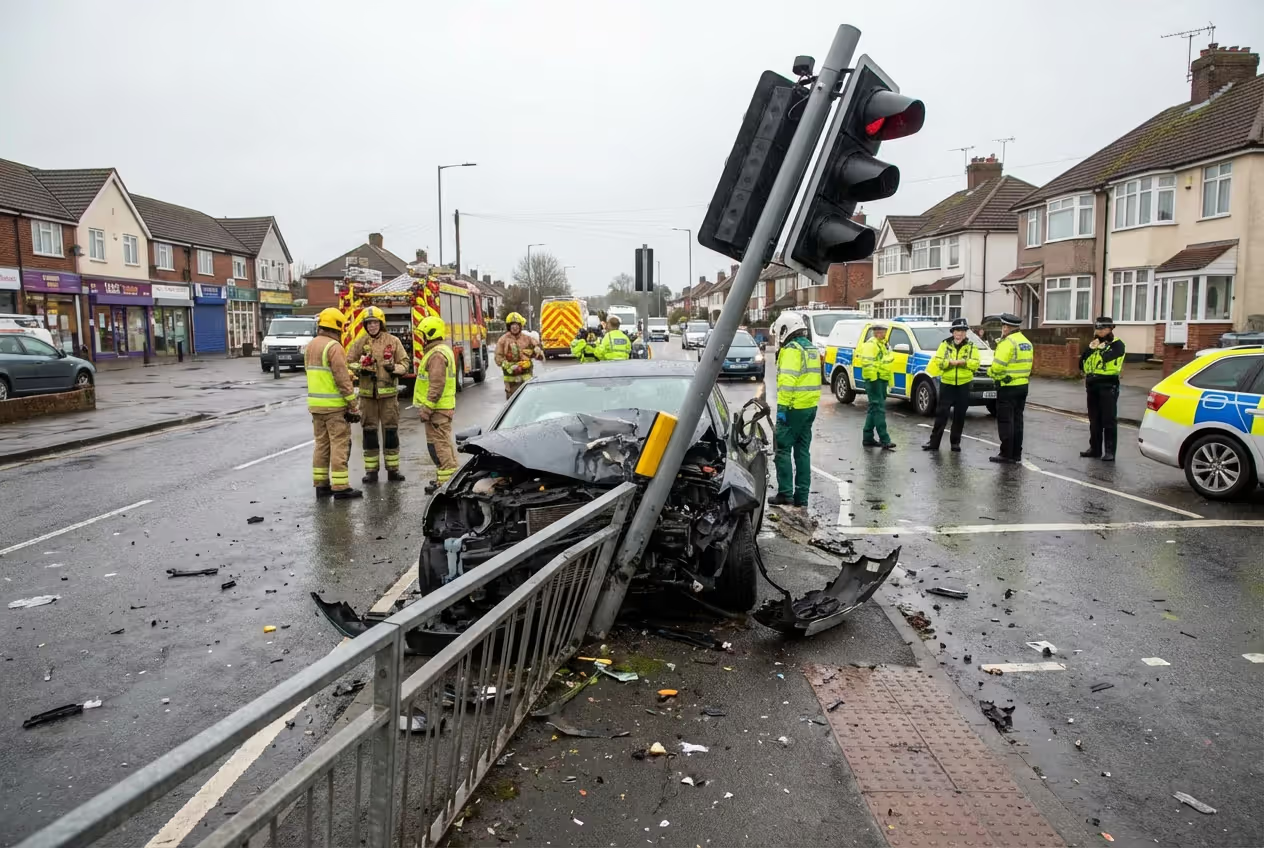
Less obvious scenarios include damage to public property. Strike a traffic signal, guardrail, or utility pole, and the government entity or utility company will bill your insurance for repairs. These claims can be surprisingly expensive—replacing a modern traffic signal system can cost $30,000 or more.
Your property damage liability also pays for loss of use when you damage someone's vehicle. If repairs take three weeks, your coverage reimburses the owner for rental car costs during that period. For someone who drives a luxury vehicle, this could add $1,500 or more to your claim.
Understanding Liability Limits in Insurance
Liability limits define the maximum your insurer will pay for a single accident. These limits appear in your policy declarations and determine your financial protection when you're at fault.
Most states use split limits, which set separate maximums for bodily injury per person, bodily injury per accident, and property damage. You'll see these expressed as three numbers, such as 25/50/25. This means $25,000 maximum per injured person, $50,000 maximum for all bodily injuries in one accident, and $25,000 maximum for property damage per accident.
Here's how split limits work in practice: You cause an accident injuring three people with medical expenses of $30,000, $40,000, and $15,000 respectively. With 25/50/25 coverage, your insurer pays $25,000 for the first person (the per-person limit), $25,000 for the second person (also capped at the per-person limit), and $15,000 for the third person. That's $65,000 in total injuries, but your per-accident limit of $50,000 means your insurer pays only $50,000. You're personally responsible for the remaining $15,000.
Combined single limit (CSL) policies work differently. Instead of separate limits for bodily injury and property damage, CSL provides one total limit per accident. A $100,000 CSL policy pays up to $100,000 for any combination of bodily injury and property damage in a single accident. This offers more flexibility—if injuries are severe but property damage is minor, the entire limit can apply to medical costs.
State minimum requirements typically range from 15/30/5 to 25/50/25. Florida requires 10/20/10 for personal injury protection states. California mandates 15/30/5. These minimums were often set decades ago and haven't kept pace with medical costs or vehicle values. A moderate injury requiring surgery can easily exceed $50,000, and many new vehicles cost more than $25,000.

Author: Brandon Ellery;
Source: nayiyojna.com
What Happens If You Exceed Your Liability Limits
When damages exceed your liability limits, you become personally liable for the difference. Your insurance company pays up to your policy maximum, then the injured parties can pursue you directly for remaining amounts through lawsuits and judgments.
Exceeding your limits triggers serious financial consequences. Injured parties can sue you for the uncovered damages. If they win a judgment, they can garnish your wages, place liens on your home, seize bank accounts, and claim other assets to satisfy the debt. In many states, these judgments remain enforceable for 10 to 20 years and accrue interest.
Bankruptcy might seem like an escape, but personal injury judgments from driving negligence are often non-dischargeable, meaning they survive bankruptcy proceedings. You could emerge from bankruptcy still owing hundreds of thousands to accident victims.
Some states allow injured parties to pursue your future earnings and assets. A judgment creditor might wait years until you inherit money, receive a bonus, or accumulate home equity, then execute the judgment against those assets.
Choosing the Right Liability Limit for Your Situation
Selecting appropriate liability limits requires assessing your risk exposure and asset protection needs. The right amount balances premium costs against potential financial devastation.
Consider your net worth as a starting point. If you have $300,000 in home equity, retirement accounts, and other assets, carrying only $50,000 in liability coverage leaves you vulnerable. A general rule suggests carrying liability limits at least equal to your net worth, plus expected earnings over the next five years.
Your profession and income matter too. High earners face greater risk because they have more to lose in wage garnishment and represent attractive lawsuit targets. A surgeon earning $400,000 annually needs substantially more coverage than someone earning $45,000.
Driving patterns influence your risk. Daily highway commuting in heavy traffic creates more exposure than occasional local trips. Households with teenage drivers face elevated accident risk and should consider higher limits.
Many insurance professionals recommend 100/300/100 as a reasonable minimum for most drivers, with 250/500/100 or higher for those with significant assets. The premium difference between state minimums and substantially higher limits is often surprisingly small—sometimes $200 to $400 annually for double or triple the protection.
Umbrella liability insurance provides another layer of protection. These policies typically offer $1 million to $5 million in additional liability coverage across your auto, home, and other policies. Umbrella coverage is remarkably affordable, often $200 to $400 annually for $1 million in protection, because it only pays after your underlying policies are exhausted.

Author: Brandon Ellery;
Source: nayiyojna.com
Common Mistakes People Make With Liability Coverage
Many drivers sabotage their financial protection through preventable mistakes with liability coverage. Understanding these pitfalls helps you avoid expensive consequences.
Carrying only state minimum limits ranks as the most dangerous mistake. Those 25/50/25 minimums might satisfy legal requirements, but they're woefully inadequate for modern accidents. A single trip to the emergency room can cost $15,000. Moderate injuries requiring surgery easily reach $75,000. Serious injuries run into hundreds of thousands. When you're at fault for a significant accident with minimum coverage, you're essentially self-insuring the excess—gambling your financial future on avoiding serious accidents.
Assuming liability coverage protects you in all scenarios creates dangerous gaps. Liability coverage doesn't pay for your own injuries or vehicle damage—that requires collision, comprehensive, and medical payments coverage. It also excludes intentional acts, racing, using your vehicle for commercial purposes without proper coverage, and accidents while driving under the influence in some policies.
Failing to understand policy exclusions leads to nasty surprises. Most personal auto policies exclude coverage when you're driving for ride-sharing services like Uber or Lyft without proper commercial coverage. They also typically exclude coverage for vehicles you don't own if you use them regularly. Borrowing your friend's car occasionally is usually covered, but driving your roommate's car daily might not be.
Neglecting to review coverage during major life changes leaves you underinsured. When you buy a home, get married, have children, or receive a significant promotion, your liability needs change. That $50,000 coverage you bought at age 25 with no assets makes no sense at 40 with a house, retirement accounts, and a family depending on your income.
Dropping liability coverage to save money ranks among the worst financial decisions. Unlike collision or comprehensive coverage on an older vehicle, which you might reasonably drop, liability coverage protects your entire financial life. The $30 monthly savings isn't worth the risk of a $500,000 judgment.
I've seen too many families lose everything because they thought $25,000 in coverage was enough.One serious accident can generate $500,000 or more in medical bills and lost wages. When your insurance pays its $25,000 limit, you're personally liable for the rest. I strongly encourage everyone to carry at least $250,000 per person in bodily injury liability, and seriously consider umbrella coverage if you have any significant assets or income. The small premium increase is nothing compared to losing your home or having your wages garnished for the next 20 years
— Jennifer Martinez
Frequently Asked Questions About Liability Coverage
Insurance liability coverage represents your financial firewall against the devastating costs of at-fault accidents. The coverage you choose today determines whether a single mistake on the road becomes a manageable insurance claim or a financial catastrophe that haunts you for decades.
State minimum requirements offer bare-bones protection designed to ensure some compensation for victims, not to protect your assets. Modern medical costs, vehicle values, and injury awards have far outpaced these decades-old minimums. Adequate coverage—100/300/100 or higher, supplemented with umbrella insurance—costs surprisingly little compared to the protection it provides.
Review your liability limits annually, especially after major life changes that increase your net worth or income. Speak with your insurance agent about your specific situation, assets, and risk factors. The conversation takes 15 minutes and could save you from financial ruin. When you're behind the wheel, you're operating a multi-ton machine capable of causing immense harm. Your liability coverage is your promise that if the worst happens, you can make your victims whole without destroying your own financial life in the process.