

Buyer signing car loan documents at dealership desk
What Is a Loan Maturity Date and How Does It Work

Content
You just signed papers for a $30,000 Honda Accord. The finance manager points to your $487 monthly payment, you nod approvingly, and everything gets initialed in about fifteen minutes. Buried on page three sits a date you probably glossed over: "Final Payment Due: March 15, 2030."
Fast forward six years. That seemingly random date now determines whether you walk away clean or face serious financial consequences. Your lender won't accept excuses, partial payments, or requests to "figure something out later." Everything you borrowed—every dollar of principal plus accumulated interest—needs to be settled before business hours end on that specific day.
This single deadline shapes your entire financial relationship with the lender. Total interest charges? Controlled by this date. Want to sell your car or refinance your house? You'll need to work around it. Ignore it completely, and you might face repossession letters, a credit score that drops 150 points overnight, or a balloon payment that wipes out your emergency fund in one afternoon.
Here's the pattern I've noticed: Borrowers who actively track this date end up refinancing when it actually makes sense, they never get blindsided by massive final payments, and they're planning their next financial move while everyone else is frantically calling their lender asking for extensions.
Loan Maturity Date Defined

Author: Brandon Ellery;
Source: nayiyojna.com
What is a loan maturity date? It's the contractual expiration of your borrowing arrangement. By this calendar date, your lender requires complete repayment—final principal balance plus any remaining interest.
The loan maturity meaning extends beyond simple deadlines. When both parties signed your closing paperwork, you agreed this specific date terminates the lender's legal right to collect from you (assuming you've paid everything). Your contract built this endpoint using three inputs: how much you borrowed, what interest rate applies, and the total count of scheduled payments.
Maturity timelines shift dramatically depending on what you're financing:
- Mortgages: Typical residential loans stretch 15 or 30 years from the first payment. Close on your house April 1, 2012 using conventional 15-year financing? The loan reaches maturity April 1, 2027—exactly 180 monthly payments later
- Auto loans: Current market averages range from 3 to 7 years. The sweet spot right now seems to be 60 or 72 months, though borrowers with challenged credit sometimes end up in 84-month agreements with steeper rates
- Personal loans: Usually 2 to 5 years, though certain online lenders now offer 7-year terms when you borrow above $25,000
- Student loans: Federal programs span anywhere from 10 to 25 years based on which repayment option you choose, while private lenders generally cap terms at 20 years
- Business term loans: Highly variable—equipment financing might mature within 3 years, commercial real estate could stretch 25 years
Here's how lenders actually calculate it: They start from your first scheduled payment, then count forward by your total number of payments. Finance that car with your first payment scheduled May 1, 2026 under 60-month terms? Maturity lands on April 1, 2031. Payment number 60 closes everything out.

Author: Brandon Ellery;
Source: nayiyojna.com
How Loan Terms and Maturity Dates Differ
People mix these up constantly—I've even heard loan officers use them interchangeably during closings. Understanding loan term vs maturity date becomes critical when you're comparing offers from three different lenders or deciding whether refinancing makes financial sense.
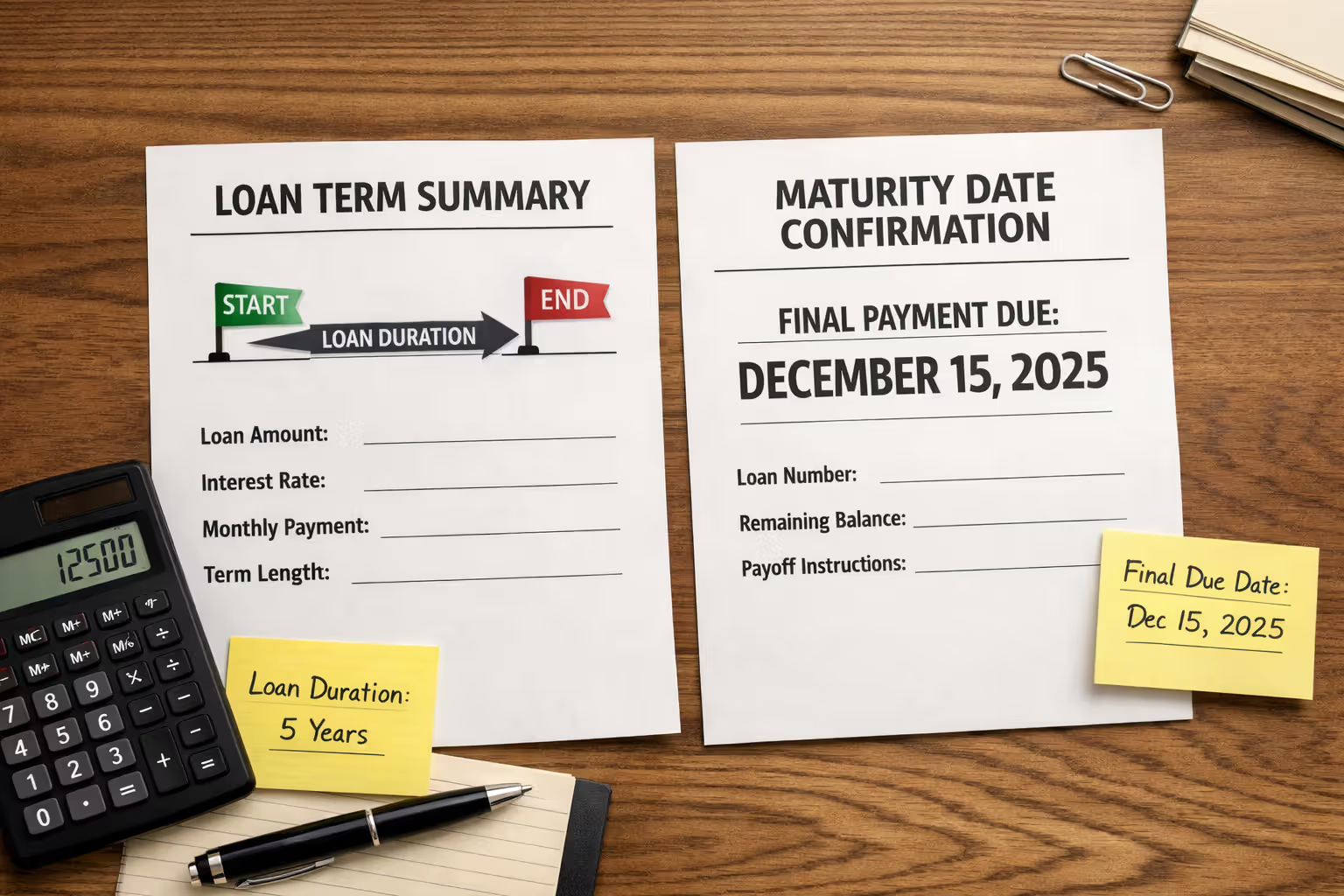
Your loan term represents duration—a timespan measured in months or years. Someone tells you "5 years" or "360 months." Meanwhile, your maturity date pins that duration to an actual calendar day—the precise moment when your obligations end.
Think about it differently: The term tells you how long the trip takes. The maturity date tells you exactly when you'll arrive.
This distinction creates practical consequences that cost real money:
| Loan Type | How the Term Is Defined | What the Maturity Date Represents | Typical Term Length | Sample Maturity | Why This Distinction Costs You Money |
| Mortgage | Total years of house payments | Exact day you'll own property free and clear | 30 years (360 payments) | January 15, 2056 | Quoted rates connect directly to term length; stretching maturity by even 2 years can add $15,000+ in interest |
| Auto Loan | How many months you'll make car payments | Precise day the lender must release your vehicle title | 72 payments (6 years) | June 30, 2032 | Monthly payment size flows from term choice; you can't sell or trade the car without lender permission until this date arrives |
| Personal Loan | Contract length measured in months | Calendar day your account permanently closes | 48 payments (4 years) | March 1, 2030 | Shorter terms mean higher monthly bills but dramatically lower rates; interest accumulation stops completely at maturity |
| Student Loan | Selected repayment timeframe | Day your balance theoretically hits zero | 10 years (standard federal) | July 1, 2036 | Changing repayment plans can push maturity out by 10-15 years, potentially doubling your total cost |
| Business Term Loan | Predetermined repayment window | Absolute final deadline for every dollar owed | 7 years | December 31, 2033 | Term choice impacts monthly cash flow planning; any collateral stays encumbered until maturity passes |
Here's what catches people off guard: Terms can change midstream through refinancing or modifications. Every refinance essentially creates a brand-new loan with fresh terms and a different maturity date. Your original maturity date stays frozen in time unless you formally modify the contract.
What Happens When Your Loan Reaches Maturity
Understanding what actually happens on your final payment date explained varies significantly based on how your loan was structured. Knowing what's coming prevents expensive last-minute scrambling.
Author: Brandon Ellery;
Source: nayiyojna.com
Fully amortizing loans—where each payment chips away at both principal and interest—typically end without drama. Your last payment in February 2031 looks identical to the one you made in January 2031. The account closes, you get confirmation paperwork, and you're finished.
Balloon payment structures tell a completely different story. These loans charge smaller regular payments with a massive lump sum waiting at the finish line. Commercial real estate financing uses balloons all the time—maybe you're paying $1,500 monthly for 10 years on a $200,000 loan, then suddenly owe $150,000 as your final balloon. Default on that balloon payment and your flawless 10-year history becomes meaningless. You've breached the contract immediately.
After your final payment clears, several administrative wheels start turning:
- The lender updates your account to "paid as agreed" status and closes it in their system
- Secured debts trigger a lien release process on whatever collateral you pledged
- All three credit bureaus receive notification showing zero balance and closed account status
- Written confirmation arrives—satisfaction of mortgage documents for real estate, clean titles for vehicles
What happens at loan maturity splits into two very different paths based on whether you pledged collateral.
Secured vs. Unsecured Loan Maturity
Secured loans backed by assets require extra documentation at maturity. Finish paying your mortgage and the lender must file either a satisfaction of mortgage or reconveyance deed with your county recorder. This formally removes their claim from your property's title chain. Processing timeframes vary wildly—some states mandate filing within 30 days, others permit 90 days, and a few don't specify deadlines at all.

Author: Brandon Ellery;
Source: nayiyojna.com
Auto financing follows similar patterns. The lender holds your title certificate throughout the loan. Make that final payment and they'll mail the title listing you as sole owner. Most states process these transfers within 2 to 4 weeks. Some states skip direct mailing and require lenders to submit titles straight to the DMV, which then issues fresh titles to borrowers.
Unsecured debts like personal loans simply close. No collateral means no release paperwork required. The account zeros out and vanishes from your active loan list. Still, request written confirmation showing the zero balance and closed status—you'll want that documentation if erroneous charges appear months later.
Common mistake I see constantly: People assume lien releases happen automatically and correctly. They frequently don't. Lenders sometimes forget to file the satisfaction paperwork, or they file it in the wrong county, or they misspell your name. Some states actually place the recording burden on borrowers even though lenders prepare the documents. Verify completion yourself, or you'll discover the problem five years later when you're trying to sell and the title search reveals an ancient lien still attached.
Early Payoff Before Maturity
Want to eliminate debt before the maturity date arrives? You generally can, though whether you should depends on penalty clauses hidden in your contract fine print.
Prepayment penalties compensate lenders for the future interest they'll lose when you pay off early. Federal law banned these penalties on most residential mortgages after the three-year mark, though they remain perfectly legal on other products. Personal loans, auto financing, and business debt frequently include them—typically calculated as 1% to 5% of your remaining balance, or sometimes as three to six months' worth of interest charges.
Before dumping extra cash toward your loan, locate your original agreement and search for any prepayment language. No penalty clause listed? Accelerate those payments aggressively and pocket the interest savings. Someone owing $15,000 on an auto loan at 6% over 60 months will pay roughly $2,400 in total interest. Pay it off at month 36 instead? You've just saved approximately $800.
Even when penalties exist, early payoff frequently makes financial sense. Calculate the penalty fee, then compare it against your total interest savings. Go with whichever option costs you less overall.
Why Your Loan Maturity Date Matters

Author: Brandon Ellery;
Source: nayiyojna.com
Ignoring why maturity dates matter quietly drains thousands from your bank account while creating completely avoidable planning disasters. This date influences several crucial financial areas.
Credit impact: Maturity dates control how long loans actively contribute to your credit mix. While your account stays open with regular payments, it strengthens your score by demonstrating diverse credit usage and consistent payment behavior. After maturity when the account closes, it shifts to "closed account" status on your report. It remains visible for up to 10 years—still helping your payment history—but no longer counting as active credit. Expect a minor temporary score drop (typically 5-10 points) when any loan reaches maturity and closes.
Payment planning: Loans with balloon payments demand serious advance preparation. Owing $50,000 on your maturity date means having that cash ready or securing refinancing beforehand. Start planning 6 to 12 months early by either accumulating savings aggressively or shopping refi options with multiple lenders. Scrambling during the final 30 days forces terrible decisions and expensive emergency refinancing with whatever lender will take you.
Refinancing decisions: Maturity dates determine whether refinancing actually saves money. Interest rates dropped 2% and you've got 15 years remaining on your mortgage? Refinancing could save $30,000+ in interest over time. But 18 months from maturity? Refinancing costs—appraisal fees, title work, origination charges—probably exceed any interest savings across such a short remaining window.
Real scenario I saw recently: A homeowner with a 30-year mortgage from 2011 at 5.5% refinanced in 2020 when rates bottomed out at 3%, shifting maturity from 2041 to 2050 but slashing monthly payments by $300. By 2026, rates had bounced around considerably and they needed to evaluate whether another refinance made mathematical sense given their current balance and remaining timeline.
Tax considerations: Business loans and investment property mortgages create tax situations directly tied to maturity dates. Interest payments remain tax-deductible throughout the loan term, so knowing your maturity helps forecast future tax positions across multiple years. Settle a loan for less than the full amount owed before maturity arrives? That forgiven amount might count as taxable income—an ugly surprise for borrowers negotiating short sales or debt settlements without considering tax consequences.
I review loan documents with clients almost every week, and I'd estimate 80% have never looked at their maturity date since the closing appointment. Then they call me panicked about a $40,000 balloon payment due in 90 days, or confused why refinancing with only two years remaining doesn't make financial sense. You need to know this date from day one and review it annually when you're doing your financial planning. It's not some abstract future deadline—it's a hard constraint shaping every decision you make about that debt
— Marcus Chen
Common Loan Maturity Scenarios in the US
Real-world examples demonstrate how maturity dates actually function across different borrowing situations Americans encounter.
Mortgages: Sarah closed on her house in March 2016, borrowing $250,000 at 4.25% with standard 30-year financing. Maturity date: March 2046. Ten years in (2026), she's paid the balance down to roughly $195,000 with 20 years remaining. She's exploring a refinance to 15-year terms, which would shift her maturity date forward to 2041—five years earlier than her current trajectory. The trade-off? Monthly payments jump by about $400, but she'll save over $80,000 in total interest by cutting five years off the back end.
Auto loans: James financed a $32,000 truck in January 2024 with a 72-month note at 5.9%, establishing January 2030 as his maturity date. By mid-2026, he still owes around $20,000 but the truck's current value sits at $17,000. He's underwater—owing more than the vehicle's worth. He can't refinance profitably because no lender will loan more than current market value. His options: keep making payments until values and balance align better, or trade it in and roll the negative equity into a new (and worse) loan.
Personal loans: Maria consolidated $18,000 in credit card debt using a 5-year personal loan at 9.5% in July 2024. Maturity date: July 2029. She now makes fixed $377 monthly payments. Unlike her old revolving credit cards that had no defined endpoint, this maturity date creates a concrete finish line. She knows exactly when she'll be completely debt-free, which helps her plan other financial goals and major purchases around that specific date.
Student loans: Kevin graduated in 2016 owing $45,000 in federal loans under the standard 10-year plan, originally setting maturity for 2026. But in 2020, he switched to an income-driven repayment plan, immediately pushing maturity out to 2040—20 years from the switch date. Monthly payments dropped from $475 to $200, dramatically improving cash flow but increasing total interest by tens of thousands. Any balance remaining at the 2040 maturity gets forgiven, though he'll owe ordinary income tax on that forgiven amount.
Business loans: A restaurant owner secured a $100,000 SBA 7(a) loan in 2021 with a 10-year term, setting maturity for 2031. Monthly payments run about $1,200 covering principal plus 6.5% interest. The complication? This loan includes financial covenants requiring minimum debt service coverage ratios. Violate those covenants and the lender can accelerate maturity, demanding immediate full repayment. Unlike consumer loans where you just make payments on autopilot, business borrowers must actively monitor both maturity dates and ongoing covenant compliance to avoid catastrophic acceleration clauses.
How to Find Your Loan Maturity Date
Your maturity date appears in multiple places, though tracking it down sometimes requires a bit of detective work.
Loan documents: Your promissory note or loan contract from closing day explicitly states maturity. Search for sections labeled "final payment date," "maturity date," "loan term," or "termination date." Mortgage borrowers should check page 1 of their closing disclosure under the "Loan Terms" box—it's printed right there in the standard format. Auto loan buyers will find it in the retail installment sales contract signed at the dealership, usually on page 2 or 3.
Amortization schedules: This payment-by-payment breakdown shows every single payment across your entire loan lifecycle. The very last line displays your final payment date—your maturity. Lenders often provide these at closing, though you can generate one yourself using free online calculators if you know your current loan amount, interest rate, and term length.
Online account portals: Log into your lender's website and navigate to loan details or account summary sections. Most display maturity prominently, though some mislabel it as "payoff date" or "final payment date" instead. Banks, credit unions, and loan servicers all organize their portals differently, so you might need to click through several menus.
Monthly statements: Your payment statements typically include maturity somewhere, often in small print at the bottom or inside an account information box. Not all lenders include it on every single statement, though checking your last few statements usually turns it up.
Direct lender contact: Can't locate it anywhere after searching? Call customer service with your account number ready. They'll tell you immediately and can email written confirmation if you need documentation for refinancing applications or tax purposes.
Quick quirk worth noting: Some lenders define "maturity date" as when your final payment comes due, while others define it as the day after your final payment processes and the loan officially closes in their system. The difference rarely matters for everyday purposes, but if you need precision for refinancing timing or tax year reporting, clarify which definition your specific lender uses.
Frequently Asked Questions About Loan Maturity Dates
That single date printed in your loan documents—your maturity date—controls far more than just when your last payment comes due. It determines your total interest cost, influences your refinancing opportunities, impacts your credit planning timeline, and in certain cases, decides whether you'll face a manageable final payment or a budget-destroying balloon amount that drains your savings.
The borrowers who consistently thrive treat this date as an active planning tool rather than passive information. They review it annually when interest rates shift or their income changes significantly. They start preparing a full year ahead when balloon payments loom on the horizon. They understand that refinancing three years before maturity usually makes mathematical sense, while refinancing six months before maturity typically wastes money on unnecessary fees.
Keep your loan documents accessible somewhere you'll actually remember—a fireproof safe, a clearly labeled file folder, or a secure digital folder with proper backups. When your secured loans mature, personally verify that your lender files the proper lien releases with your county or state offices. Don't assume it happens automatically just because you made your final payment. And if you're genuinely confused about your specific maturity date or final payment requirements, call your lender directly. A five-minute phone call beats a costly mistake every single time.
The path to complete debt freedom runs straight through your maturity date. Know exactly where it is, plan deliberately around it, and use it strategically instead of letting it surprise you when it finally arrives.