

First-time homebuyer reviewing FHA mortgage paperwork with a lender
What Is a FHA Loan and How Does It Work

Content
You've saved $12,000 for a house down payment. Your credit score hovers around 620. Traditional banks keep turning you away or demanding 10% down on that $280,000 starter home you want. Sound familiar? This is where FHA financing enters the picture—a mortgage option that's been rescuing buyers from this exact predicament since the 1930s. More than 8 million Americans currently hold FHA mortgages, and there's a good chance this loan type could work for your situation too.
FHA Loan Meaning and Purpose
Think of an FHA mortgage as a regular home loan with federal backing. The Federal Housing Administration—part of HUD—doesn't cut you a check or hand you mortgage documents. Private lenders (your neighborhood banks, online mortgage companies, credit unions) actually fund these loans using their own money. What makes it "FHA" is the insurance wrapper protecting the lender if you default.
This setup matters more than you'd think. Your loan officer works at Wells Fargo or Rocket Mortgage or a local credit union—not at a government desk. You'll compare rates, submit your W-2s, and sign closing papers with a traditional lender who happens to offer FHA-insured products.

Author: Matthew Redford;
Source: nayiyojna.com
Back in 1934, America's housing market had flatlined. Banks demanded half the home's value upfront and expected full repayment within 3-5 years—terms that locked out virtually everyone. The newly created FHA changed the game by guaranteeing mortgages, which convinced nervous lenders to start writing home loans again with reasonable terms. Suddenly, 20-year mortgages with affordable down payments became possible.
Fast forward to 2026, and the mission hasn't changed much. This program still exists for people facing roadblocks: maybe you're buying your first place, or rebuilding credit after a divorce, or you simply haven't accumulated the cash pile needed for conventional financing.
How FHA Loans Work
Shopping for FHA financing looks identical to any mortgage hunt. You'll compare lenders, get pre-approved, lock rates, and eventually close on your home. The lender evaluates your application using FHA-published guidelines that generally accept higher risk than conventional standards allow.
Your lender funds everything from their own pocket (or wholesale credit lines). The FHA sits quietly in the background until something goes wrong. If you stop paying, the insurance you've been paying protects the lender's investment. The FHA processes their claim and makes them whole. This safety net is precisely why lenders will approve a 590 credit score with 3.5% down—risk they'd never touch otherwise.
FHA Mortgage Insurance Requirements
Every FHA borrower pays insurance twice, and you can't negotiate your way out of either charge.
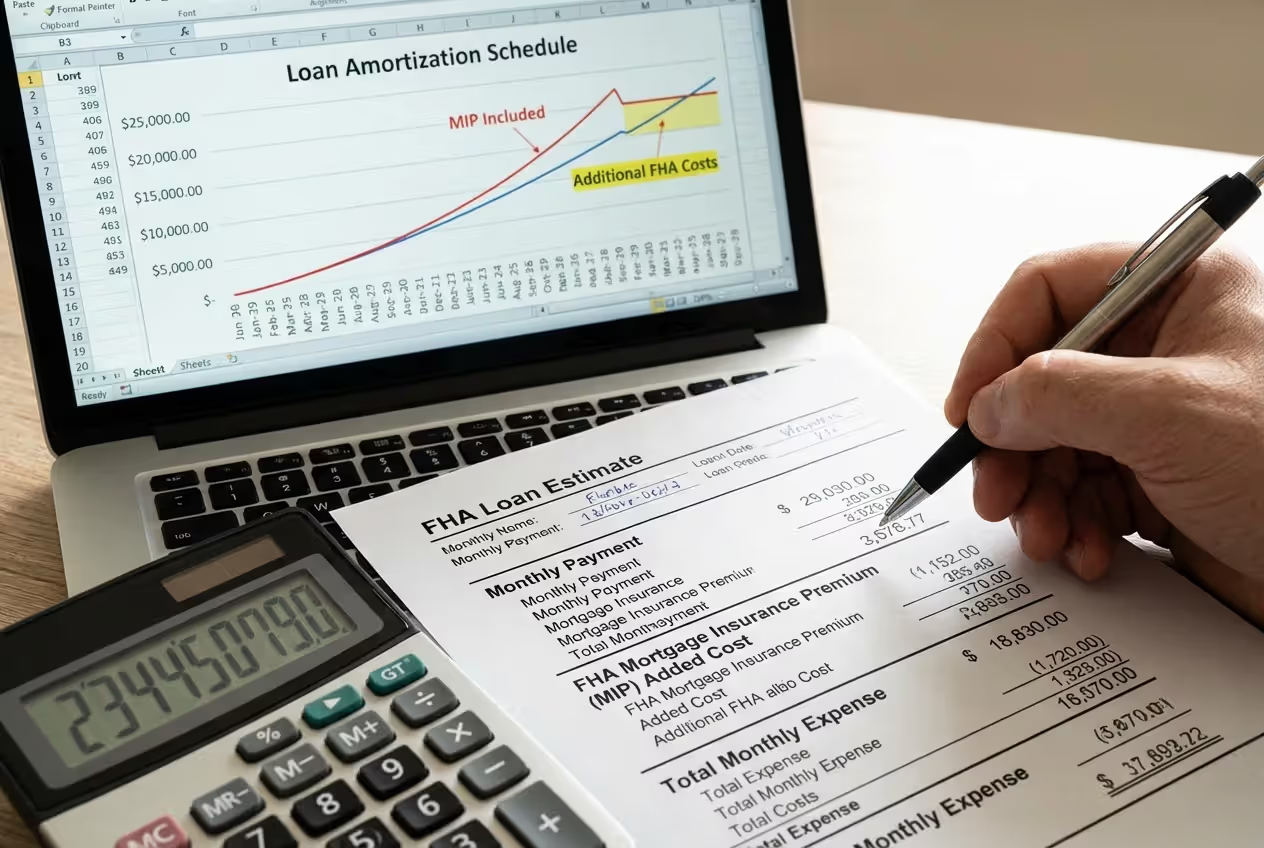
First comes the upfront chunk: 1.75% calculated against your base loan amount. Borrowing $320,000? That's $5,600 due at closing. Almost everyone rolls this fee into their final loan balance instead of writing a check, which means you'll carry that cost—and pay interest on it—across your entire repayment timeline.
The second piece hits monthly. Depending on your loan size, how much you borrowed against the home's value, and your repayment term, you'll pay somewhere between 0.15% and 0.75% annually. Most borrowers with 30-year terms and minimal down payments land at 0.55% per year. Let's make that concrete: a $320,000 mortgage generates $1,760 in annual premiums, which breaks down to roughly $147 tacked onto your monthly payment.
Now here's where people get frustrated. Put down less than 10%, and that monthly insurance charge never disappears. Not when you've paid half the loan. Not when the home doubles in value. Never—unless you refinance into a different mortgage product. Put down 10% or more from day one? You'll escape the premium after year eleven.
Author: Matthew Redford;
Source: nayiyojna.com
Down Payment and Funding Process
With a credit score at 580 or above, FHA requires 3.5% down. Score between 500-579? You're looking at 10% minimum. That's the difference between $9,625 and $27,500 on a $275,000 property—huge gap.
Your down payment sources can be flexible. Personal savings, sure. Money from parents or siblings? Absolutely. State or local first-time buyer grants? Those work too. Sellers can contribute up to 6% of the purchase price toward your closing expenses, which frees up more of your cash for the down payment itself.
Once approved, the funding mechanics mirror conventional loans. You'll schedule the appraisal, complete final underwriting checks, get your clear-to-close, and sign a mountain of papers. The distinguishing factor: your property faces FHA minimum property standards inspection, which can derail deals when homes have condition issues.
FHA Loan Requirements for Borrowers
Getting approved for FHA financing means clearing several hurdles, and understanding these fha loan basics for beginners helps you prepare properly. Remember, the FHA publishes minimum requirements, but your actual lender might demand more—these stricter internal rules are called overlays.
Credit score minimums: Yes, FHA guidelines technically allow 500 scores. Realistically? You need 580 just to access the 3.5% down payment option, and most lenders won't touch applications below this threshold regardless. Even at 580, expect limited options and steeper rates. Hit 620 or better, and suddenly you've got multiple lenders competing for your business.
Debt-to-income ratio: Lenders calculate two ratios. Front-end (housing costs ÷ gross monthly income) can reach 31%. Back-end (all monthly debts ÷ gross monthly income) stretches to 43%, sometimes 50% with strong compensating factors like six months of reserves or flawless payment history. Earn $7,000 monthly? You could potentially qualify with $3,010 in total monthly obligations under the 43% cap.
Employment verification: They want evidence of two consecutive years working, ideally in the same field or industry. Employment gaps raise uncomfortable questions during underwriting. Self-employed borrowers must produce two years of tax returns showing stable or growing income. Switching employers right before applying won't necessarily sink your application if you stayed within the same profession, but career changes often cause approval problems.
Property standards: The home becomes your primary residence—no rental properties, no vacation condos. It must pass FHA minimum property standards inspection: safe structure, functional systems, no health hazards. Homes built before 1978 with peeling exterior paint? That triggers mandatory lead testing and remediation. Missing handrails on stairs, water-damaged ceilings, or damaged roofing can force repairs before closing or kill the transaction entirely.
Primary residence requirement: Plan to move in within 60 days of closing and occupy the property for at least twelve months. After that first year, you could rent it out or purchase another home. Generally you can only carry one FHA mortgage at a time, though exceptions exist for job relocations beyond 100 miles.
FHA Loans vs. Conventional Loans
Deciding between FHA and conventional financing gets confusing because neither option dominates in every category. Here's what actually differs:
| Feature | FHA Loan | Conventional Loan |
| Minimum Credit Score | 500-580 minimum (580+ realistic for 3.5% down) | 620 minimum (some programs dip to 580) |
| Down Payment | 3.5% at 580+ score; 10% at 500-579 | 3% available for first-timers; typically 5% for repeat buyers |
| Mortgage Insurance | 1.75% upfront + 0.15%-0.75% yearly (permanent with <10% down) | 0.5%-1.5% yearly (cancels automatically at 20% equity) |
| Debt-to-Income Ratio | Up to 50% possible with compensating factors | Usually capped at 43%, occasionally 50% for strong borrowers |
| Loan Limits (2026) | $498,257 floor (low-cost counties) to $1,149,825 ceiling (expensive areas) | $766,550 baseline to $1,149,825 high-cost maximum |
| Property Requirements | Must satisfy FHA minimum property standards inspection | Standard appraisal with fewer condition restrictions |
Pay special attention to the insurance difference. Conventional PMI disappears once you build 20% equity through payments or appreciation. FHA insurance with minimal down payment? It's welded to your loan permanently. Across three decades, that's $40,000-$60,000 in extra payments.
FHA rates sometimes run slightly lower than conventional offerings for borrowers with damaged credit, but that small rate advantage gets obliterated by lifetime insurance costs.
Author: Matthew Redford;
Source: nayiyojna.com
When an FHA Loan Makes Sense
Despite permanent insurance premiums, FHA mortgages solve genuine problems for specific buyers.
Your credit score lands between 580-660: Most conventional lenders either reject applications in this range or price them punitively. FHA lenders built their business around these scores. A buyer with a 605 score might secure an FHA rate around 6.5% when their only conventional option quotes 8.5%—or denies them outright.
You have limited savings for a down payment: Accumulating 5-10% for conventional financing might push your purchase back two or three years. FHA's 3.5% minimum gets you into homeownership faster. If home prices in your market climb 5-6% annually, waiting two years to save more could cost you far more than you'd pay in FHA insurance.
Recent credit events damaged your score: Conventional guidelines impose four-year waiting periods after foreclosure and two years following bankruptcy discharge. FHA reduces foreclosure waiting periods to three years and bankruptcy to two years—sometimes shorter with extenuating circumstances documentation.
You're self-employed with complex income: FHA underwriters sometimes show more flexibility interpreting self-employed tax returns where legitimate business deductions reduce reported income but don't actually limit your ability to make payments.
Seller concessions matter to your budget: FHA allows 6% seller contributions toward closing costs versus 3% conventional maximum. That difference could mean $6,000-$9,000 more to cover fees, prepaid taxes, and insurance—money you don't have to bring to closing.
I tell clients with sub-640 credit scores to view FHA as their entry ticket, not their forever home loan. Use it to get into the property, then spend the next 3-5 years building equity and repairing credit so you can refinance to conventional. That's when you stop bleeding insurance premiums and start building actual wealth
— Jennifer Patterson
Common FHA Loan Mistakes to Avoid
Shopping only one lender: FHA rates and fee structures vary wildly between lenders. One might quote 6.5% with $3,200 in origination and processing fees. Another offers 6.25% with $1,700 in fees. Pull quotes from at least three FHA-approved lenders before committing.
Ignoring the total cost of MIP: A 0.55% annual premium sounds almost reasonable until you multiply it across 360 months. On $320,000 borrowed, you'll pay approximately $52,800 in insurance premiums over the loan's life. Always run comparison numbers showing FHA versus conventional with cancellable PMI.
Choosing FHA when conventional works: Don't automatically default to FHA just because you've heard it's "easier for first-time buyers." If your credit score sits at 680+ and you can assemble 5% down, conventional almost always costs less long-term.
Underestimating property condition issues: FHA appraisers flag problems that conventional appraisers often overlook. That ceiling water stain requires proof of repair and remediation documentation. Chipped paint on 1970s-era homes mandates lead-based paint testing and professional remediation. These requirements delay closings or completely torpedo deals on fixer-uppers.
Missing the refinance window: Starting with FHA makes sense for many buyers, but you need an exit strategy. Set recurring six-month calendar reminders to check refinance options once you've reached 20% equity or improved your credit score significantly. Countless borrowers pay unnecessary insurance for years simply because they never bother checking refinance opportunities.

Author: Matthew Redford;
Source: nayiyojna.com
Maxing out your approval amount: Qualifying for a $375,000 loan doesn't mean borrowing $375,000 makes sense. FHA's generous debt-to-income allowances can push you into precarious financial territory if unexpected expenses hit or income drops temporarily.
Frequently Asked Questions About FHA Loans
FHA mortgages occupy a specific niche in the lending ecosystem—they crack open homeownership doors for borrowers who can't satisfy conventional lending criteria. Lower credit score thresholds and minimal down payment requirements provide access that would otherwise remain blocked for years.
The trade-off is crystal clear: you'll pay insurance premiums that compound into $40,000-$60,000+ across the loan's lifetime. For borrowers with sub-640 credit or minimal savings, that cost represents the admission price for homeownership today instead of three years from now. For buyers with stronger financial profiles, conventional financing almost always delivers better economics.
View FHA financing as a strategic tool rather than your automatic choice. It works best when you've planned your refinance exit strategy, treating it as a temporary bridge rather than a permanent solution. Calculate total costs including all insurance premiums, compare honestly against conventional alternatives, and realistically estimate how long you'll maintain this financing.
The optimal mortgage isn't about copying what your coworker did—it's about matching loan structure to your specific credit situation, available savings, and long-term housing plans. For millions of Americans each year, particularly first-time buyers, FHA mortgages remain the most practical path available for owning rather than renting.