

Person holding a car title beside a vehicle outside a loan office
What Is a Title Loan and How Does It Work

Content
Need $1,500 by tomorrow? A title loan can get you there—but you're gambling with your car. Here's how it works: hand over your vehicle's title to a lender, walk out with cash, and keep driving like normal. Miss a payment, though, and a tow truck shows up to haul away your ride.
These short-term loans let you borrow anywhere from a couple hundred bucks to $10,000, depending on what your car's worth. The catch? You'll pay interest rates that make credit cards look generous—often 200% to 500% APR. That's not a typo.
Before you sign anything, understand exactly what you're getting into and why consumer advocates call these loans predatory.
Understanding Title Loans
Think of a title loan as a pawn shop transaction, except you're pawning your car's paperwork instead of your grandmother's ring. The core idea: leverage your vehicle's equity for immediate cash without selling it.
Banks won't touch you if your credit score looks like a bad report card. Title lenders don't care. They're not running credit checks or analyzing your debt-to-income ratio. Own your car outright? That's their green light. You could have a 480 credit score and three maxed-out credit cards—doesn't matter to them.
Walk down any commercial strip in states where these loans are legal, and you'll spot the storefronts. Bright yellow signs promise "Quick Cash Now" or "Bad Credit OK." Inside, the process moves faster than a fast-food order. Online lenders have exploded too, letting you upload documents from your couch and get approved within hours.
Here's what determines your loan amount: what's your car worth, and how desperate is the lender to make the deal? Generally, you're looking at 25% to 50% of your vehicle's value. Got a 2018 Honda Accord that Kelley Blue Book values at $15,000? You might qualify for $4,000 to $7,500. Drive a beat-up 2010 Ford F-150 with 180,000 miles? Maybe $1,000 if the lender's feeling generous.
Lenders use the same valuation tools as used car dealers—NADA Guides, Black Book, Kelley Blue Book. But they're conservative with their numbers because they're planning for the worst-case scenario. If they have to repossess and auction your car, they need to recoup their money fast.
The standard loan term? Thirty days. Some lenders stretch it to three or six months, but monthly repayment is the industry norm. During that time, the lender holds your title with their name listed as a lienholder. You keep your keys, your insurance, and your daily commute. Everything seems normal until it isn't.
What separates title loans from every other borrowing option is the speed-versus-risk ratio. You can't get $2,000 from a bank by 5 PM today. You absolutely can from a title lender—if you're willing to risk losing the car that gets you to work.
Author: Olivia Stratfor;
Source: nayiyojna.com
How Title Loans Work Step by Step
Picture this: you've got a $900 electric bill threatening a shutoff. It's 10 AM on a Tuesday. By noon, you could have cash in hand.
First, you'll gather your documents. You need the vehicle and its title (in your name, with no existing liens), a government-issued ID like a driver's license, something proving your income—recent pay stubs, bank statements, or tax returns—and proof of residence such as a utility bill. Some lenders want car insurance documents and personal references.
Show up at the lending office. A loan officer walks outside to inspect your vehicle. They're checking the odometer reading, looking for dents and scratches, peering under the hood, confirming the VIN on your dashboard matches what's printed on your title. They snap photos from multiple angles.
Back inside, they punch your vehicle information into their system. A few keystrokes later, your car's estimated value pops up. The loan officer tells you the maximum they'll lend—let's say $1,200 on a car valued at $4,000 internally.
Here come the terms: borrow $1,200 and owe $1,500 in 30 days. That $300 difference is their "finance charge." They won't call it interest, but that's exactly what it functions as. Your paperwork shows every detail—the total you're borrowing, when it's due, what happens if you're late.
You'll sign a stack of documents. The loan agreement itself. State-mandated disclosure forms explaining your rights (in small print). A power of attorney that's frankly terrifying—it authorizes them to repossess without getting a court order first if you default. You hand over your physical title. They hand you a check or cash.
You walk out with money in your pocket and a ticking clock in your head.
For the next 30 days, nothing changes outwardly. You drive your car to work, to the grocery store, to pick up kids from school. The lender doesn't track you or install monitoring devices in most states, though some require GPS on higher-value loans.
Day 30 arrives. You've got three choices, and only one of them is good.
Pay the full $1,500, get your title back, and you're done. The lien gets released within a few business days. You're free and clear, though you paid 25% interest for a one-month loan—effectively a 300% APR if you calculate it annually.
Or you show up with just $300. That's the "finance charge." They'll extend your loan another 30 days through what's called a rollover or renewal. Problem is, you still owe the original $1,200 in principal. Next month, another $300 comes due. After six rollovers, you've paid $1,800 in fees while still owing that initial $1,200.
Third option: don't pay anything. Default. Within days—sometimes within hours—your car vanishes from wherever you parked it.

Author: Olivia Stratfor;
Source: nayiyojna.com
This rollover cycle destroys people financially. You're not making progress on the debt. You're paying hundreds of dollars monthly just to keep the lender from taking your car, knowing next month you'll face the exact same crisis.
Collateral Requirements and Ownership Rules
Let's be crystal clear: you must own your vehicle completely. Still making payments to Honda Financial or Chase Auto? You don't qualify. Another title lender already has your title? You're locked out until you pay them off. The title must show your name as the sole owner with zero existing liens.
Most lenders work with standard vehicles—cars, trucks, SUVs, motorcycles. Some specialized lenders handle RVs, boats, even ATVs or commercial vehicles, but these are niche markets. Your vehicle must carry current registration and active insurance in the state where you're applying. California title, applying in Arizona? You'll need to retitle your vehicle first, which means DMV visits, fees, and waiting periods.
Age and mileage requirements vary wildly by lender. Some accept vehicles up to 20 years old. Others draw the line at 10 years. Here's what really matters: can they sell it quickly at auction if you default? A 2008 Toyota Camry with 190,000 miles might still qualify because Camrys are reliable, common, and auction buyers snap them up. A 2012 Land Rover with a check engine light? Probably rejected despite being newer, because repairs are expensive and resale is slow.
The moment you sign your loan documents, the lender records a lien against your title with your state's Department of Motor Vehicles. This lien is public record. Anyone running a title search on your vehicle—like a potential buyer—sees it immediately. You can't sell your car, transfer ownership, or refinance it without first paying off the title loan and getting a lien release.
Insurance becomes mandatory, and not just the minimum liability coverage your state requires. Most title lenders demand comprehensive and collision coverage protecting the vehicle's full value. Why? If your car gets stolen or totaled in an accident, they need that insurance payout to recover their loan. Some lenders verify your coverage monthly by contacting your insurance company. Others check only at origination. Let your policy lapse, though, and you've violated your loan agreement. That can trigger immediate default provisions.
State-specific regulations create a confusing mess. Montana caps title loan APRs at 36%. Texas has virtually no limits. Illinois requires lenders to provide detailed written disclosures in plain English and restricts how quickly they can repossess. Nevada allows repossession the day after you default. If you're shopping for a title loan, your state determines what protections you have—or don't have.
The Real Risks of Borrowing Against Your Car
Let's talk about the interest rates without the marketing spin. Lenders advertise their monthly fees: "Only 25% per month!" Sounds almost reasonable until you run the math. A 25% monthly charge translates to a 300% annual percentage rate. If you saw a credit card with a 300% APR, you'd laugh. Title loans routinely charge 200% to 400% APR. Some hit 500% or higher once you factor in documentation fees, late fees, and other charges buried in the fine print.
Put that in perspective. Borrow $2,000 on a credit card at 24% APR, make minimum payments for 12 months, and you'll pay around $280 in interest. Take that same $2,000 as a title loan at 300% APR, and you're looking at $6,000 in interest over a year—assuming you could even afford payments that high, which most borrowers absolutely cannot.
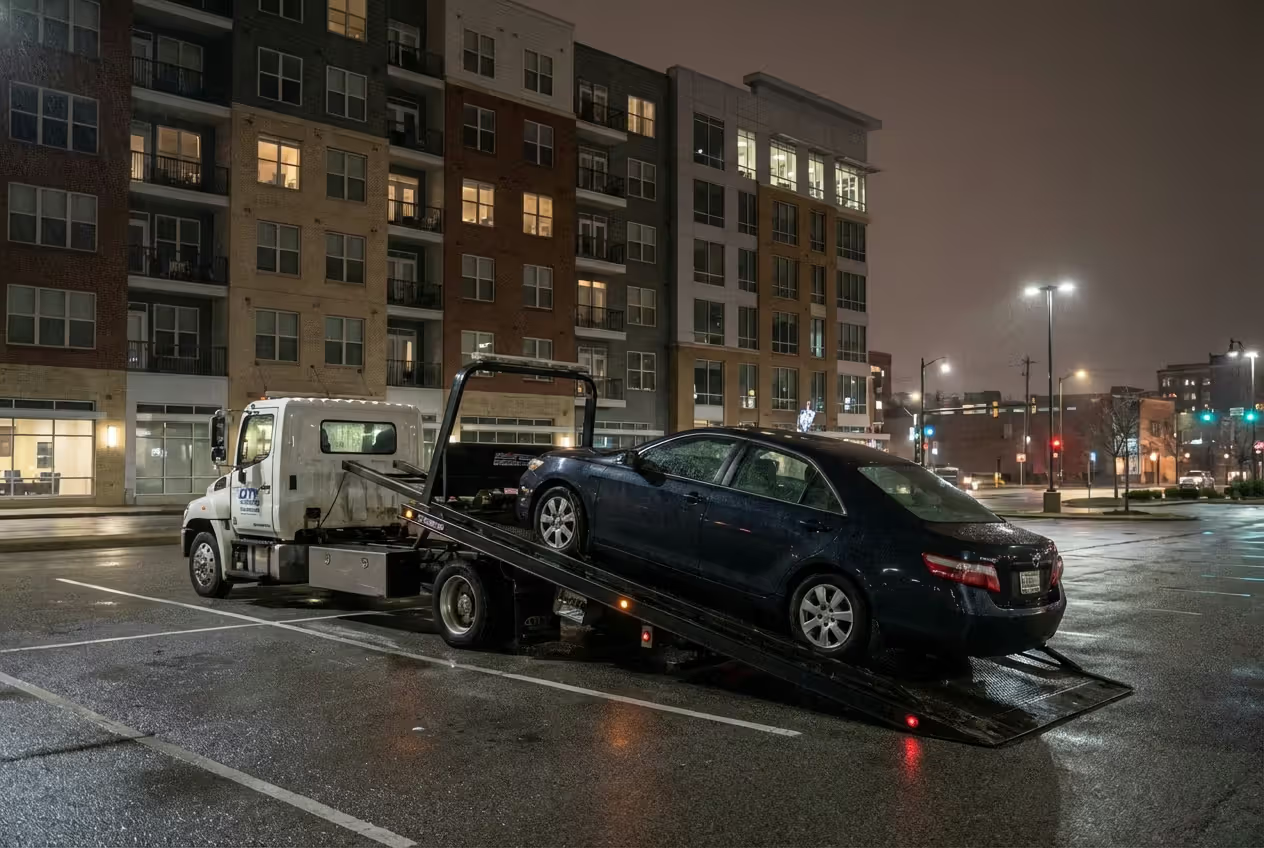
Repossession happens faster than you'd believe possible. Miss one payment deadline, and the lender can legally seize your vehicle in many states. No warning phone call. No grace period. No judge signing off on it. You wake up one morning, look out your window, and your car is gone. Or you finish your shift at work, walk to the parking lot, and there's an empty space where you parked.
Tow truck operators working for title lenders know your home address, your workplace, your regular haunts. They operate at night. They're quick and efficient. Your car disappears in minutes.
Once they've got your vehicle, the clock starts on your redemption period—typically 15 to 30 days depending on state law. During this window, you can reclaim your car by paying the full loan balance plus repossession fees (usually $200 to $400), storage fees ($25 to $50 per day), and whatever other charges they tack on. These fees can add $800 or more to your debt.
Can't come up with the money during redemption? They sell your car at auction. Here's where it gets even worse. Auctions generate wholesale prices, not retail. Your car that was worth $6,000 sells for $3,500. The lender applies that $3,500 to your debt, which has now grown to $3,200 with all the fees. You still owe $700—and you no longer have a car. Some states require lenders to pay you the surplus if the auction brings in more than you owe. Good luck actually collecting it without hiring a lawyer.
The rollover trap snares most borrowers. Consumer Financial Protection Bureau research found that a typical title loan borrower renews their loan eight times, paying thousands in fees before either scraping together enough to clear the principal or losing their vehicle. Borrow $1,500, pay $375 monthly in finance charges for nine months, and you've handed over $3,375 in fees before finally paying off that original $1,500. Total cost: $4,875 to borrow $1,500 for nine months.
Title loans are designed to trap borrowers in debt. The typical borrower renews their loan eight times, paying $3,000 in fees on a $1,000 loan before losing their vehicle to repossession. These products strip wealth from communities that can least afford it
— Rebecca Martinez
Losing your car triggers a domino effect. Can't get to work? You lose your job. Can't take your kids to school? They miss classes. Can't make medical appointments? Your health suffers. Families living paycheck-to-paycheck have no buffer. One repossessed vehicle can spiral into job loss, then missed rent, then eviction. A single bad decision snowballs into catastrophe.
Title Loan Costs Compared to Other Borrowing Options
| Borrowing Method | APR You'll Actually Pay | How Long to Repay | What You Risk Losing | Can They Take Your Car? | Do They Check Credit? |
| Title Loan | 200%–500% | 30 days to 6 months | Vehicle title | Yes—immediately when you default | No |
| Personal Loan | 6%–36% | 1 to 7 years | Nothing (unsecured) | No | Yes |
| Credit Card | 18%–29% | Revolving credit | Nothing | No | Yes |
| Payday Loan | 300%–600% | 2 to 4 weeks | Nothing (but they can garnish wages) | No | No |
| Credit Union Loan | 8%–18% | 1 to 5 years | Sometimes requires collateral | Only if you specifically pledged it | Yes, but they're flexible |
Looking at this comparison, title loans sit in an awkward middle ground. They're not the absolute most expensive option—payday loans often charge even more on an annualized basis. But payday lenders can't drive off with your transportation. That's the critical difference.
Credit cards and personal loans blow title loans out of the water on cost, but here's the problem: they require decent credit. Someone with a 520 credit score isn't getting approved for a personal loan at 12% APR. Banks reject them automatically. That's precisely why people turn to title loans—not because the terms are good, but because every conventional door has slammed shut.
Credit union loans deserve special mention here. Federal credit unions can offer Payday Alternative Loans (PALs) with APRs capped at 28% and terms up to 12 months. You'll need to join the credit union first, which usually means opening a savings account with $5 to $25. Not everyone qualifies for membership—credit unions serve specific communities, employers, or geographic areas—but checking takes five minutes online and could save you thousands of dollars.
Safer Alternatives When You Need Cash Fast
Personal installment loans from online lenders serve the "bad credit but not terrible credit" crowd. Companies like Upstart, Avant, and OneMain Financial approve borrowers with credit scores in the 580 to 650 range. You'll pay 18% to 36% APR, which feels steep until you compare it to 300% APR on a title loan. Loan amounts run $1,000 to $50,000. Applications take 15 minutes online. Funding hits your bank account in one to three business days. You keep your car.
Join a credit union, even if you've never considered it before. Search "credit unions near me" or visit MyCreditUnion.gov to find options you're eligible for. Many serve people who live in specific counties, work for particular employers, or belong to certain organizations. Membership requirements are surprisingly easy to meet. Once you're in, apply for a small loan. Credit unions often lend as little as $500 with six to 12-month repayment plans. They actually want to help you build credit, not trap you in debt.

Author: Olivia Stratfor;
Source: nayiyojna.com
Call your creditors before they call you. Owe $800 to a hospital? Phone their billing department. Explain your situation. Propose paying $200 monthly for four months. Most medical providers, utility companies, and even landlords will work out payment arrangements, especially if you make a good-faith payment immediately. This approach costs zero interest and prevents the need for a title loan entirely.
Community assistance programs exist specifically for emergencies like yours. Dial 211 (yes, it's a real number nationwide) to reach United Way's helpline. They'll connect you with local resources: emergency rent assistance, utility payment help, food banks, medical bill support. Religious organizations keep emergency funds for congregation members and community residents. Nonprofits like Catholic Charities, Salvation Army, and Jewish Family Services provide one-time grants or interest-free loans. You'll fill out applications and possibly wait a week or two, but you won't risk your vehicle.
Sell stuff you're not using. Seriously. Your garage, attic, and closets probably hold $500 to $2,000 in sellable items you've forgotten about. Old gaming consoles, tools you never touch, furniture gathering dust, jewelry sitting in drawers. List items on Facebook Marketplace, Craigslist, or OfferUp. Price them to sell quickly. You can generate cash within 48 hours without taking on any debt.
Pawn shops offer another option. Bring in valuables—electronics, musical instruments, jewelry, power tools—and get a loan on the spot. Pawn rates are high (10% to 20% per month), but they're lower than title loans, and you're not risking your car. Can't repay? They keep your Xbox or guitar. You keep your transportation to work.
Ask family or friends, awkward as it feels. Be direct. "I need $1,200 to cover an emergency. Can you lend it to me? I'll pay you back $300 monthly for four months." Put the agreement in writing with specific terms. This protects your relationship and gives both parties clarity. Most people would rather lend money to someone they care about than watch them lose their car to a predatory lender.
Check if your employer offers paycheck advances. Some companies provide this benefit formally through HR. Others will approve a one-time advance if you explain the situation to your manager. Apps like Earnin, Dave, and Brigit let you access $100 to $500 of your earned wages before payday for minimal fees (usually $3 to $8). Use these sparingly—they're not a long-term solution—but they beat a title loan for a small, short-term gap.
Frequently Asked Questions About Title Loans
Title loans solve one problem—immediate cash need—while creating three more: crushing interest costs, repossession threats, and debt traps that multiply your financial stress. APRs exceeding 300%, aggressive collection practices, and loan structures designed to generate renewals make these products a last resort that frequently backfires.
Exhaust every alternative first. Negotiate with whoever you owe money to. Apply for credit union membership and a small loan. Seek community assistance. Sell possessions. Borrow from people who actually care about you. If none of these work and you're truly cornered into a title loan, borrow the absolute minimum, have a concrete repayment plan in writing before you sign, and understand your state's specific repossession laws.
Your vehicle represents more than just collateral on a loan application. It's how you earn your paycheck, fulfill family responsibilities, and maintain independence. Risking that asset to solve a temporary cash shortage with a loan engineered to trap borrowers rarely ends well. Make your decision with complete information about true costs and explore every safer option that won't put your transportation—and your livelihood—on the line.