

Person reviewing installment loan documents at a desk with laptop and calculator
What Is an Installment Loan and How Does It Work

Content
Borrowing money doesn't have to feel like navigating a maze. When you need to finance a car, buy a home, or consolidate debt, installment loans offer a straightforward path: borrow a fixed amount, then repay it in regular, predictable chunks over time. Unlike credit cards that let you borrow, repay, and borrow again, installment loans give you one lump sum upfront with a clear finish line.
Understanding how these loans function—and when they make sense—can save you thousands of dollars and help you avoid common pitfalls that trap borrowers in expensive debt cycles.
Installment Loan Meaning and Core Features
The installment loan meaning centers on a straightforward concept: you receive a specific sum of money upfront and commit to repaying it through regularly scheduled payments across a defined timeframe. Every monthly payment you make contains two elements—a portion reduces your original borrowed amount (principal), while another portion covers the lender's charge for providing the funds (interest).
These loans stand apart from other borrowing options because of their predetermined structure. At signing, you'll know your exact monthly obligation, the total number of payments you'll make, and the precise date when your debt disappears. Financial advisors often call them fixed payment loans because this predictability distinguishes them from flexible credit arrangements.
Understanding payment composition helps you grasp how these loans work. During your initial payments, interest charges consume a larger share while principal reduction receives less. As months pass, this balance shifts dramatically—you'll see more of each payment actually eliminating what you owe. Financial professionals call this gradual shift amortization, and it guarantees your balance reaches zero after your final scheduled payment.
Borrowers frequently fixate on whether they can afford the monthly amount without examining what they'll actually spend over the loan's entire lifespan.Choosing a loan with comfortable monthly payments but an extended timeline can cost thousands more than selecting a slightly higher payment spread across fewer years. Run the total repayment numbers before you agree to anything
— Michael Chen
Different loan categories come with vastly different repayment windows. Personal loans might span anywhere from two to seven years, auto financing typically runs three to six years, and mortgages commonly extend across 15 to 30 years. Your chosen term directly influences both your monthly payment size and cumulative interest expense—condensed timelines mean larger monthly obligations but substantially less interest paid overall.
How Installment Loans Work Step by Step
Your borrowing journey starts when you submit an application. Lenders will request details about your earnings, job stability, monthly housing expenses, and current debt obligations. They analyze this information to evaluate your creditworthiness, determine your eligibility, establish your interest rate, and decide your maximum borrowing amount.
During evaluation, most lenders perform a credit check that creates a hard inquiry on your credit file. This inquiry might temporarily reduce your credit score by several points, signaling to other lenders that you're actively shopping for credit. Fortunately, if you complete all your rate shopping within 14 to 45 days, credit scoring formulas typically treat multiple inquiries as one event, protecting you from compounding damage.
After receiving approval, you'll examine the complete loan package: your borrowed sum, the annual percentage rate, your monthly obligation, total payment count, and final repayment cost. The APR proves more valuable than interest rate alone because it incorporates both the rate and specific fees, revealing your true borrowing expense.
Following your signature on the agreement, you'll receive your funds surprisingly fast—frequently between one and five business days. Loans tied to specific purchases, like vehicle financing, often route payment directly to the seller. Personal loans deposit money straight into your checking account, available for your intended purpose.

Author: Matthew Redford;
Source: nayiyojna.com
Your payment obligation begins promptly, with your initial payment typically due 30 days after receiving funds. You'll submit identical payments on the same monthly date throughout your loan's life. Setting up automatic withdrawals helps many borrowers sidestep late charges and the credit damage that accompanies missed deadlines.
After submitting your final payment, the loan account closes permanently. Any collateral liens get released, and your credit report displays the account as "paid as agreed." While this positive payment track record strengthens your credit profile, you might notice a small temporary score reduction from losing an active account in your credit portfolio.
Common Types of Installment Loan Examples
Personal Loans
Personal loans function as the versatile option among installment loan examples—lenders rarely restrict how you spend the money. From covering emergency medical expenses to financing home renovations or consolidating credit card balances, these loans generally range from $1,000 to $50,000.
Repayment periods typically fall between two and seven years, with annual percentage rates spanning roughly 6% to 36% based on your credit strength. Exceptional credit (scores exceeding 750) unlocks the most favorable rates, while fair credit (scores between 580 and 669) results in significantly higher costs. Because most personal loans don't require collateral—nothing backs the lender's risk—their rates exceed what you'd encounter with secured alternatives like vehicle financing.
Auto Loans
Vehicle financing creates one of the most prevalent forms of installment credit. These loans commonly range from $10,000 to $70,000, with standard repayment periods between three and six years (although seven-year terms have grown more popular despite their elevated total expense).
Your financed vehicle serves as the loan's security—lenders maintain repossession rights if you stop paying, which enables them to charge less than unsecured borrowing options. Interest rates differ depending on whether you're purchasing new or pre-owned vehicles, with new car financing typically offering more attractive terms. Annual percentage rates generally fall between 4% and 15%, determined by your creditworthiness and prevailing market dynamics.
Mortgages
Home loans represent the largest installment borrowing most individuals ever undertake. These substantial loans finance property purchases or refinancing transactions, typically starting at $100,000 and climbing beyond $1 million in expensive housing markets.
Thirty-year terms dominate the mortgage landscape, though 15-year and 20-year alternatives exist for borrowers seeking faster payoff. Extended repayment windows keep monthly obligations manageable despite enormous principal amounts. The property itself secures your mortgage, and payment failures can trigger foreclosure proceedings. Mortgage interest rates shift with economic cycles but generally span 5% to 8% for qualified applicants with strong credit profiles and sufficient down payments.
Student Loans
Education financing divides into two distinct categories: federal loans backed by government guarantees and private loans issued by financial institutions. Federal options provide fixed interest rates (currently hovering around 5% to 8% depending on specific loan programs and disbursement dates) plus flexible repayment arrangements including income-based payment plans.
Private education loans operate more like conventional installment borrowing, with rates determined by your credit standing. Repayment windows typically stretch from 5 to 20 years, and unlike federal programs, private lenders rarely accommodate financial hardship situations. Borrowing amounts fluctuate based on educational expenses, though graduate students can secure six-figure sums for advanced professional degrees.
Revolving Credit vs Installment Loan: Key Differences
Grasping the contrast between these credit categories helps you select the appropriate financial instrument for your circumstances.
| Feature | Installment Loan | Revolving Credit |
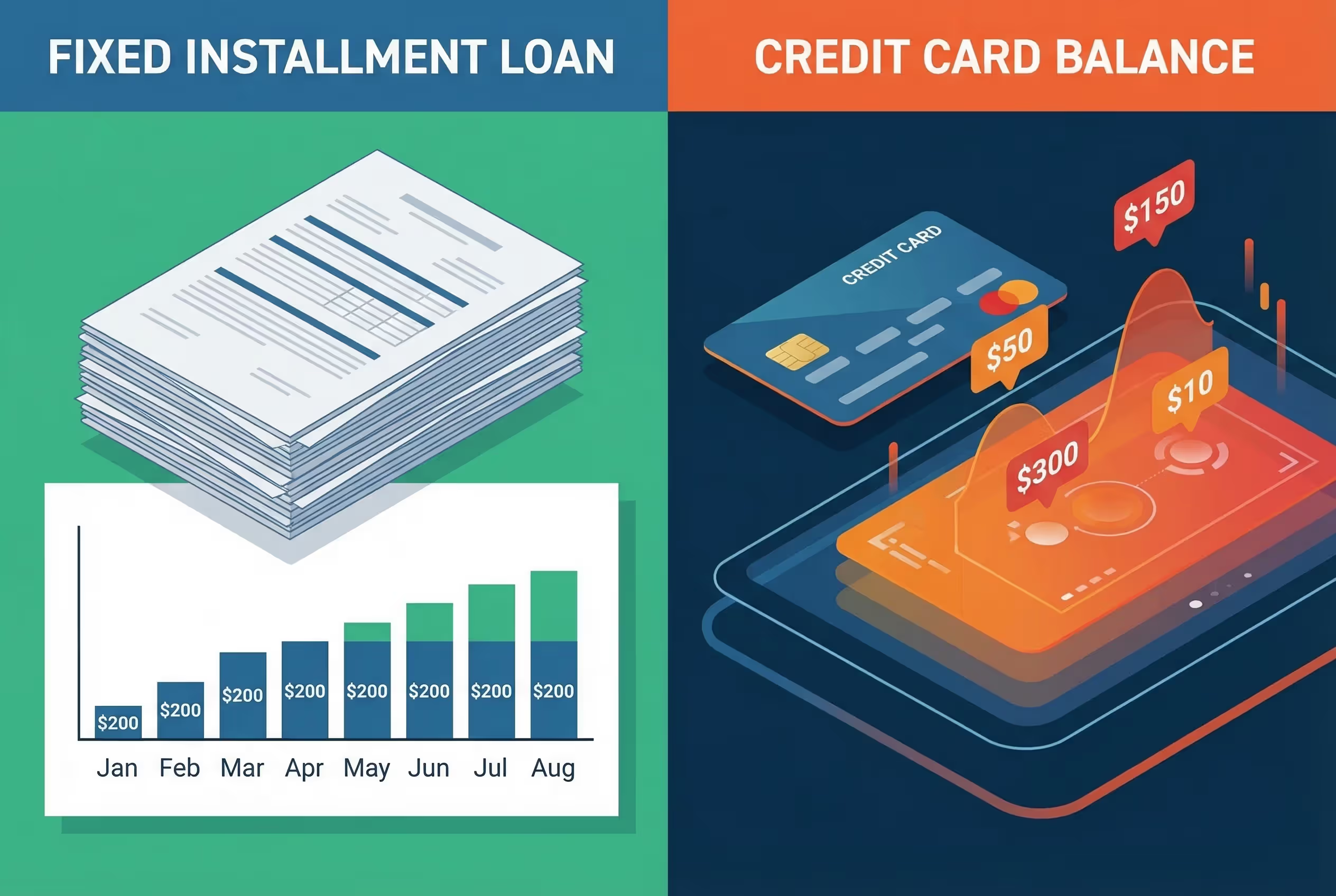
| How You Pay | Identical monthly amount until fully repaid | Minimum required payment fluctuates with your balance |
| Borrowing Amount | You receive a predetermined sum one time | Access to a reusable credit line up to your maximum limit |
| Rate Characteristics | Predominantly fixed (occasionally variable) | Generally variable rates |
| Timeline to Payoff | Defined conclusion date (example: 60 months) | Indefinite duration; continues while account stays active |
| Credit Score Effects | On-time payments strengthen score; account closes after payoff | Balance-to-limit ratio significantly influences score; stays open indefinitely |
| Borrowing Adaptability | Cannot access additional funds; new application required | Repeatedly borrow, repay, and borrow again within your limit |
The revolving credit vs installment loan examination exposes fundamental contrasts in accessing and repaying borrowed funds. Credit cards exemplify revolving arrangements—you receive a spending ceiling, can charge purchases approaching that ceiling, and as you reduce your balance, that borrowing capacity regenerates. Your required payment adjusts according to your outstanding balance.
Installment borrowing operates quite differently. You collect the complete amount immediately and cannot access additional funds without submitting a fresh loan application. Your payment amount stays constant throughout the loan's duration, and the account terminates once you've completed all scheduled payments. This framework simplifies budget planning but sacrifices the adaptability you'd have if surprise expenses emerge.
Credit evaluation systems assess these borrowing types through different lenses. With revolving accounts, your utilization percentage (outstanding balance compared against available credit) dramatically affects your score. Exceeding 30% utilization can damage your score even with perfect payment timing. Installment arrangements avoid this calculation entirely—no utilization measurement exists because you received the full loan amount at origination.
Advantages and Drawbacks of Fixed Payment Loans
Benefits of Predictable Payments
The consistent payment structure of fixed payment loans delivers several meaningful advantages. Budget management becomes remarkably simple when your monthly obligation never changes. Unlike variable-rate credit cards where minimum payments shift and interest accumulates on carried balances, installment loans eliminate uncertainty.
This payment consistency supports effective long-term financial strategy. You can pinpoint exactly when you'll eliminate the debt and determine your complete interest expense. For substantial purchases like real estate or vehicles, this transparency proves essential when mapping your financial trajectory.
Installment borrowing also builds your credit history effectively. Every timely payment gets recorded by credit bureaus, establishing your dependability as a borrower. The account enriches your credit mix—the variety of credit categories you handle—which accounts for 10% of your FICO scoring.
Author: Matthew Redford;
Source: nayiyojna.com
Many installment products, especially mortgages and vehicle loans, deliver lower rates than credit cards because collateral backs the lender's risk. Even unsecured personal loans used for balance consolidation frequently beat credit card annual percentage rates, potentially preserving thousands in interest expenses.
Potential Limitations to Consider
The identical structure providing stability simultaneously creates inflexibility. After committing to an installment arrangement, you're bound to that payment timetable. Should your earnings decrease or unexpected bills surface, you cannot simply reduce one month's payment like you might with a credit card's minimum requirement.
Certain lenders impose early payoff charges—financial penalties for eliminating your debt before the scheduled conclusion. While less common today, particularly for home and personal loans, these penalties still appear in some contracts. An early payoff penalty can erase the interest savings you'd achieve through accelerated repayment, effectively trapping you in the original timeline.
Approval standards can present significant hurdles, especially for larger borrowing amounts or applicants with imperfect credit histories. Lenders need verification of consistent income, acceptable debt-to-income percentages (generally under 43% for home loans), and credit scores meeting their minimum thresholds. Applicants with poor credit may encounter outright rejection or rates so steep that borrowing becomes financially impractical.
Payment delinquency triggers severe repercussions. Late charges typically range from $25 to $50 per occurrence, and payments exceeding 30 days past due get reported to credit agencies, inflicting score damage. Persistent delinquency progresses to default status, inviting collection activity, potential lawsuits, and repossession or foreclosure proceedings for secured borrowing.
When to Use an Installment Loan
Installment loans excel in particular situations. Significant, one-time acquisitions exceeding your available savings make ideal candidates—purchasing a vehicle, financing a residence, or covering a wedding celebration. Structured repayment distributes costs across time while you immediately enjoy or utilize your purchase.
Balance consolidation represents another intelligent application. When you're managing multiple high-rate credit cards, combining them into one installment product with a reduced rate can shrink your monthly obligation and cumulative interest expense. You'll also streamline your finances by submitting one payment rather than juggling several.

Author: Matthew Redford;
Source: nayiyojna.com
Establishing or repairing credit becomes more manageable with installment products. Consistent payment records demonstrate reliability to prospective lenders. For individuals with limited credit histories or past credit difficulties, a modest installment loan (including credit-builder loans specifically designed for this objective) can create positive payment patterns.
However, installment borrowing isn't universally appropriate. For minor, short-duration needs you can repay rapidly, credit cards might prove more sensible—particularly if you can eliminate the balance before interest charges begin. For continuous, unpredictable expenses, revolving credit provides superior adaptability compared to repeatedly pursuing new installment loans.
Skip installment loans when payment ability seems questionable. The inflexible structure means falling behind initiates a problematic cascade. If your income fluctuates unpredictably or existing obligations already stretch your budget, adding a fixed payment commitment can accelerate your path toward default.
Likewise, financing depreciating purchases you don't genuinely need—such as vacation expenses—frequently proves financially detrimental. You'll pay interest on experiences providing only temporary satisfaction, extending costs far beyond any received benefits.
Frequently Asked Questions About Installment Loans
Installment loans function as powerful financial instruments when applied appropriately. Their structured characteristics—predetermined amounts, unchanging payments, and definite timelines—make them ideal for significant acquisitions and consolidating expensive revolving debt. The repayment certainty facilitates budgeting and extended planning in ways that revolving credit arrangements simply cannot replicate.
Yet this identical structure demands thorough evaluation before commitment. Can you manage the monthly payment not merely today, but across the loan's complete duration? Does the full cost, encompassing all interest charges, justify your purchase or consolidation objective? Have you compared multiple offers to confirm you're securing competitive rates and favorable terms?
Borrowers who derive maximum benefit from installment products are those who comprehend precisely what they're committing to—the aggregate cost, the payment requirements, and the repercussions of falling behind schedule. They evaluate multiple offers, scrutinize contracts for early payoff penalties or hidden charges, and verify the loan integrates sensibly within their comprehensive financial landscape.
Before submitting applications, calculate your debt-to-income percentage, verify your credit score, and establish how much you can realistically afford monthly while still covering remaining expenses and accumulating savings. The appropriate installment loan secured at the optimal moment can help you accomplish significant objectives while strengthening credit. The inappropriate loan, pursued without complete comprehension or beyond your financial capacity, can generate financial strain persisting for years.
Your financial trajectory depends on making educated decisions now. Whether financing your initial vehicle, purchasing a residence, or consolidating debt, understanding installment loan mechanics equips you with knowledge to borrow prudently and repay successfully.